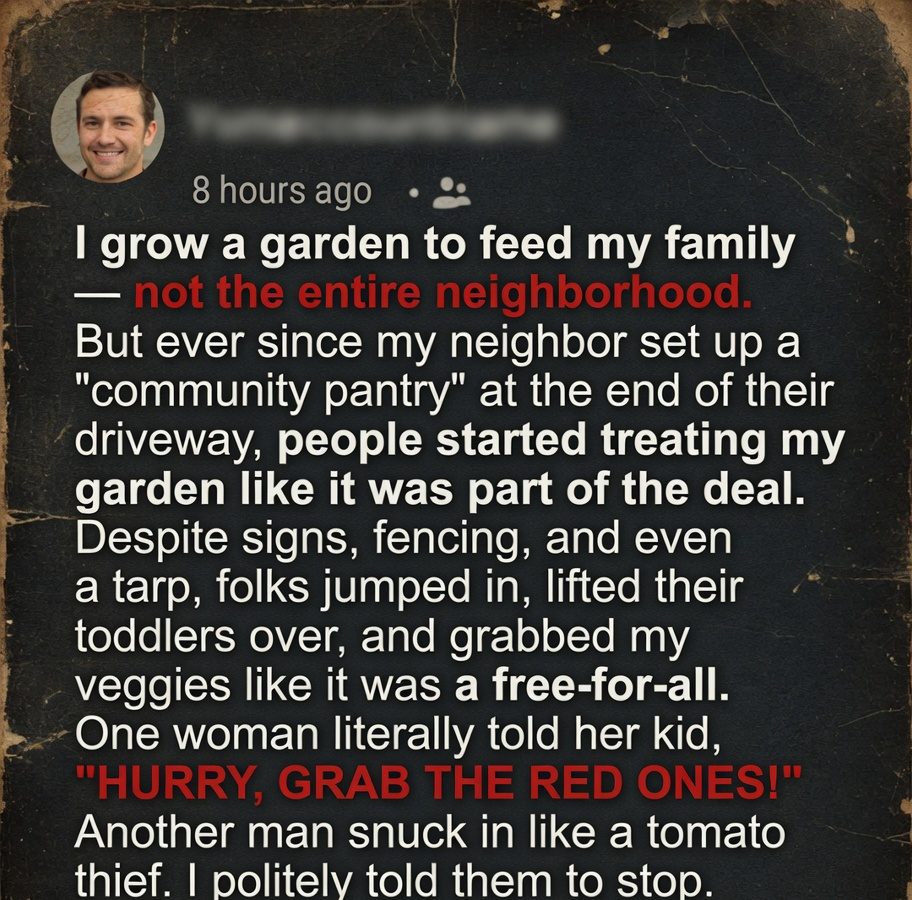
My name is Mara, and I grow vegetables so my family can eat. Not because it’s trendy or for social media likes — just for basic survival.
We’re not wealthy. Every tomato, carrot, and cucumber in the dirt patch behind my house comes from sore knees, early mornings, and late-night prayers that the squirrels won’t destroy everything first. If I could afford a proper fence, I would have built one long ago. But fences cost money, and so do groceries. When your family’s meals depend on what you pull from the soil, there’s nothing cute about it.
It started with my neighbor Julian’s “Sharing Shelf” — a small community pantry at the end of his driveway filled with canned goods. He posted about kindness and togetherness on Facebook. I thought it was harmless.
But soon, people began treating my backyard garden like it was part of his free pantry.
At first, it was small things. A few cucumbers gone. Some radishes pulled and left with limp tops on the soil. I tried to convince myself it was animals. But the neatness of the theft made my stomach twist.
Then I saw her.
A woman was lifting her three-year-old toddler over my low bunny fence like it was a playground. The boy landed straight in my kale bed, crushing three perfect heads with his shoes. His mother looked right at me standing on the porch with the hose in my hand and waved cheerfully.
“Hurry, Henry! Grab the red ones!”
The red ones were my tomatoes — my dinner, my pasta sauce.
I was frozen between shock and rage.
After that, I put up signs. Big, bold ones that read: “Private Property! DO NOT TOUCH!” I added a second, small fence — not strong enough to stop determined thieves, but clear enough to show a boundary.
The signs became invisible. The fence was treated like decoration. People still helped themselves.
I even covered part of the garden with a tarp so they couldn’t see the vegetables from the street. It lasted three days before someone moved it.
One afternoon, I caught a middle-aged man with a Bluetooth headset tiptoeing through my squash vines. I yelled at him.
“I was just taking a few,” he said, holding a handful of cherry tomatoes. “It’s my anniversary. I need them for a salad!”
“This is my garden!” I snapped. “Get out!”
Another time, teenagers climbed in at dusk, sat in the rows like it was a park, drank soda, and trampled my lettuce.
I finally spoke to Julian the next morning, still shaking with anger.
“I get the pantry idea, Julian, but it’s making people think they can take from anywhere — including my garden. That’s not okay.”
Julian gave me a wide, condescending smile. “Well, can’t you afford to share?”
The audacity hit me hard.
“No, Julian. I cannot afford to feed people who ignore boundaries. I grow this food for my family. We’re not rich. If I had extra to give, I would. But I don’t.”
He tried to brush it off. “It’s just a few tomatoes…”
I walked away before I said something I’d regret. It wasn’t about the vegetables. It was about respect. About the early mornings, the aching back, the YouTube videos on soil and composting because I couldn’t afford mistakes. The weekend the hose burst and drowned my seedlings, forcing me to start over. The constant choice between paying bills or buying groceries.
And now people were calling me selfish for protecting what I worked so hard to grow.
The breaking point came when half my zucchini disappeared overnight, ripped straight from the stalks.
That was it.
For a week I fumed. I barely slept. The neighborhood Facebook group was full of posts shaming me, with pictures of my garden and comments like “She can spare some” and “How selfish.”
I considered buying a camera, but then I remembered the old irrigation system in the shed. It had motion sensors that still worked.
I spent an entire day rewiring it, adjusting the nozzles, and setting the sensitivity perfectly. Then I waited.
The first victim was a woman with a yoga mat. She leaned over the fence for a pepper — and got blasted with a high-pressure jet of cold water straight to the chest. She screamed, slipped, and fell into the mulch.
Next came a man reaching for carrots. Another sharp hiss, and icy water knocked him backward into the mud.
Word spread fast. The Facebook group exploded with warnings: “Mara has a water trap! She’s crazy!”
Julian cornered me at the mailbox a few days later.
“Mara, this is harassment,” he said loudly so others could hear.
“It’s just water,” I replied. “If people weren’t trespassing, they wouldn’t get wet.”
“You’re ruining the spirit of the neighborhood,” he complained.
“I’m defending my home,” I said. “If the neighborhood really cared about community, they would ask before taking. You all should have respected me.”
After that, the thefts almost stopped. My garden finally started to recover. The tomatoes ripened without disappearing. My youngest child began asking for salad again — and this time I could say yes.
One afternoon, while I was weeding the kale, a 12-year-old girl approached the fence. She stayed on her side and didn’t step over.
“I’m sorry, ma’am,” she said quietly. “My brother took a lot from your garden. My mom made him apologize, but I don’t think he meant it. I brought you cookies we baked.”
I took the bag, touched by her honesty and the fact that she respected the boundary.
As she left, she glanced back. “I think the sprinklers were smart. My brother called it psycho, but I think it was clever.”
That evening, I cooked with real joy again. My husband noticed.
“It feels quiet again,” he said.
“They thought I was crazy,” I replied.
“You kind of were,” he teased, “but in a good way.”
“I just wanted to protect what matters.”
My garden still isn’t perfect. Weeds come, rows grow crooked, and the weather doesn’t always cooperate. But it’s mine — and now it’s finally respected.
People still slow down when they drive by, but they stay on the street. They read the signs. They understand the boundaries.
Julian moved his pantry to another street. The entitlement was the real problem, not the idea of sharing. If anyone had simply asked, I might have given them a tomato or two with a smile.
Instead, they took without permission — again and again. So I taught them that actions have consequences.
Even if those consequences come in the form of ice-cold water and a bruised ego.
Now I’m saving up for a greenhouse. And I’ll keep feeding my family with what I grow by hand.