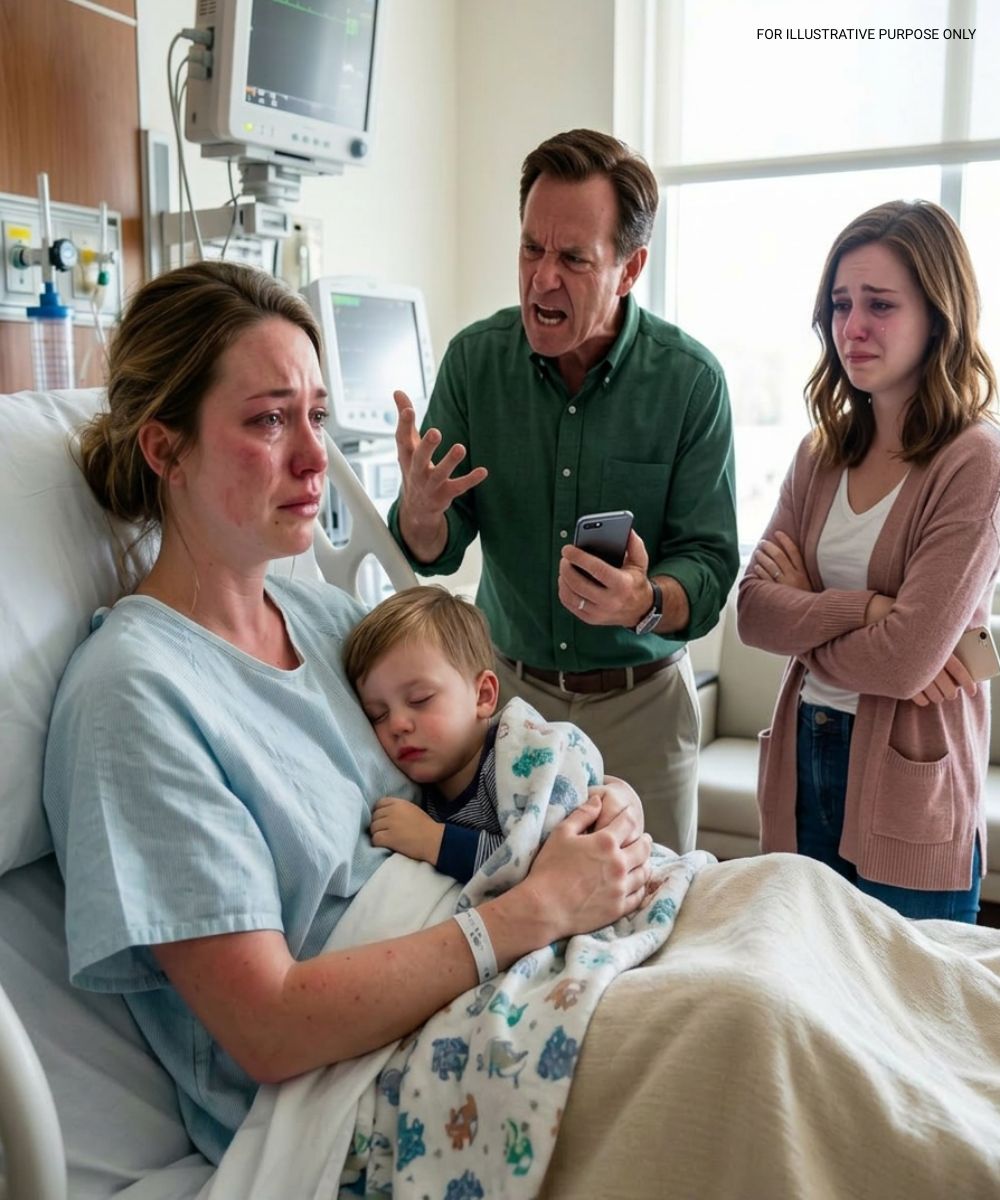
I sent one message after the crash: My son and I are alive. We’re in the hospital. Please keep us in your prayers.
No one replied. Not a single person. But my sister still found time to post a photo online with the caption, Family is everything—as if my son and I didn’t exist. Three days later, I woke up to 48 missed calls from my father and one message: Answer now. When I finally did, what he said made me cut them out of my life.
The first text Lauren Pierce sent after the accident was written through shock and pain. She was in a trauma room at St. Vincent’s in Indianapolis, blood drying on her sleeve, while her six-year-old son slept beside her under a heated blanket. His face was bruised from the seat belt, and every time he stirred, Lauren felt panic tighten inside her chest all over again. Just hours earlier, a pickup truck had lost control on black ice along I-70 and crashed into the passenger side of her car, sending it into the guardrail with enough force to deploy every airbag.
What she remembered most clearly wasn’t the impact itself, but Oliver crying from the back seat, calling for her while steam rose from the hood and cars slowed around them as if scenes like that happened every day. The doctors said Lauren had a broken wrist, heavy bruising across her ribs, and a concussion. Oliver had a mild head injury, stitches above one eyebrow, and needed to stay under observation for at least two days. Everyone kept calling them lucky. Lucky to be alive. Lucky the truck had missed Oliver’s door by inches. Lucky no one had died. Lauren agreed, because she knew it was true. But as the long fluorescent night turned into morning, another truth settled over her just as heavily: not one member of her family had answered.
Not her father, Thomas Pierce, who never missed a chance to talk about the importance of family at church.
Not her older sister, Megan, who filled social media with quotes about loyalty and grace. Not her younger brother, Cole, who could respond instantly to fantasy football messages but somehow had nothing to say when his sister and nephew were lying in a hospital. Lauren checked the group chat over and over again. At four in the morning—nothing. At seven twenty—still nothing.
By noon, the message sat there unanswered between an old recipe discussion and a holiday photo Megan had shared days earlier. When Lauren’s friend Tessa arrived with fresh clothes and a phone charger, she asked the question Lauren already dreaded: “Who’s called?” Lauren let out a brittle laugh. “You already know.” Then Tessa showed her Megan’s public post from that same morning. It was a cheerful family lunch photo: Megan, their father, Cole, his wife, and two cousins smiling around a farmhouse table at their aunt’s house. The caption read: Sunday lunch with the people who matter most. Family is everything. Lauren stared at the words until they blurred. No mention of the crash. No check-in. No concern for Oliver. She locked the screen and set the phone down because she knew her anger was too dangerous to carry while her child slept beside her and her own body was still injured.
Three days later, after they were discharged and back in her small townhouse in Carmel, Lauren woke from medicated sleep to the sound of her phone rattling across the coffee table. There were forty-eight missed calls—all from her father—and one short message telling her to answer immediately. She stared at it, then called back. When Thomas answered, he didn’t ask if she or Oliver were okay. He didn’t ask how they were recovering. He sounded irritated.
The first thing he said was, “Finally. What were you thinking?” Lauren thought for a moment the medication must have distorted his words. But no—he was angry. Angry that she had sent what he called a dramatic message to the family group without enough context. Angry because Megan was hosting relatives and church guests that day, and Lauren’s text had caused people to ask questions. Lauren sat there in disbelief as he explained that Megan hadn’t wanted the lunch gathering ruined. That was his explanation. Not that they had been worried. Not that they didn’t know how serious it was. Just that her accident had been inconvenient.
As the conversation went on, the truth got uglier. Megan had seen the message right away and ignored it because, in her words, Lauren always made things too intense. Cole had muted the group chat. Their father had agreed they would deal with it later, after lunch, after company, after appearances. Then later became tomorrow, and tomorrow became the next day, until someone outside the immediate family found out the crash had really happened and contacted Thomas in shock.
That was when the missed calls started. Not because he was worried. Because he had been exposed. Lauren listened to every word until the illusion she had carried for years finally fell apart. Her family didn’t fail her by accident. They made a choice. They protected appearances instead of people. When her father told her to stop making the situation public before others got the wrong impression, Lauren finally answered with the truth: the right impression was that her son had been hospitalized and none of them cared enough to send a single text back.
After the call ended, she sat there shaking—not from the accident this time, but from the realization of what had always been true. Tessa found her crying so hard she could barely breathe and said the one thing Lauren needed to hear: You are allowed to stop asking for love where there isn’t any. That night, Lauren blocked Megan. Then Cole. Then her father. She sent one final email making her boundary clear: until further notice, she and Oliver would have no contact with the family.
No visits, no surprise drop-ins, no messages passed through relatives or church members. If there was a genuine emergency, it could go through her attorney. The backlash came quickly. Cousins called her dramatic. An aunt wrote that family deserved grace. Megan posted vague lines online about betrayal. None of it changed the simple truth: when Lauren and Oliver were hurt, afraid, and alone, the family that preached closeness chose optics over love. Once she saw that clearly, she couldn’t pretend otherwise anymore.
At first, cutting them off didn’t feel strong. It felt like losing a limb.
The first Thanksgiving without the Pierces left Lauren unsettled for days, even though she knew exactly how those holidays usually worked—Megan arranging everything like a performance, Thomas blessing the meal with tears in his eyes, everyone speaking about gratitude while carefully avoiding anything that would make the room honest. But over time, the silence changed. It stopped feeling empty and started feeling peaceful.
Oliver healed well. His headaches faded, the stitches softened into a pale scar, and by spring he was back to school, soccer, and arguing that pancakes could count as dinner. Lauren’s wrist took longer to recover, and cold weather still made her ribs ache, but the deeper healing happened somewhere no one could see. She stopped checking social media. Stopped rehearsing explanations in her head. Stopped wasting energy on people who had already shown her who they were. Instead, she built a smaller, truer life. Tessa became family in the real sense of the word. So did Mrs. Alvarez next door, who brought tamales every Wednesday and stayed to help Oliver with reading.
At a quieter church Lauren eventually began attending, people didn’t ask for a polished version of what happened. They just brought food, drove her to follow-up appointments, and fixed the broken railing on her steps without turning kindness into a lesson. At first, that kind of ordinary care embarrassed her. Then it taught her something. Real love does not always announce itself. Real family is not always blood.
About six months later, Thomas sent a letter by certified mail. Lauren almost returned it unopened. Instead, she read it at the kitchen counter while Oliver colored dinosaurs nearby. The first page was defensive, full of familiar language about misunderstandings and hurt feelings. But by the third page, something more honest appeared. Thomas wrote about attending Pastor Brooks’s funeral and seeing Brooks’s estranged daughter standing at the edge of the church, uncertain whether she even belonged there.
Watching that scene, he said, was the first time he understood what it meant to build pride so high that your own children no longer felt safe coming home. The apology wasn’t perfect. He still excused too much and softened his own failures. But one sentence stopped Lauren cold: When Oliver needed me, I failed him, and I don’t know how to forgive myself for that. She didn’t rush to call him. She waited weeks. She talked to her therapist first. Then she called one quiet Sunday while Oliver was away. Thomas cried before he even finished saying hello.
What came after was not easy, dramatic, or instant.
Lauren didn’t restore the old family, because the old family was exactly what had hurt her. Instead, she built something new with boundaries. She met her father first in a counselor’s office, then later in a park with Oliver present for a short visit. Thomas apologized to his grandson directly, in simple words a child could understand. He admitted he had been wrong. Oliver, practical and honest in the way children often are, nodded and said, “Okay. But next time you answer faster.” Thomas laughed through tears.
Megan never truly changed. Cole remained distant. Lauren stopped trying to fix what was false. But with her father, something real slowly began to grow—not innocence, not a return to the old version of family, but a relationship rebuilt through honesty, effort, and consequence. That was what Lauren hadn’t expected: cutting people off was not always the end. Sometimes it was the first honest beginning.
Years later, when Oliver asked why they spent some holidays with church family and some with Grandpa Thomas but not Aunt Megan, Lauren gave him the lesson the crash had carved into her life: love is not proven by what people say. It’s proven by what they do when you need them most. And in learning that, she gave her son something better than the illusion of a perfect family. She gave him a truthful one.