After the funeral of the only man who ever truly saw me, I found myself in a battle over legacy, lies, and blood. As secrets unraveled and loyalties fractured, I learned that family isn’t always who shares your DNA — it’s who shows up when everyone else disappears.
The day we buried my grandfather, the sky felt heavy and gray, like it had taken the weight from my chest and stretched it across the clouds. I stood beside his casket, unmoving, while distant relatives offered practiced condolences and stiff handshakes. They touched my shoulder gently, as if testing how much grief a person who never really belonged could carry.
Grandpa Ezra had been more than a grandfather. He was my friend, my sanctuary — the only real adult who looked me in the eyes when I spoke. My mother, Lenora, was always too distracted by charity events and her constantly ringing phone. My father had drowned himself in bourbon long before his liver gave out. I’d never said it aloud, but I always felt different, like I didn’t quite match the blueprint of the man I was told was my father.
My sister Marianne had spent our childhood nurturing a silent resentment that poisoned everything it touched. But Grandpa? He loved me. Not out of obligation or guilt — he just did.
After the service, the air felt thick with unspoken tension. People murmured and sipped cold church coffee, but none of it reached me. My mind was still at the gravesite, fingers brushing the cool edge of the casket.
That’s when I felt her behind me — my mother.
“Rhys,” she said, her voice tight with something that wasn’t grief. “Come here a moment.”
She didn’t wait. Her manicured hand closed around my elbow and steered me to a quiet alcove near the side entrance, beneath a tall window with etched glass saints that looked as tired as I felt.
Her overly sweet perfume mixed with incense and old wood, turning my stomach.
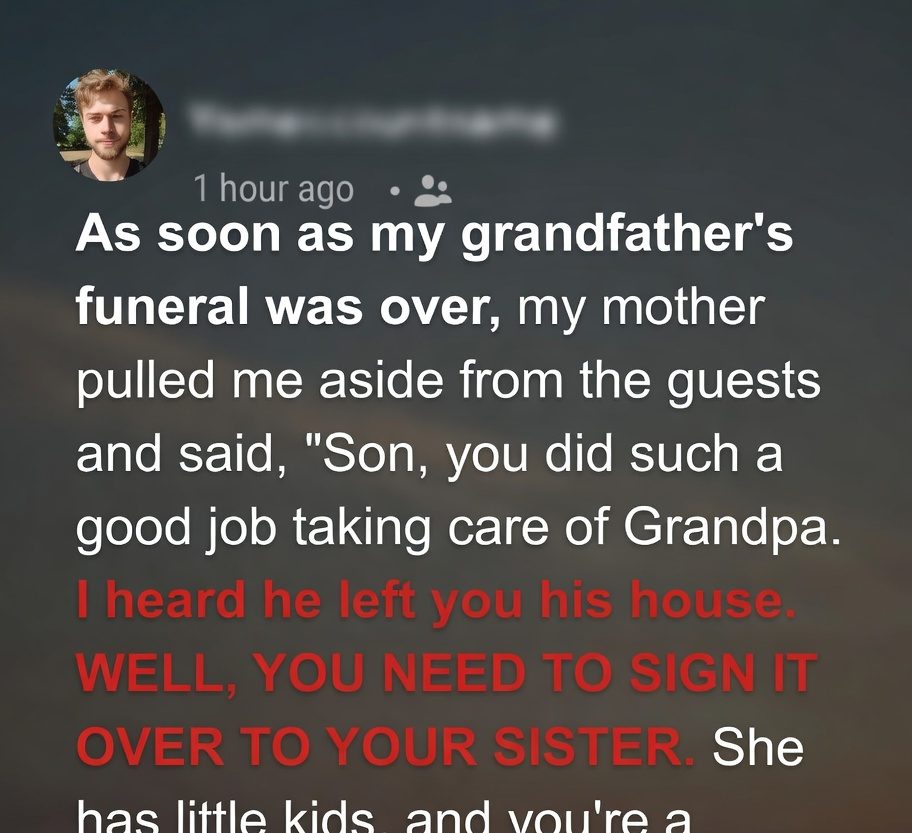
“You did such a good job taking care of Grandpa,” she said, brushing something invisible from her sleeve. “I heard he left you the house. That was… generous.”
“Yeah,” I replied, mouth dry. “He wanted me to have it.”
“Well,” she continued with that same insincere smile, “you need to sign it over to your sister. As soon as possible.”
“Excuse me?” My jaw tightened.
“Marianne has little kids. You’re a young bachelor — you can buy another one someday. She needs the stability.”
“Mom, why should I go against Grandpa’s final wish? If he wanted Marianne to have it, he would have left it to her.”
Her smile vanished. Her eyes turned cold and calculating.
“Because, Rhys,” she said slowly, voice dripping with sugar and poison, “you don’t really have a choice… unless you want the truth about our family to come out.”
I didn’t flinch. I didn’t ask what she meant. I already knew.
She continued, voice clipped. “You’d better listen, or you’ll regret it.”
I nodded once, not in agreement, but because I refused to waste more words on her. “I’ll think about it.”
She left, trailing perfume and betrayal.
The calls started the next day. At first, she used her sweet tone, saying how proud Grandpa would be if I made the “right decision.” Soon the mask dropped. She demanded I sacrifice for family — for Marianne.
Marianne had her own tactics. She texted photos of her twins coloring on the living room floor with messages like, “They’d love a real garden to play in! When can we come see the house?”
When I didn’t reply, she called. “Rhys, this isn’t just about me. The kids need space and stability. Can’t we talk?”
Two weeks later, the envelope arrived — a court order. My own mother was suing me, claiming I had inherited the house through deception. She alleged I wasn’t biologically Ezra’s grandson because she had cheated during her marriage. Therefore, the house should go to Marianne, Ezra’s only “true” blood descendant.
I read the papers and laughed out loud — not from joy, but from the sheer insult. They thought this would work.
What they didn’t know was that Grandpa Ezra had known the truth all along. And he had made sure I would never have to prove my worth.
The courtroom smelled of old carpet and stale coffee. I walked in with my back straight and a USB drive in my pocket.
My mother sat two rows ahead, posture perfect, looking like she was at brunch instead of trying to disinherit her son. Marianne sat beside her, clutching a tissue, eyes red for show.
When my name was called, I stood and handed the USB to the clerk. The screen flickered to life.
There was Grandpa Ezra, sitting in his favorite blue chair by the window, sunlight dappling the floor.
“Hi kiddo,” he said with that warm smile. “If you’re watching this, it means your mother is trying to steal the house from you. Can’t say I’m surprised.”
A ripple went through the courtroom. My mother froze, color draining from her face.
“I did a DNA test a few years ago, Rhys — for both of us. I know you’re not my biological grandson. But I don’t care. Blood means nothing if love isn’t behind it.”
He leaned forward, voice warmer. “You were the only one who treated me like a person, not a wallet. You visited. You helped me when I couldn’t bathe myself. You cooked with me and listened to my stories. That house is yours. I want it to be yours. And I do not want that lying, cheating woman or her spoiled daughter getting a single brick of it.”
When the video ended, silence fell thick and heavy.
The judge cleared his throat. “I see no reason to contest the will. This case is dismissed.”
Karma wasn’t finished.
When my mother filed the lawsuit, she had to publicly confess her affair to make her claim. The secret became public record. Whispers spread fast. Friends stopped inviting her to events. Neighbors avoided Marianne. The air around them turned sour.
Marianne’s husband Tyler, who had long suspected her manipulation, used the lawsuit as his final straw. He filed for full custody of the twins and won.
“I cited emotional instability,” he told me later at the grocery store. “The three of us are doing well now.”
“You’re welcome to bring the kids over anytime,” I said. “We can have a backyard barbecue.”
“I’ll hold you to that, brother.”
Marianne moved in with our mother — two bitter women suffocating in a two-bedroom house under the weight of their choices.
I moved properly into Grandpa’s house. I painted the porch the soft green he always wanted. I cleared the weeds and planted lavender. I hung his favorite fishing photo by the front door. The kitchen still carried the scent of his stew — thyme, memory, and warmth that asked for nothing in return.
One Sunday, I took my rescue dog Cooper to the cemetery. We sat beside Grandpa’s grave as the early sun brushed the headstone.
“I’m proud to be your grandson,” I said, resting a hand on the cool marble.
Later that evening, I boiled pasta in his old pot and stirred sauce, thinking about my mother. Maybe my face reminded her of her mistake every time she looked at me. Maybe that’s why she kept me at arm’s length.
I didn’t know. And I didn’t need to. I already had the only father figure I ever needed. Blood and DNA didn’t matter. No one could ever fill Ezra’s shoes.
And honestly? I was done searching for anyone else.