We were sixteen when my best friend became a mother.
In our small town, gossip moved faster than the river that ran behind the high school. Everyone knew she was pregnant. Everyone waited for the name of the father. She never gave one.
Not to her parents. Not to teachers. Not even to me.
I never pushed. Friendship, I told myself, means holding space for silence when someone isn’t ready to speak. So I stood beside her through the whispers, the doctor appointments, the baby shower no one else threw. When Thomas arrived—tiny, loud, perfect—I became the unofficial aunt who showed up with diapers, lullabies, and endless patience.
Years passed. Life carried us forward. Thomas grew from a chubby toddler into a thoughtful twelve-year-old who asked questions about stars, dinosaurs, and why some families look different from others. I babysat when his mom worked late shifts. I cheered at his soccer games. I helped with homework and listened when he worried about fitting in.
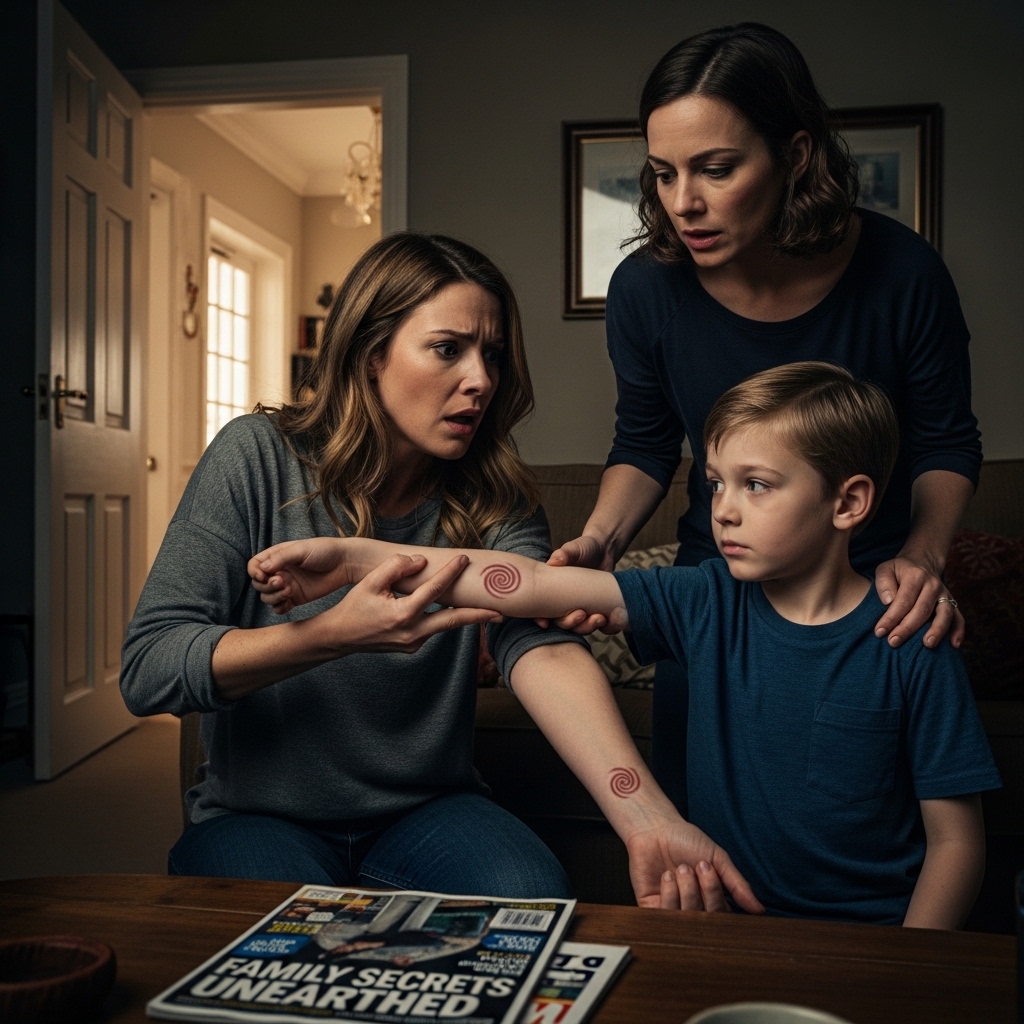
One ordinary Tuesday evening, while we cleared plates after dinner, he reached across the table for a glass of water. His T-shirt slipped off one shoulder.
That’s when I saw it.
A small, distinct birthmark—dark, crescent-shaped with a tiny fork at one end—right above his collarbone.
My breath caught.
I knew that mark.
My grandfather had it in the exact same place. My older brother carried it. One cousin too. It was rare enough that family photos always included a quiet joke: “There’s the crescent club again.”
I laughed it off in the moment. Told Thomas his shirt was slipping. But the image burned behind my eyes.
Coincidence, I told myself. Birthmarks aren’t that unique. Lots of people have similar shapes.
The thought refused to leave.
Weeks later, alone in my apartment, I ordered a consumer DNA kit. Not to accuse. Not to pry. Just to quiet the question that had started waking me at 3 a.m.
I swabbed my cheek. Mailed it off. Told myself the result would be nothing—a distant ethnic overlap, maybe a shared ancient ancestor. Harmless.
When the email arrived, I sat on the couch for ten full minutes before clicking.
The dashboard loaded.
Thomas appeared in my “close family” matches.
Not a vague fourth cousin. A first cousin once removed.
The connection traced to my father’s side—specifically to my uncle Daniel.
Uncle Daniel, who left town abruptly when I was nine. Who rarely called. Who sent Christmas cards with no return address for years before they stopped completely.
The timeline snapped into place like ice cracking.
My friend was sixteen. Daniel would have been twenty-three.
I stared at the screen until the letters blurred.
Then I remembered fragments I’d never connected.
The summer Daniel visited before he disappeared for good. How he and my friend had been seen talking at the county fair more than once. How she’d grown quiet that August, stopped coming over as often.
I never asked her about it then. I didn’t ask now.
Instead I sat with the knowledge alone for days—turning it over, feeling its weight.
When I finally called her, I didn’t accuse. I didn’t demand.
I simply said, “I did a DNA test. Thomas is my cousin.”
Silence stretched so long I thought the call had dropped.
Then her voice, small and cracked: “I swore I’d never tell anyone. He asked me to keep it quiet. Said he wasn’t ready to be a dad. Said he’d ruin everything if people knew.”
She told me the rest in a rush, like she’d been holding the words underwater for twelve years.
Daniel had promised to stay in touch. He sent money for a while—quiet transfers she never told anyone about. Then the messages stopped. The money stopped. He vanished again—this time for good.
She raised Thomas alone. Told him his father “had to leave for work” and never came back. She never wanted pity. Never wanted blame placed on a boy who wasn’t there to defend himself.
“I didn’t want you to look at me differently,” she whispered. “Or at him.”
I cried then—not from betrayal, but from the sheer exhaustion of the secret she’d carried.
The next weekend, Thomas came over like always.
We sat on the porch steps eating ice cream.
I didn’t tell him everything. Not yet. But I told him something true.
“You know how some families have matching birthmarks?” I asked.
He nodded, licking chocolate off his thumb.
“I have one too,” I said. “Same place as yours. Turns out we’re related. Like… actual cousins.”
His eyes widened. “Really?”
“Really.”
He grinned—the big, unguarded kind only kids still have.
“That’s cool,” he said. “Does that mean you’re stuck with me forever?”
I pulled him into a side hug. “Yeah, kid. Stuck with you forever.”
Later, when his mom picked him up, our eyes met over his head.
No apologies. No explanations needed.
Just a quiet understanding that some truths arrive late, but they arrive.
And when they do, they don’t break what was already built.
They simply make the circle wider.
Thomas still doesn’t know the full story of his father. Maybe one day he will. Maybe he won’t need to.
For now, he knows he belongs—to his mom, to me, to a family marked by the same small crescent.
And sometimes that’s enough.
More than enough.