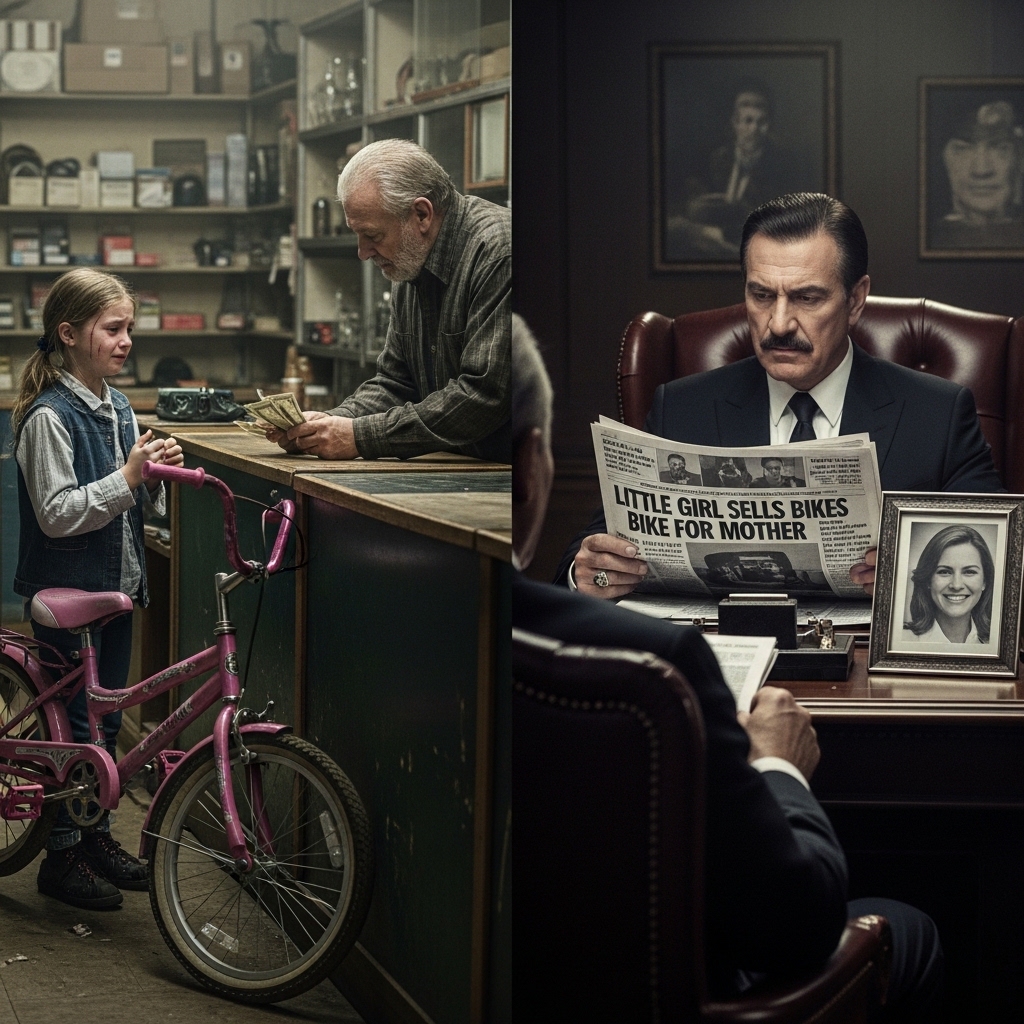
Rain hammered the pavement when Rocco Moretti stepped out of his black SUV outside the rundown convenience store. He needed to make a call, but a small voice stopped him cold.
“Sir… sir, can you buy my bike?”
He turned. A seven-year-old girl—Emma—stood soaked and shivering, pushing a rusted pink bicycle toward him. Torn shoes, pale cheeks, eyes too weary for her age.
Rocco frowned. Kids usually crossed the street to avoid him. Adults looked away. But this child was desperate enough to approach the most feared man in the city.
“What are you doing out here alone?” he asked.
She thrust the bike forward with both hands. “Please. Mommy hasn’t eaten in days. I can’t sell the house stuff, so I’m selling my bike.”
Something twisted hard in Rocco’s chest. “How long since she ate?”
“Since the men came,” she whispered.
His eyes narrowed. “What men?”
She glanced around, voice barely audible. “The ones who said Mommy owed money. They took everything—furniture, clothes, even my baby brother’s crib.”
Rocco’s jaw locked when she rolled up her sleeve. Bruises bloomed across her thin arm.
“They said not to tell,” she added. “But I recognized one. He was from your gang, sir. Mommy cried and said the mafia took it all.”
The words landed like ice water. Someone had used the Moretti name to prey on a starving mother and child.
He straightened, rain streaming off his coat. “Where’s your mother now?”
“Home. She’s too weak to get up.”
Rocco handed her his keys. “Get in.”
Whoever had done this—using his name, touching that girl—would learn exactly why people whispered Rocco Moretti’s name like a prayer and a curse.
The drive felt endless. Emma sat silent, clutching the bike handles like a lifeline. She was seven, had been selling whatever she could for a week just to buy bread.
“Turn here,” she whispered, pointing down a dark street of cracked sidewalks and boarded windows.
They parked outside a peeling house, door hanging crooked, windows black—no power.
Emma pulled a key from under a loose brick. The door creaked open to bare rooms: no furniture, no pictures, only echoes and dust.
“Mommy,” she called softly. “I brought someone to help.”
A faint voice answered. “Emma, baby… come here.”
They found Sarah on a pile of blankets in the corner—gaunt, exhausted, eyes widening in terror when she saw Rocco.
“Please,” she rasped, struggling up. “We have nothing left. Don’t hurt us.”
Rocco knelt, hands visible. “I’m not here to hurt you. Your daughter told me what happened. I need names.”
Sarah looked from him to Emma. “You’re the boss. The one they work for.”
“Some claim to,” Rocco said evenly. “This wasn’t authorized. It was theft. Cruelty.”
Tears slipped down Sarah’s face. “They said my husband Marcus owed $15,000 plus interest. He died months ago. Never borrowed from anyone—he worked three jobs to stay clean.”
She described the tall man with a scar on his cheek. “Vincent. He showed papers with Marcus’s signature. But it wasn’t his handwriting.”
They’d stripped the house in two visits. Threatened worse if she called police.
Emma spoke up. “He hurt Mrs. Patterson too. And the family with the new baby. I see them crying.”
Seven families. At least.
Rocco’s voice stayed calm. “Vincent Caruso.”
He made calls: groceries, cash, power restoration, door repair. Then he stared into the rain.
Vincent had just crossed the one line Rocco never allowed.
Later, Vincent called—too casual. “Boss, heard you were in my neighborhood. Everything okay?”
Rocco kept ice in his tone. “Just business. Meet me tonight. Bring the Thompson paperwork.”
Vincent arrived at the office nervous, folder in hand.
Rocco studied the loan document. “Vincent, today’s November 15.”
“Yeah?”
“Marcus Thompson died August 23. How’d a dead man sign this?”
Vincent paled.
“You forged it. Stole from a widow and her seven-year-old. Bruised that child’s arm. Used my name.”
Vincent stammered excuses—extra money, nobodies, kids bounce back.
Rocco’s hand clamped his shoulder. “Wrong answer.”
By dawn, evidence piled up: Vincent’s accounts swollen by $200,000, surveillance of him loading stolen goods, a storage unit crammed with cribs, photos, toys, wedding rings—even a wheelchair.
Vincent sat tied in that unit, surrounded by proof.
“You’ll return everything,” Rocco said. “Every item. And apologize. Personally.”
Vincent sneered weakly. “Then what? You let me walk?”
Rocco picked up a small pink teddy bear—remembered Emma’s desperate grip on her bike. “No. That’s not how this works.”
Over hours, Vincent loaded trucks under guard. First stop: Mrs. Patterson’s. He carried her television, returned photos, admitted forging documents. She accepted in silence.
Next, the young family. He brought back the crib while the mother wept—her newborn had slept on blankets for weeks.
Last: Sarah and Emma’s.
Word had spread. Neighbors watched from porches.
Emma saw Vincent and froze, fear flashing. She ran toward the house.
Rocco stepped out. “Emma, it’s okay. He’s here to give it back.”
Men unloaded: couch, dresser, Emma’s bed with pink butterfly sheets.
Sarah appeared, stronger from food and care. Anger burned in her eyes.
“You took my daughter’s crib while she cried. You looked at a seven-year-old and decided her tears didn’t matter.”
Vincent couldn’t meet her gaze. “I was wrong. I’m returning everything. Paying back what I took.”
“Pay?” Sarah stepped closer. “Money doesn’t fix what you did to my daughter.”
Emma edged forward, seeing Vincent’s fear now. “You hurt my arm,” she said quietly. “When I tried to keep my bike.”
Vincent flinched.
Rocco watched the exchange, then spoke low. “Vincent. Apologize.”
Vincent swallowed. “I’m sorry, Emma. I’m sorry, Sarah. I had no right. I hurt you both.”
Emma studied him a long moment. “Are you going to hurt anyone else?”
“No,” Vincent whispered. “Never again.”
Rocco nodded to his men. They escorted Vincent away.
He never came back to the neighborhood.
Weeks later, Emma rode her pink bike again—returned, polished, tires pumped. Sarah smiled from the porch, stronger every day.
Rocco never spoke of it publicly. But word spread quietly through the streets: the Moretti family had rules. And the hardest rule was this—
You don’t starve children. You don’t bruise them. You don’t hide behind the name to prey on the helpless.
Because when you do, even the devil himself will come knocking—and he’ll make sure every stolen piece comes home.
Sometimes justice arrives in a black SUV on a rainy night. And sometimes it starts with a little girl brave enough to sell her bike so her mother could eat.