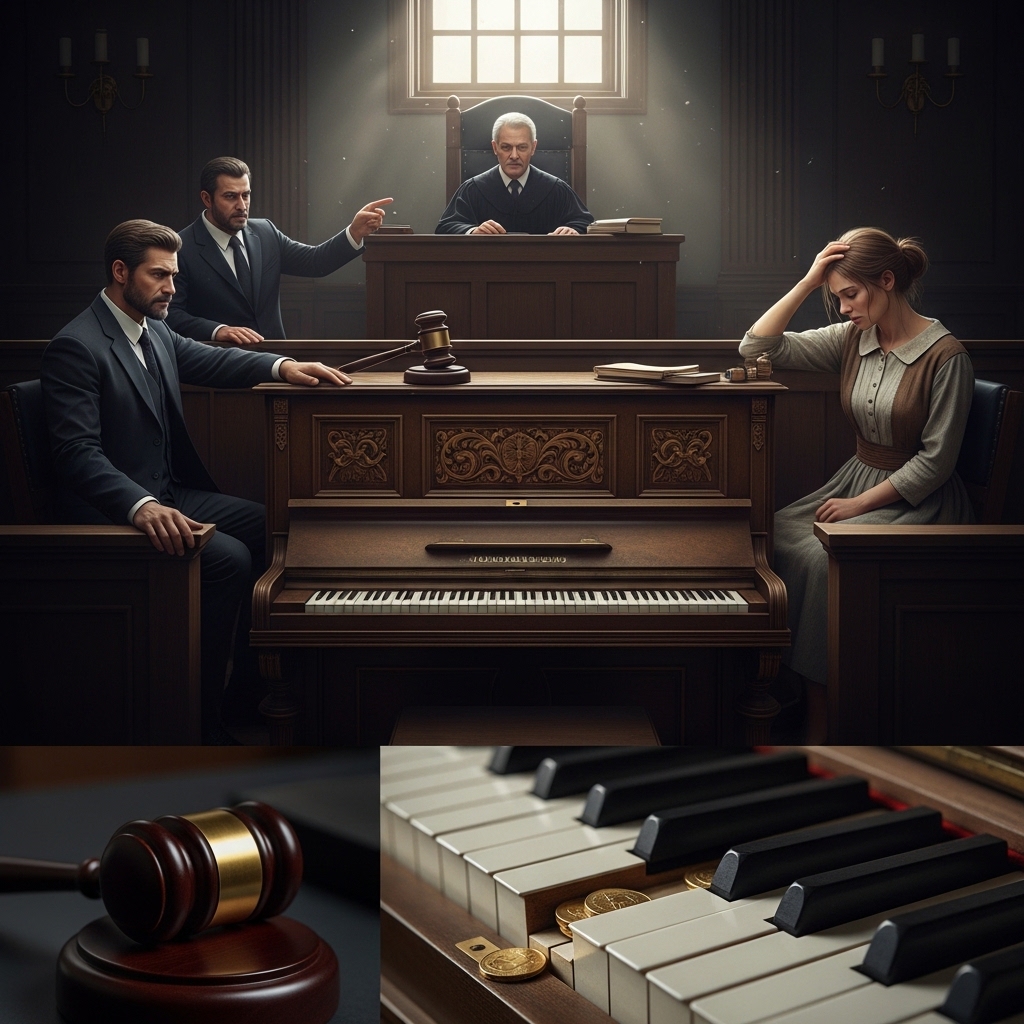
The courtroom still smelled of old paper and wax polish the day our marriage officially ended.
Ten years with Daniel—building a home, a life, a future—gone in under six months of vicious legal warfare. Lawyers carved up every asset like surgeons: house in his name, savings mysteriously moved to hidden accounts, the business I helped grow legally his alone.
No prenup. No separate finances. “Why would we need that?” I’d laughed back then. “We’re in this together.” Daniel had smiled. Now that smile felt like a warning I’d ignored.
The judge’s gavel fell. My lawyer touched my shoulder gently. “You’re walking away with very little.”
Very little meant nothing. Except my clothes. And the one item Daniel dismissed as junk: the old upright piano.
A dark walnut beast from his mother Eleanor, gifted four years into our marriage. It stood against the living room wall like a quiet witness. Daniel hated it—“too big, too old”—but let me keep it because, to him, it was worthless furniture.
To me, it was the last piece that felt like home.
Three days post-divorce, alone in my tiny rented apartment—mattress on the floor, two suitcases, and that piano—I stared at it, numb.
My phone buzzed. Eleanor.
We’d never been close. Polite distance, short sentences, rare smiles. I’d always assumed she looked down on my modest roots.
Her text: “Don’t sell the piano.”
Then: “Slide back the desk cover where the sheet music sits and look inside.”
Inside?
The music desk above the keys—polished wood, brass hinges—nothing special. I’d rested hundreds of scores there.
Still, I lifted the lid, slid the cover back with a soft click.
At first, nothing. Then, deep in the frame: a thick, yellowed envelope.
My fingers shook as I pulled it out. Fragile paper. Inside, protective sleeves. And inside those… stamps.
Five tiny masterpieces—intricate engravings, vivid colors, historical markings. Even I, no philatelist, could tell they were special. Carefully preserved. Carefully hidden.
Heart pounding, I searched online.
Results hit like a wave. Rare pieces from a legendary international collection. Each worth tens of thousands—some far more. Together? More than the house Daniel had fought tooth and nail to keep.
Hands trembling, I dialed Eleanor.
She answered on the second ring. “Did you find it?” Calm as ever.
“Yes… I—I don’t understand.”
A quiet pause. Then her voice softened—truly softened—for the first time.
“Those stamps belonged to my father. He collected them his whole life. I kept them hidden for years.”
“Why give them to me?” I whispered.
Another silence. Heavy.
“Because I know my son.”
The words landed like stones.
“I went through the same thing,” she continued softly. “Thirty years ago. Your father-in-law destroyed me in court. I trusted him the way you trusted Daniel.”
My chest squeezed.
“He left me with almost nothing,” she said. “Except what I hid.”
I sank onto the piano bench.
“I watched Daniel grow up. Saw echoes of his father—the ambition, the ruthlessness. I warned him not to treat you this way.”
Her voice cracked just a little.
“But he didn’t listen.”
Silence wrapped around us—comforting in its weight.
“I couldn’t stop the divorce,” she said gently. “But I could break the cycle.”
Tears fell freely.
“You deserve a safety net,” she finished.
I pressed my palm to the worn wood.
“Why not tell me sooner?”
“Because if Daniel had known,” she replied quietly, “he would have taken that from you too.”
For the first time in a decade, I saw Eleanor clearly. Not cold. Patient. Waiting for the moment I’d need her most.
Sometimes the greatest fortune isn’t in bank accounts or court papers. It’s in the quiet foresight of someone who’s walked the same painful road—and chose to leave you a hidden door out.