Two years after losing my wife Lauren and our six-year-old son Caleb in a car accident, I was barely functioning. The house felt wrong. Lauren’s mug still sat by the coffee maker. Caleb’s sneakers waited by the door. His drawings stayed taped to the fridge. I slept on the couch with the TV on all night, trying to drown out the silence.
Then, one night at 2 a.m., scrolling Facebook to avoid sleep, I saw a local news share: “Four siblings need a home.” A photo showed four kids squeezed together on a bench—ages 3, 5, 7, and 9. Caption: “Both parents deceased. No extended family able to take all four. If no home is found, they will likely be separated.”
They looked like they were bracing for it. The oldest boy had his arm around the girl next to him. The little girl clutched a stuffed bear and leaned into her brother.
Comments were full of “So heartbreaking,” “Praying,” “Shared.” No one said, “I’ll take them.”
I put the phone down. Picked it up again.
I knew what it felt like to walk out of a hospital alone. Those kids had already lost their parents. Now the system planned to split them up on top of that.
In the morning, I called the number in the post. “Child Services, this is Karen.” “Hi. I’m Michael Ross. I saw the post about the four siblings. Are they still needing a home?” A pause. “Yes, they are.” “Can I come in and talk about them?”
That afternoon, Karen laid their file on the table. “Owen is nine. Tessa is seven. Cole is five. Ruby is three.” Their parents died in a car accident. No family could take all four. They were in temporary care.
“What happens if no one takes all four?” I asked. “Then they’ll be placed separately,” she said. “Most families can’t take that many children at once.”
I stared at the file. “I’ll take all four.”
Karen blinked. “All four?” “Yes. I know there’s a process. I’m not saying tomorrow. But if the only reason you’re splitting them is that nobody wants four kids… I do.”
She looked at me for a long time. “Why?” “Because they already lost their parents. They shouldn’t have to lose each other too.”
Months of home studies, background checks, interviews, and paperwork followed. A therapist asked, “How are you handling your grief?” “Badly,” I said. “But I’m still here.”
The first meeting was in a visitation room with ugly chairs and fluorescent lights. All four sat on one couch, shoulders and knees touching. Owen watched me like a little adult. Tessa folded her arms, suspicious. Cole stared at my shoes. Ruby hid her face in Owen’s shirt.
I sat across from them. “Hey. I’m Michael.”
“Are you the man who’s taking us?” Owen asked.
“If you want me to be.”
“All of us?” Tessa pressed.
“Yeah. All of you. I’m not interested in just one.”
Her mouth twitched. “What if you change your mind?”
“I won’t. You’ve had enough people do that already.”
Ruby peeked out. “Do you have snacks?”
I smiled. “Yeah. I’ve always got snacks.”
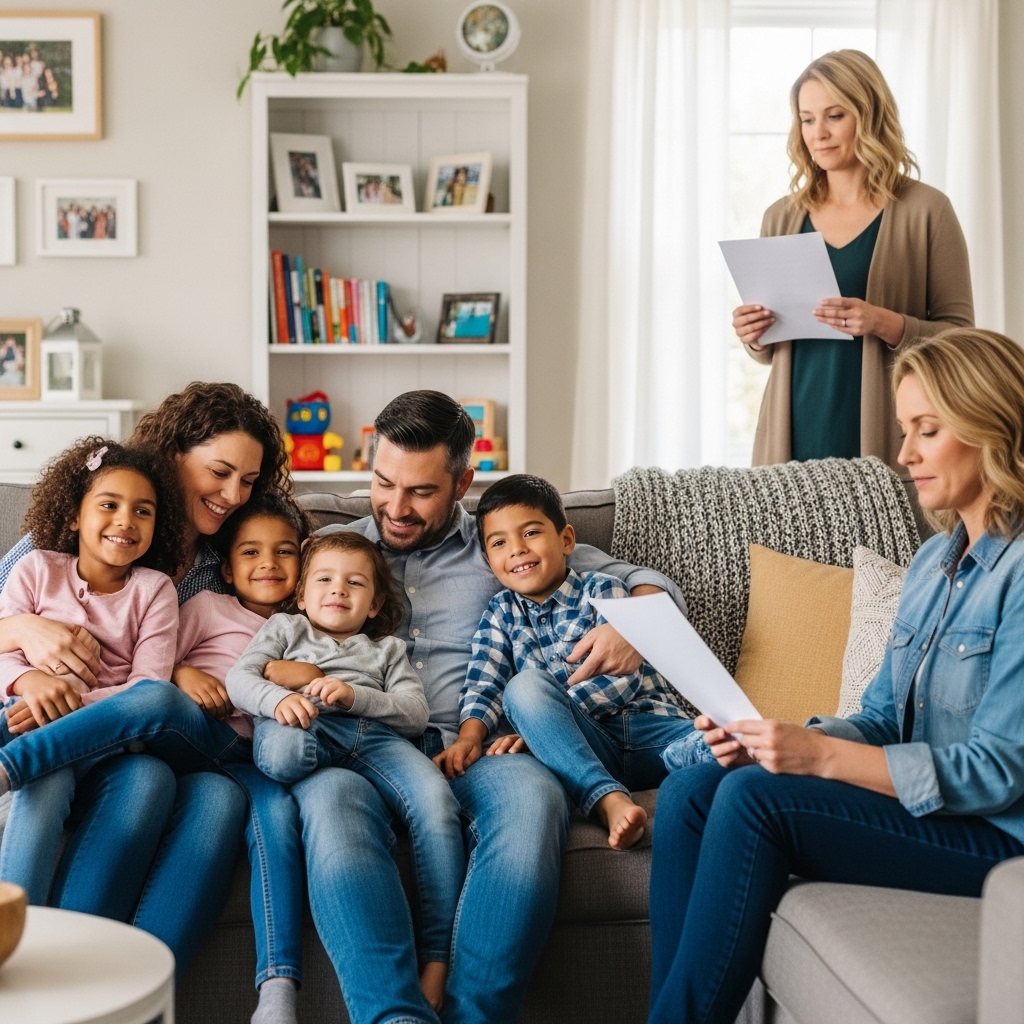
The day they moved in, my house stopped echoing. Four sets of shoes by the door. Four backpacks in a pile.
The first weeks were hard. Ruby woke crying for her mom almost every night. I sat on the floor beside her bed until she fell asleep. Cole tested every rule. “You’re not my real dad,” he shouted once. “I know,” I said. “But it’s still no.”
Tessa hovered in doorways, ready to step in if needed. Owen tried to parent everyone and collapsed under it.
I burned dinner. Stepped on Legos. Hid in the bathroom just to breathe.
But it wasn’t all hard. Ruby fell asleep on my chest during movies. Cole brought me a crayon drawing: stick figures holding hands. “This is us. That’s you.”
Tessa slid me a school form. “Can you sign this?” She’d written my last name after hers.
One night Owen paused in my doorway. “Goodnight, Dad,” he said, then froze—like he’d surprised himself.
I acted like it was normal. “Goodnight, buddy.”
Inside, I was shaking.
A year after the adoption finalized, life looked messy-normal. School runs, homework, soccer, arguments over screen time. The house was loud and alive.
One morning, after dropping them at school and daycare, I came home to start work. Half an hour later, the doorbell rang.
A woman in a dark suit stood on the porch, holding a leather briefcase. “Good morning. Are you Michael? Adoptive father of Owen, Tessa, Cole, and Ruby?”
“Yes. Are they okay?”
“They’re fine,” she said quickly. “I’m Susan, the attorney for their biological parents.”
My chest tightened.
We sat at the kitchen table. I pushed cereal bowls and crayons aside.
She opened the briefcase and pulled out a folder. “Before their deaths, their parents came to my office to make a will. They were healthy—just planning ahead.”
She slid a document across the table. “In that will, they made provisions for the children. A small house. Some savings. Not huge, but meaningful. Legally, it all belongs to them.”
“To them?”
“You’re listed as guardian and trustee. You can use it for their needs, but you don’t own it. When they’re adults, whatever is left is theirs.”
I exhaled slowly. “Okay. That’s… good.”
“There’s one more important thing.”
She flipped a page. “Their parents were very clear they did not want their children separated. They wrote that if they couldn’t raise them, they wanted them kept together—in the same home, with one guardian.”
I stared at the words on the page: “Do not separate our children.”
While the system was preparing to split them, their parents had already written: Don’t separate our kids.
They’d tried to protect them—even from that.
“Where’s the house?” I asked.
Susan gave me the address. It was across town.
That weekend I loaded all four into the car. “We’re going somewhere important.”
“Is it the zoo?” Ruby asked.
“Is there ice cream?” Cole added.
“There might be ice cream after—if everyone behaves.”
We pulled up to a small beige bungalow with a maple tree in the yard.
The car went quiet.
“I know this house,” Tessa whispered.
“This was our house,” Owen said.
“You remember it?”
They nodded.
I unlocked the door with the key Susan gave me. Inside it was empty, but they moved like they knew every inch by heart. Ruby ran to the back door. “The swing is still there!”
Cole pointed at a wall. “Mom marked our heights here. Look.”
Faint pencil lines peeked through the paint.
Tessa stood in a small bedroom. “My bed was there. I had purple curtains.”
Owen went to the kitchen, touched the counter. “Dad burned pancakes here every Saturday.”
After a while, Owen came back to me. “Why are we here?”
I crouched down. “Because your mom and dad took care of you. They put this house and some money in your names. It all belongs to you four—for your future.”
“Even though they’re gone?” Tessa asked.
“Yeah. Even though. They planned for you. And they wrote that they wanted you together. Always together.”
“They didn’t want us split up?” Owen asked.
“Not ever. That part was very clear.”
“Do we have to move here now?” he asked. “I like our house. With you.”
I shook my head. “No. We don’t have to do anything right now. This house isn’t going anywhere. When you’re older, we’ll decide what to do with it. Together.”
Ruby climbed into my lap and wrapped her arms around my neck.
“Can we still get ice cream?” Cole asked.
I laughed. “Yeah, bud. We can definitely still get ice cream.”
That night, after they were asleep back in our crowded rental, I sat on the couch and thought about how strange life is.
I lost a wife and a son. I’ll miss them every day.
But now there are four toothbrushes in the bathroom. Four backpacks by the door. Four kids yelling “Dad!” when I walk in with pizza.
I’m not their first dad. But I’m the one who saw a late-night post and said, “All four.”
And now, when they pile onto me during movie night—stealing my popcorn and talking over the movie—I think: This is what their parents wanted. Us. Together.
I didn’t adopt them because of a house or an inheritance. I didn’t even know any of that existed. I did it because four siblings were about to lose each other.
The rest was their parents’ last way of saying: “Thank you for keeping them together.”