When I gave birth to my daughter Sarah at 41, I was already a proud mother to an extraordinary girl. Everyone who met her praised her generosity and kindness. She truly was one of a kind.
At 31, Sarah became pregnant. The day I learned I was going to be a grandmother was the happiest of my life. A tiny bundle of joy was about to change everything. I never imagined the change would be so painful.
Sarah died giving birth. In those raw moments of grief, her boyfriend said he couldn’t handle fatherhood alone—he wasn’t ready to be a single dad. He asked me to take our granddaughter. Without hesitation, I became Amy’s sole guardian. Her father sends small checks each month—barely enough for diapers, never mind food, clothes, or toys.
Today it’s just me and Amy. I’m 72. Raising a baby at my age is exhausting in ways I never expected. But she’s all I have left of Sarah, and I’m all she has. So I stay strong. That’s the only option.
That day at the pediatrician’s office didn’t go as planned. Amy was cranky—unusually so. She cried through the entire check-up. I prayed we’d get home quickly.
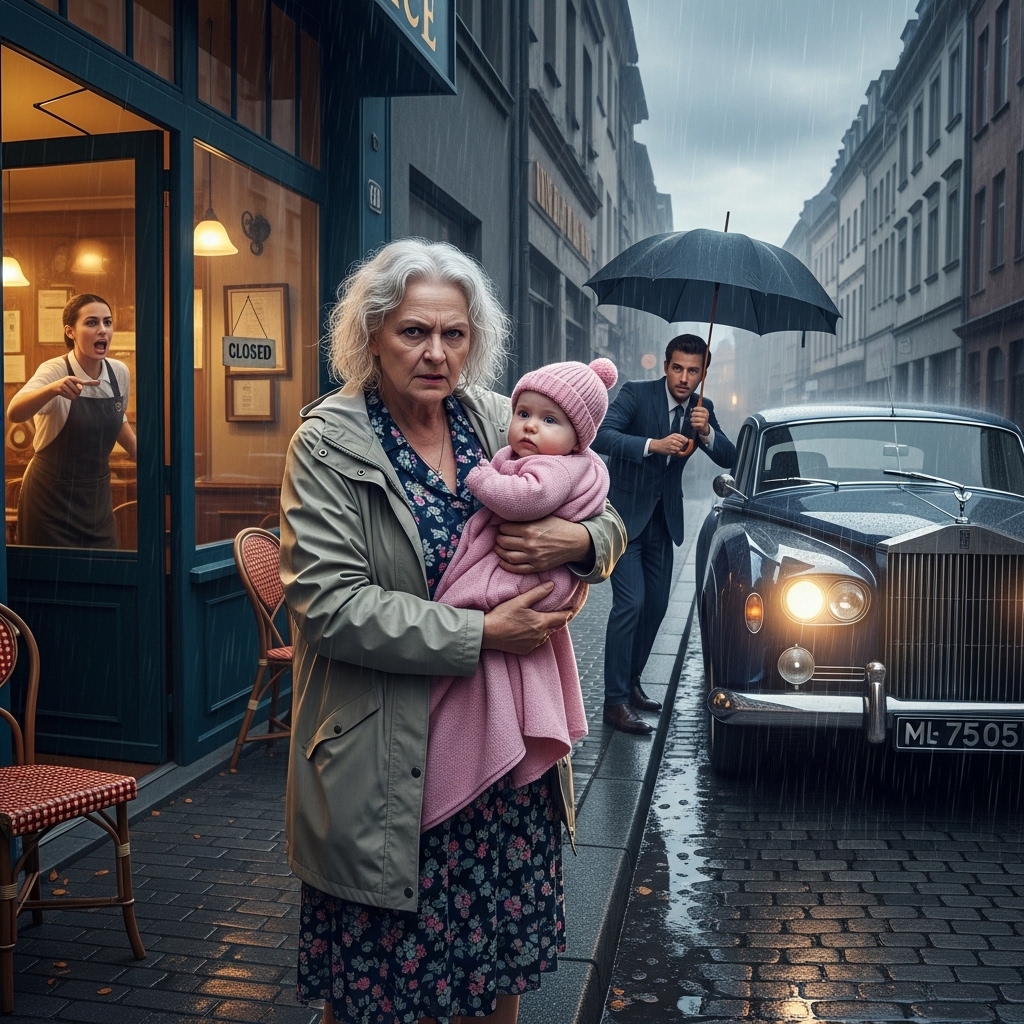
Outside, the sky had opened. Heavy rain poured down, wind whipping sideways. No umbrella, no car nearby. I spotted a cozy-looking café just across the street. I draped my coat over Amy’s stroller and hurried inside.
The place felt warm and inviting—perfect for a rainy day. We found a table near the window. I settled Amy beside me. She started crying again. Nothing soothed her.
As I tried to feed her, the woman at the next table spoke loudly. “Hey, lady. This isn’t daycare. People come here to relax, not listen to a baby screaming.”
Her companion chimed in. “Why don’t you take that baby and leave?”
Humiliation burned my cheeks. I wanted to disappear. But there was nowhere to go in that downpour.
“I’m so sorry,” I said. “She’s just hungry. Once I feed her she’ll quiet down.”
The woman scoffed. “Couldn’t you do that in your car? If you can’t calm your baby, why bring her out?”
The waitress overheard everything. Before she even reached my table she said, “Ma’am, maybe it would be better to feed her outside and come back once she calms down. Other customers are complaining.”
I looked around, hoping someone—anyone—might speak up for an old woman and a crying infant. No one did.
I was still weighing impossible options when the café door opened. Two police officers stepped inside, shaking rain from their jackets. They scanned the room, then one locked eyes with me.
“Good afternoon, ma’am,” the older officer said. “We were told you’re disturbing customers. Is that true?”
My stomach dropped. Someone had called the police on a 72-year-old grandmother with a hungry baby?
The manager had spotted us outside and exaggerated the situation. The officers approached. “What’s the problem here?”
I explained—voice shaking—that I planned to order once Amy was fed. It was pouring rain. I had nowhere else to go.
The younger officer glanced at Amy, still fussing. “So the ‘disturbance’ is just a hungry baby crying?”
The waitress nodded stiffly. The manager insisted I had to leave because I hadn’t ordered anything—ignoring that I’d had no chance.
The older officer raised an eyebrow. “Know what?” he said. “My sister has three kids. I’m pretty good with babies.”
Before anyone could object, he gently lifted Amy from the stroller. To everyone’s surprise—including mine—she quieted almost instantly, nestling against his shoulder.
“Guess the disturbance is over,” he said with a small smile.
The manager and waitress still pressed—I needed to leave. The officer shook his head. “Bring us three coffees and three slices of apple pie with ice cream,” he told the waitress. “It’s cold out there, but pie and ice cream are good for the soul.” He nodded at his partner—who was still holding Amy—to join us at the table.
Suddenly the staff became polite. Very polite.
They introduced themselves: Christopher (older) and Alexander (younger). We talked. I shared about Sarah—how she died giving birth, how I became Amy’s guardian at 72, how hard it is some days but how much I love her. I told them exactly what happened in the café.
Alexander shook his head. “I knew the manager was exaggerating the second we walked in. You’re doing everything you can for your granddaughter. You should be proud.”
Before we left—the rain had eased—Alexander asked if he could take a photo of Amy and me. “For the report,” he said.
“Of course,” I replied.
A few days later my neighbor called, practically vibrating with excitement. “Maggy, have you seen the newspaper? You’re everywhere!”
I hadn’t. Between diapers, feedings, and exhaustion, I barely had time to breathe.
She sent me the link. Alexander had forwarded the photo to his sister—a local reporter. She was disturbed by how we’d been treated and wrote a piece about it. The article highlighted the vulnerability of elderly caregivers, the lack of compassion some people show toward crying babies (and the people caring for them), and the simple reminder: kindness costs nothing.
The story went viral locally. People were furious at the café. The next day a sign appeared on their door: “Babies Welcome”
Amy and I returned a few days later. The waitress greeted us with a genuine smile. She apologized—sincerely—for how we’d been treated. I told her it was okay. Everyone makes mistakes.
I ordered coffee and apple pie. When she brought it, she said, “It’s on the house.”
I left a big tip that day.
Sometimes the world shows its cruelty. But sometimes—when you least expect it—it shows its kindness too. And sometimes a crying baby, two good officers, and one honest photo can remind everyone what compassion really looks like.
Amy and I are still figuring out each day. But we’re not alone anymore. Not entirely.