Grief didn’t crash over me like a tsunami. It seeped in quietly: a late-night call from strangers, a sterile hospital hallway, two officers avoiding my gaze. My name is Rachel. I’m 19. Last fall, my parents died in a car crash on their way to dinner. One second they were alive; the next, I was clutching lukewarm vending-machine coffee at 3 a.m., begging time to reverse.
The house turned hollow. I waited for Mom’s kitchen humming, Dad’s garage calls. I barely left my room except to feed the cat and nuke frozen dinners. Grief shrinks everything.
Then came the will reading.
I arrived in borrowed black slacks and Mom’s perfume-clinging blazer, hands trembling so hard I twisted my shirt hem like a lifeline. Across the table sat Aunt Dina—Dad’s sister, though he never spoke of her with warmth. She wore a tight red dress, cocktail-party ready, no tears, no pretense.
The lawyer cleared his throat. “The house passes to Ms. Dina.”
I blinked. “Excuse me?”
Dina’s smile was pure satisfaction. “You heard him.”
“That’s impossible,” I said, voice cracking. “Mom and Dad would never—Dina hated Mom. She barely spoke to us.”
The lawyer shifted. “The document is valid, signed.”
Air vanished from the room. “There has to be a mistake.”
“No mistake,” Dina purred, leaning back like she already owned the furniture. “It’s my house now.”
I left numb, replaying every family memory, searching for how this betrayal fit. I waited for a call saying clerical error. It never came.
Two days later, she showed up.
I opened the door in pajamas and fuzzy socks. No hello. “You’ve got one day to pack and leave,” she said, arms crossed. “I want it spotless before I move in.”
My stomach plummeted. “Dina, I have nowhere to go.”
She shrugged. “Not my problem.”
“I’m your niece.”
“Correction,” she said, brushing past me. “I’m your landlord. Out.”
I begged—offered jobs, bills, anything. She rolled her eyes, flopped on the couch. “You’re blocking the TV.”
So I packed.
No sleep. Just slow-motion folding clothes, wrapping frames in towels. Every corner screamed memory: Dad teaching me to ride a bike in the backyard, Mom twirling me in the kitchen, birthday cakes thick with cinnamon.
Dina lounged, watching reruns, crunching chips, tossing barbs. “You always had too much stuff.”
“I’m going as fast as I can,” I whispered.
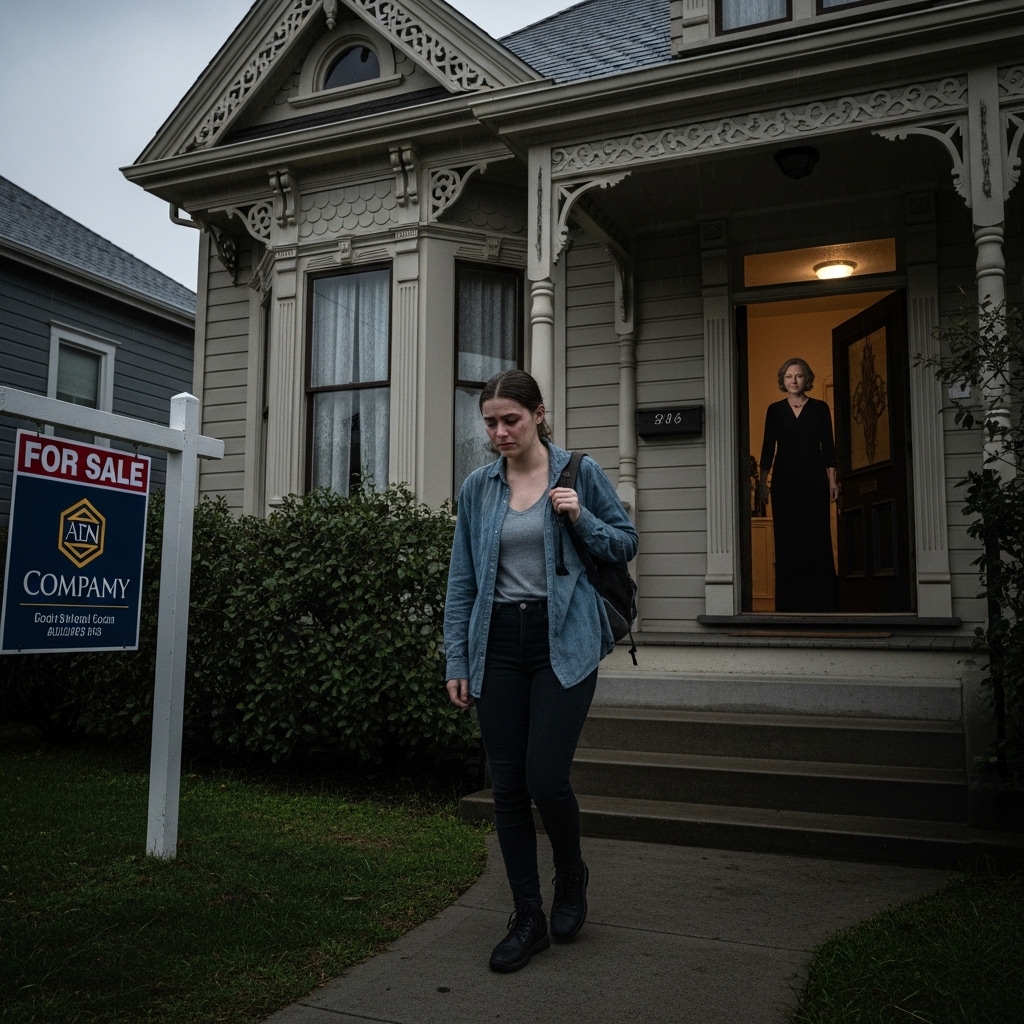
Next morning: gray, humid. I stood on the steps with two suitcases and Mom’s dying peace lily from the kitchen window. Eyes burned, but I refused tears in front of her.
One last look—the porch swing, cracked mailbox path, windows like ghosts.
Then I saw it.
A sleek black limousine purred down the street and stopped exactly in front.
I frowned. Dina didn’t have that kind of money—unless forgery paid dividends.
I started dragging my bags past when the door opened.
“Rachel?”
I froze.
A tall man in a sharp gray suit stepped out—high cheekbones, dark hair, posture that whispered wealth and composure. He adjusted his tie, met my eyes.
“Uncle Mike?”
He smiled, softer. “You’ve grown. Last time I saw you, glitter pens and cat drawings everywhere.”
I laughed despite everything. “And you gave me a fountain pen for Christmas. I thought it was a wand.”
“Not far off,” he said. “Pens hold power. Today I brought a different kind.”
I stared, dazed. “What are you doing here?”
He showed his phone: Dina’s smug Facebook post—her in the doorway, oversized sunglasses, leopard scarf, caption: New beginnings! So proud to finally have what was meant for me.
“She posted that?” I whispered.
“Saw it last night,” Mike said, pocketing the phone. “Your dad would’ve exploded. So I started digging.”
Before I could speak, two police cruisers rounded the corner and parked.
“What is this?” I breathed.
Mike stayed calm. “Stay close. It’s going to be okay.”
We approached the house together—me clutching the peace lily, Mike, two officers—like a quiet procession of justice.
Dina opened the door in a silk robe too fancy for her “broke” claims, mimosa in hand.
Her face twisted. “Rachel? You can’t just—”
“Don’t,” Mike cut in smoothly. “Don’t finish that sentence.”
He turned to the officers. “May I?”
A nod.
He opened his briefcase, pulled a thick folder. “This is proof Ms. Dina submitted a forged will. The original never existed. Document created posthumously; signature traced from a medical consent form.”
I exhaled sharply. “What?”
“Paid-off ‘lawyer’—no license, cash only. Bank records, handwriting analysis, witnesses. It’s airtight.”
Dina’s glass trembled. “Ridiculous. You can’t prove—”
“We already have,” Mike said, voice velvet over steel.
She deflated instantly—eyes darting for escape.
An officer stepped up. “Ms. Dina, you need to come with us.”
“I… need to call someone—”
“From the station,” the officer replied, cuffs out.
She yelped as they clicked them on, mimosa splashing her pink slippers.
I watched her squirm. No triumph, no rage—just bone-deep exhaustion, the kind that follows holding your breath too long.
As they drove away, Mike sighed beside me.
“I can’t believe she did this,” I whispered.
“She was always jealous of your dad—even as kids. But this crossed every line.”
I nodded, fingers tracing the peace lily pot.
“You’re not alone, Rachel,” he said gently. “I should’ve come sooner.”
Three months later.
Court ruled: no valid will existed. Parents never anticipated dying young. Intestate law made me heir. House mine. Dina erased from every record.
Her fake listing disappeared. Keys handed over quietly outside the courthouse.
Mike sued her for legal fees, emotional damages, fraud.
She lost everything.
Neighbors say she rents a cramped one-bedroom above a vape shop—flickering lights, no AC. Far from the marble islands she flaunted online.
Me?
I’m home.
The word still feels unreal. I sit in the living room where Mom and I built blanket forts. New couch cover, cinnamon in the air again. I planted flowers, herbs—basil, lavender, rosemary.
The peace lily bloomed last week.
I stared at its white petals unfurling—quiet, stubborn, alive. Just like me.
Uncle Mike visits with odd gifts: vintage chess set, leather notebook. Last Sunday he fixed the leaky faucet, handed me a wrench.
“You’re tougher than you know,” he said. “Your dad would be proud.”
I smiled. “Thanks—for everything.”
He shrugged. “What are uncles for?”
I miss my parents every day. But I’m rebuilding—from ashes, a future.
The peace lily stays by the window.