I became my grandson’s guardian when he was barely two years old.
My own son made it painfully clear he wasn’t ready to be a father, and the child’s mother vanished without leaving so much as a forwarding address. One day she was there, the next she was gone. And in the silence she left behind, a toddler stood in my living room clutching a stuffed rabbit, looking for someone to hold on to.
So I did.
I fed him, bathed him, and rocked him through fevers and nightmares. I learned how he liked his pancakes cut into triangles and how he needed the hallway light left on just a crack at night. His tiny fingers once wrapped around mine to steady himself, and before I knew it those same hands were tying their own shoes and carrying schoolbooks.
He became the rhythm of my days.
And I became the center of his world.
I truly believed our quiet life would continue that way—just the two of us against everything.
Until the morning it all fell apart.
He was twelve when she came back.
I remember the knock at the door. I wiped my hands on a dish towel and opened it, expecting a neighbor or a delivery.
Instead, she stood there in tailored clothes and polished heels, a leather handbag hanging neatly from her shoulder. Beside her stood a man in a suit holding a briefcase.
She barely looked past me toward the hallway where my grandson stood.
“Thanks for your services,” she said coolly. “I’ll take it from here.”
For a moment, I couldn’t even understand what she meant.
Then the lawyer began speaking—about custody rights, legal authority, and documentation. Buried in all the formal language was the truth that shattered everything: she was his biological mother, and now she had both the means and the legal power to take him back.
I tried to argue.
I tried to reason with her.
I begged her to at least let him choose.
But the law wasn’t on my side.
I will never forget the sound of his crying as they led him to the car. His face pressed against the window, his hand reaching toward me while tears ran down his cheeks.
I stood on the porch long after the car disappeared.
And then they were gone.
No phone calls.
No letters.
No photos.
Nothing.
The silence that followed was heavier than any argument.
I kept his room exactly the way he left it—the posters still on the wall, the worn baseball glove resting on the shelf, the blanket folded at the foot of the bed.
Every week I dusted the room. In the spring, I opened the windows so the air wouldn’t grow stale. I spoke to him in my prayers as if he could somehow hear me.
Years passed.
Birthdays came and went. Every year I baked a small cake anyway.
When his eighteenth birthday arrived, I told myself not to hope.
Hope had become too painful.
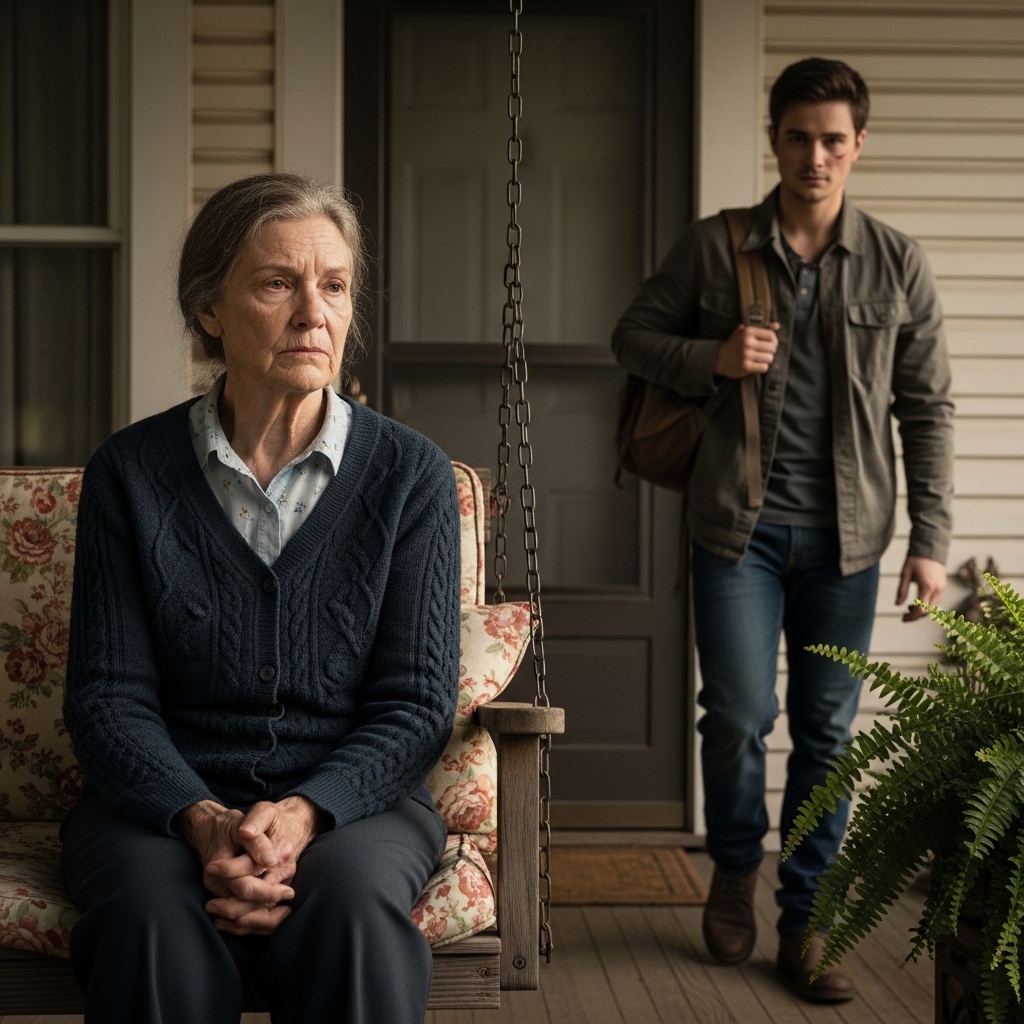
That afternoon, there was a knock at the door.
My hands trembled as I walked across the living room.
When I opened it, I forgot how to breathe.
He stood there—taller than me now, broad-shouldered, no longer a boy but a young man. But his eyes were the same.
He stepped inside and wrapped his arms around me before I could even speak.
Then he broke down.
The kind of crying that comes from years of holding everything inside.
I held him just as tightly, afraid that if I let go he might disappear again.
“I thought about you every day,” he whispered.
I assumed he had come for a visit. Maybe a weekend. Maybe just a few hours.
But then he pulled back and looked at me with a quiet certainty.
“You will always be my favorite person in the world,” he said softly. “The one I love and respect more than anyone.”
Before I could answer, he placed something cold into my palm.
A set of keys.
“I’m eighteen now,” he explained. “I can decide where I live. And I want to live with you.”
I stared at him, trying to understand.
He smiled through his tears.
“I rented us a house,” he said. “It has an elevator. No stairs. I remember how hard the steps were for you.”
My knees almost gave out.
“How did you manage that?” I asked.
He shrugged lightly.
“I saved everything Mom gave me. Allowance. Birthday money. Holiday gifts. I’ve been planning this for years.”
“For years?” I whispered.
“I always knew I’d come back,” he said.
In that moment, my heart—broken for six long years—finally began to heal.
Now we have this one precious year before he leaves for college.
We cook dinner together like we used to. We sit on the couch watching the old cartoons he loved as a child. Late at night we talk about the years we missed—the good memories, the difficult ones, and everything in between.
There are still gaps in our story. Years that can never be returned.
But we are filling the present with as much love as we can.
Sometimes I catch him standing quietly in the kitchen or sitting in his old room, as if reminding himself that it’s real.
And sometimes I simply watch him—the thoughtful, kind young man he’s become—and feel something stronger than the pain we endured.
Time can separate people.
Distance can stretch love thin.
Circumstances can steal years away.
But nothing—not law, not pride, not force—can erase the bond built through lullabies, scraped knees, and unconditional devotion.
He may have been taken from my home.
But he was never taken from my heart.
And now, finally, he’s home again.