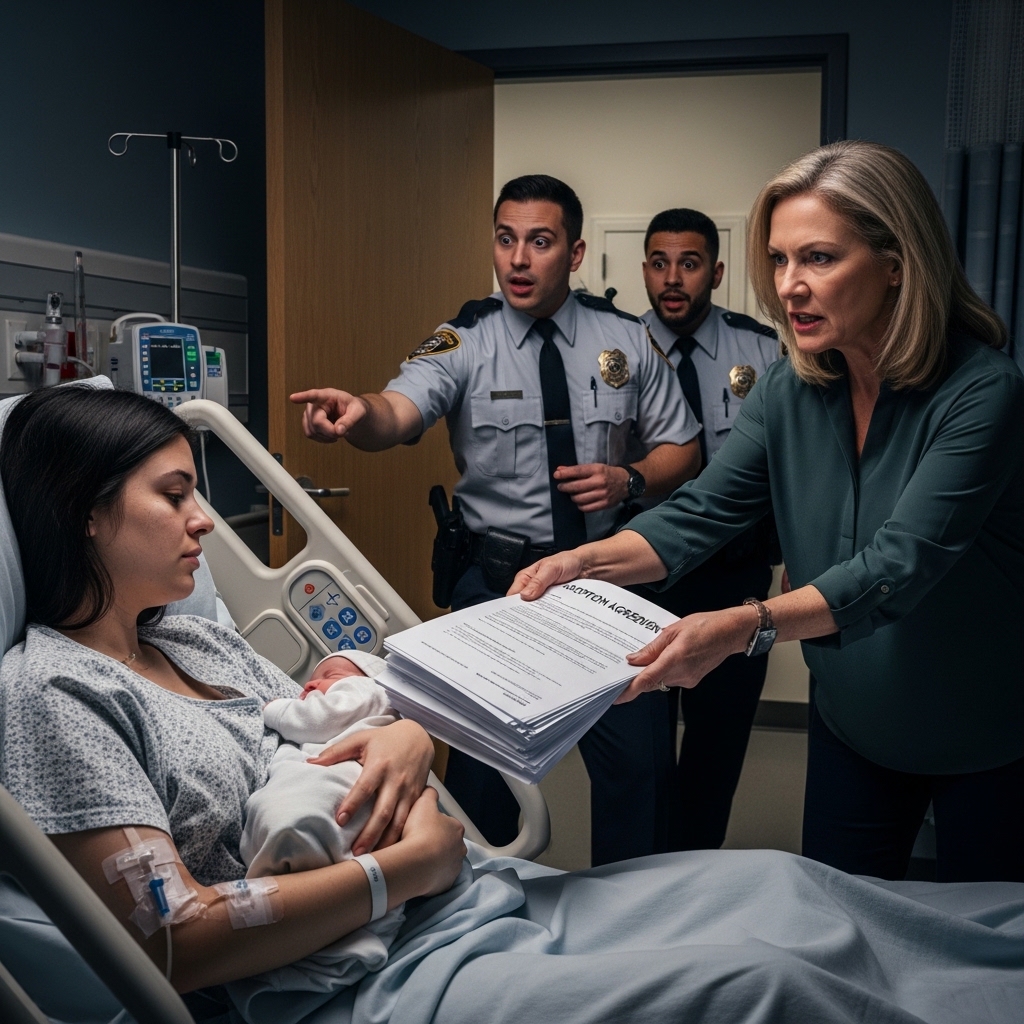
I never told my mother-in-law I was a federal judge. To her, I was just Elena Brooks—an unemployed “freelancer” living off her son’s money. Hours after my emergency C-section, she stormed my VIP recovery suite with adoption papers, demanding I hand over one of my twins to her infertile daughter. “You can’t raise two anyway,” she sneered. I hit the emergency button. Security rushed in; she screamed I was unstable. They nearly restrained me—until the chief looked at my face, froze in recognition, and everything changed.
The suite at St. Jude Medical Center felt more like a luxury suite than a hospital room: soft gray walls, Egyptian cotton sheets, floor-to-ceiling windows framing Boston’s evening glow. I’d quietly asked nurses to remove sender cards from the flowers—orchids from the U.S. Attorney’s Office, roses from Senator Whitmore, lilies from the Chief Justice. To my husband’s family, I remained simply a stay-at-home “consultant.”
My real name: The Honorable Elena Brooks-Vance, United States District Judge, Southern District.
I’d kept it hidden deliberately. After an exhausting C-section, every breath pulled at my stitches, but holding Leo and Luna—tiny, perfect, sleeping beside me—made the pain fade.
Then the door flew open.
Margaret Sterling entered in her fur coat, heels clicking like judgments, reeking of expensive perfume and entitlement. She ignored the babies, eyes sweeping the room.
“A VIP suite?” she snapped, kicking the bed foot hard enough to jolt my incision. “My son slaves away while you waste his money on silk and room service? Unbelievable.”
“My insurance covers it,” I said evenly.
She laughed mockingly. “Insurance? From your little ‘blogging’ or fake consulting? You contribute nothing. Mark pays for everything.”
Ironically, the mortgage came from my federal salary. I stayed silent.
Until she pulled folded papers from her purse and tossed them on my table.
“Sign these.”
Voluntary Termination of Parental Rights.
“Karen can’t have children,” Margaret said icily. “She needs a son to carry the Sterling name. Keep the girl. Give Leo to her. Logical—you won’t handle two.”
The room shrank to those papers and my newborns’ soft breaths. Leo’s mouth twitched in sleep; Luna’s fingers flexed gently. They were so fragile, so new—and she spoke of them like assets to reassign.
“Get out,” I said, voice steady despite the fury rising.
Margaret smiled condescendingly. “Don’t complicate this. We’re offering a solution. Be grateful.”
I glanced at the empty doorway, expecting Mark—my husband, who’d held my hand in surgery and promised safety. No sign. Just Margaret’s certainty.
She leaned in, voice low and vicious. “You have no real job, Elena. You don’t understand raising kids. Karen does. Our family does. This benefits everyone.”
The lie hung thick. She knew only the diminished version of me she’d invented: dependent, controllable.
My thumb pressed the emergency button before conscious thought finished. A soft click—and seconds later, nurses burst in, followed by security moving with practiced urgency.
Margaret spun, voice shifting to concern. “She’s unstable—confused from anesthesia. Refusing help, making wild accusations.”
An officer eyed me, the papers, Margaret. His hand rested near the rail, weighing stories.
“I’m fine,” I said clearly. “She’s coercing me to sign away parental rights. Remove her.”
Margaret’s mask slipped for a flash. “She’s lying—punishing us. She’s hysterical.”
I wasn’t hysterical. Pale, stitched, exhausted—but fully aware. Pain doesn’t equal instability, though it’s convenient to pretend.
The officer hesitated. “Ma’am, we may need to—”
“Do not touch her,” a deeper voice commanded.
The chief of security entered—older, broad, authoritative. His gaze swept: paperwork, bassinets, IV, Margaret’s coat, my bracelet.
Then he met my eyes and froze.
Recognition hit—not fear, but respect.
“Judge Brooks-Vance?” he asked, tone shifting to precise deference.
Silence blanketed the room.
Margaret’s mouth gaped wordlessly.
A nurse’s eyes widened, connecting the elite flowers to my hidden identity.
I nodded once. “Yes.”
The chief turned instantly. “Escort Ms. Sterling out. Now. Notify administration.”
Margaret retreated a step. “This is outrageous—I’m family!”
“Not here,” the chief said flatly.
She tried rallying the nurses. “She’s manipulating—”
“Ma’am,” a nurse cut in firmly, “lower your voice. You’re upsetting the patient.”
The word patient stripped her power. She was escorted out protesting, heels echoing down the hall. The door closed. The room breathed again.
A nurse approached softly. “Are you okay, Judge?”
“I’m okay,” I said. Then honestly: “I will be.”
Mark arrived minutes later, breathless, eyes wild. He saw the papers and paled. “Mom brought—she—”
“You didn’t stop her,” I said plainly.
“I was parking—I didn’t know—”
“She doesn’t act without your tacit approval,” I replied. “You’ve let her bully people forever.”
He flinched. The babies stirred innocently.
The chief offered: “Administration’s coming. Want a no-contact order filed?”
“Yes,” I said. “For this room, the babies, any unit we move to.”
Mark swallowed. “Elena, can we talk—”
“We are,” I said. “You listen.”
Administration arrived: advocate, manager, counsel. They documented, photographed the papers, took statements. Margaret’s private coercion became official record.
Later, the chief confirmed she’d been trespassed—no return without police.
Mark sat by the window, defeated. “I didn’t know she’d go this far.”
“That’s the issue,” I said quietly. “You never want to see.”
“Why didn’t you tell my family who you are?” he asked.
“Because I wanted love without leverage,” I answered. “And your mother sees titles as weapons.”
His shame showed, but shame isn’t action.
Next morning, still aching, I called my U.S. Marshals judicial safety liaison. Calmly reported coercion attempt involving minors in a medical setting. Asked for guidance and records—not vengeance.
Protective notes added to my file. Staff briefed. Visitors restricted.
Mark finally texted his mother plainly: You are not welcome near Elena or the twins. No contact. No appearances.
Her rage bounced back to him.
Three days later, holding Leo while watching Luna breathe, clarity settled—not victory or bitterness, just truth.
I’d maintained an illusion for peace with people who never offered it.
The illusion shattered. The air felt cleaner.
The chief’s recognition sparked the change, yes.
But what truly shifted everything was my own recognition: what kind of family this was, and what kind of mother I would be.
Protective. Unapologetic. Clear.
The moment I stopped pretending normalcy, pretending became impossible for them too.
What do you think—would you have kept your power hidden that long, or revealed it sooner? Share below, and pass it on if this resonated. These stories remind us: hidden strength often reveals itself exactly when needed most.
If this gripped you, check out more on the site—like the wife who flipped betrayal into unbreakable boundaries. Empowerment stories keep trending for a reason.