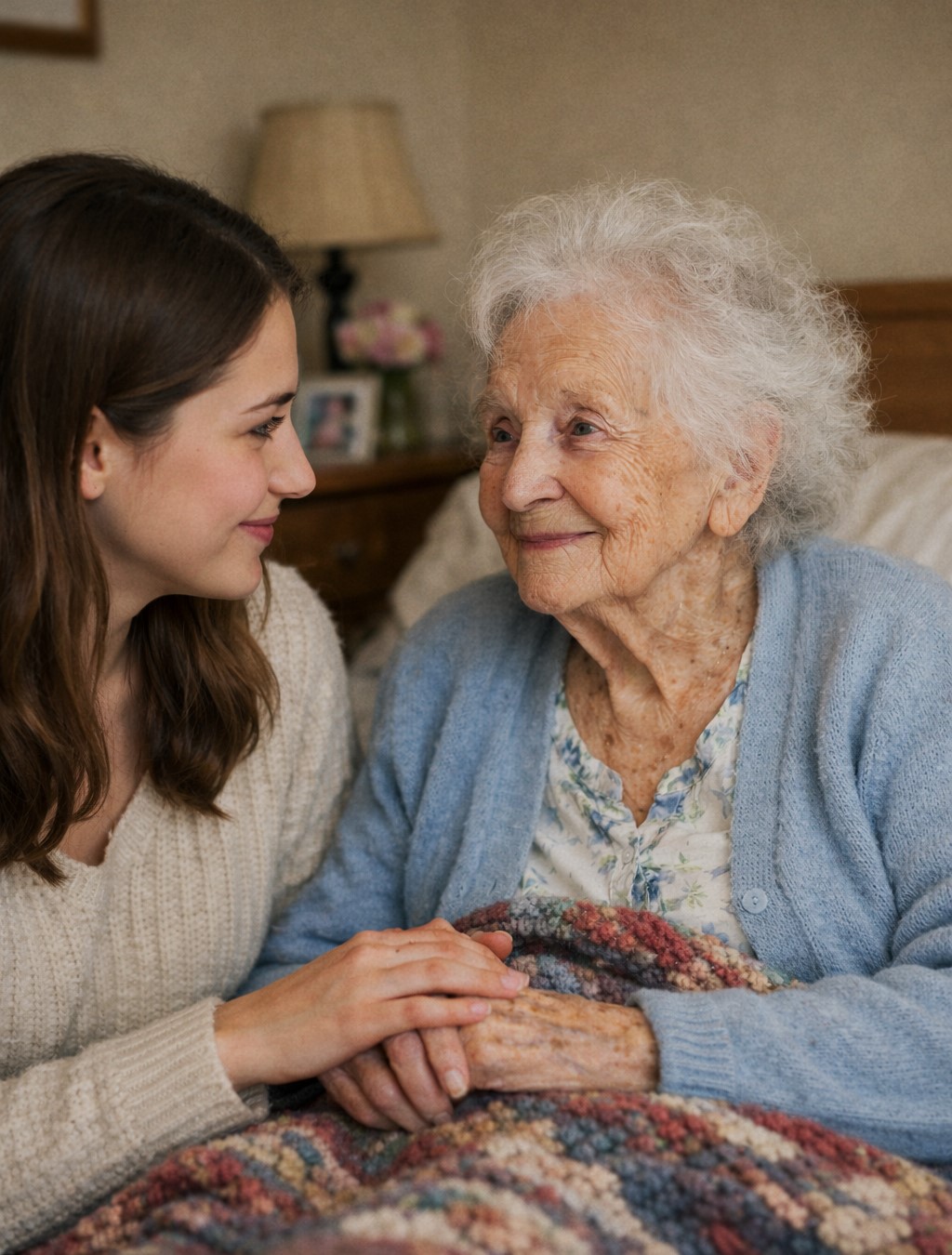
Every Thursday afternoon, after my last college class, I drove about ten minutes out of town to a small brick care home with peeling white shutters and a garden that tried its best to look cheerful.
That’s where I met Ruth.
She was eighty-four—tiny and gentle, with clouded blue eyes and thin silver hair that framed her face like a soft halo. The first time I stepped into her room, she looked up from the knitted blanket resting in her lap and smiled as if she had been waiting for me all day.
“Claire,” she whispered, her face brightening. “You’re late.”
I froze.
“I’m sorry, I think you—”
Before I could finish, a nurse standing beside me lightly touched my arm and shook her head.
Later, in the hallway, she explained quietly.
“Her daughter Claire passed away many years ago. Ruth has advanced dementia. She gets confused sometimes. It’s usually kinder not to correct her.”
So the following week, when Ruth reached for my hand and said, “Claire, do you remember the lake house? You were always afraid to walk on the dock,” I didn’t argue.
“I remember,” I said gently.
And from that moment on, I became Claire.
Each visit felt like stepping into someone else’s memories. Ruth would tell stories about “our” camping trips, how I used to braid her hair before church, how one Christmas we burned a batch of cookies and blamed the oven.
Sometimes her memories were vivid and detailed, full of laughter and warmth. Other times they faded halfway through her sentences, dissolving into confusion.
But every time she looked at me, there was relief in her eyes—like something inside her had been temporarily repaired.
Once, early on, I made the mistake of gently saying, “Ruth, I’m not really Claire.”
Her face fell instantly.
“You’re not?” she whispered. “Then where is she? Why hasn’t she come?”
The heartbreak in her voice hit me like a blow.
That night, I cried in my car for nearly an hour.
After that, I never corrected her again.
If being Claire gave her peace for even an hour, then I could be Claire.
For six months, every Thursday afternoon became our ritual.
Sometimes we sat by the window while she told stories about a lake house I had never seen. Other times we simply held hands while she hummed old songs under her breath.
Those quiet moments became strangely important to me.
Then one morning, I received a call from the care home director.
Ruth had passed away peacefully in her sleep.
I hadn’t expected the grief to hit me so hard.
She wasn’t my grandmother. She wasn’t even someone who knew my real name.
And yet… she had held my hand like it meant something.
I went to the funeral.
The service was small, held in a modest chapel filled with pale flowers and soft organ music. A simple wooden casket rested at the front.
I stood near the back, unsure if I truly belonged there.
After the service ended, a tall man in his fifties approached me. His eyes were red but warm.
“You must be the volunteer,” he said softly. “Mom talked about you. Or… she talked about Claire.”
My throat tightened.
“I’m very sorry for your loss.”
He nodded slowly, then reached into his jacket pocket.
“There’s something I want to show you.”
He handed me a slightly worn photograph.
The date written on the back read 1982.
In the picture stood a young woman about my age. Her blonde hair fell loosely over her shoulders. She had a familiar crooked smile—and a faint dimple in her left cheek.
My stomach dropped.
She looked like me.
Not exactly. But enough that it felt unsettling, like seeing a distant relative… or a reflection from another time.
“That’s my sister,” he said quietly. “Claire.”
I stared at the photograph, my hands trembling slightly.
“She died in a car accident when she was nineteen,” he continued. “The same age you are now.”
Nineteen.
The number echoed in my head.
“My mom never really recovered,” he said gently. “She kept living. She smiled. But something inside her was always broken.”
Then he studied my face carefully.
“When you started visiting, the nurses told me she thought you were Claire. At first I didn’t know what to think. But they also said you never corrected her. That you listened to her stories. That you held her hand.”
Tears burned behind my eyes.
“I didn’t mean to mislead her,” I said quickly. “They just told me it was kinder not to.”
He nodded.
“You gave her something we couldn’t,” he said softly. “For a little while, she believed her daughter had come back. She was calmer on the days you visited. She slept better. She smiled more.”
His voice faltered.
“You became her peace.”
I looked down at the photograph because I couldn’t hold his gaze anymore.
All those Thursdays.
All those borrowed memories.
The lake house. The burnt cookies. The braided hair.
I had thought I was simply volunteering—filling an empty hour for someone lonely.
But somehow, without realizing it, I had stepped into a space grief had carved out decades earlier.
“I hope it wasn’t too strange for you,” he added gently.
Strange.
Yes, it had been strange—being called by another name, becoming part of someone else’s memories, being loved for reasons that weren’t mine.
But it had also been something else.
Something meaningful.
“I don’t think it was an accident,” I said quietly, surprising myself. “That we looked alike.”
He gave a small, sad smile.
“My mom used to say God had a strange sense of humor.”
For a moment we stood there in silence—two strangers connected by a woman who had loved deeply and lost unbearably.
When I handed the photograph back, a realization settled in my chest.
For six months, Ruth hadn’t truly seen me.
But she had felt her daughter’s presence.
And maybe that was enough.
On the drive home, I kept thinking about identity—how fragile it can be, how easily memory reshapes reality when love refuses to fade.
I had walked into that care home as a college student simply hoping to do something good.
But I walked out of Ruth’s life carrying something much heavier.
A piece of grief that had waited decades for comfort.
I wasn’t Claire.
But for a little while, I had been the shape of her hope.
And somehow, that feels like the most important role I’ve ever played. 💙