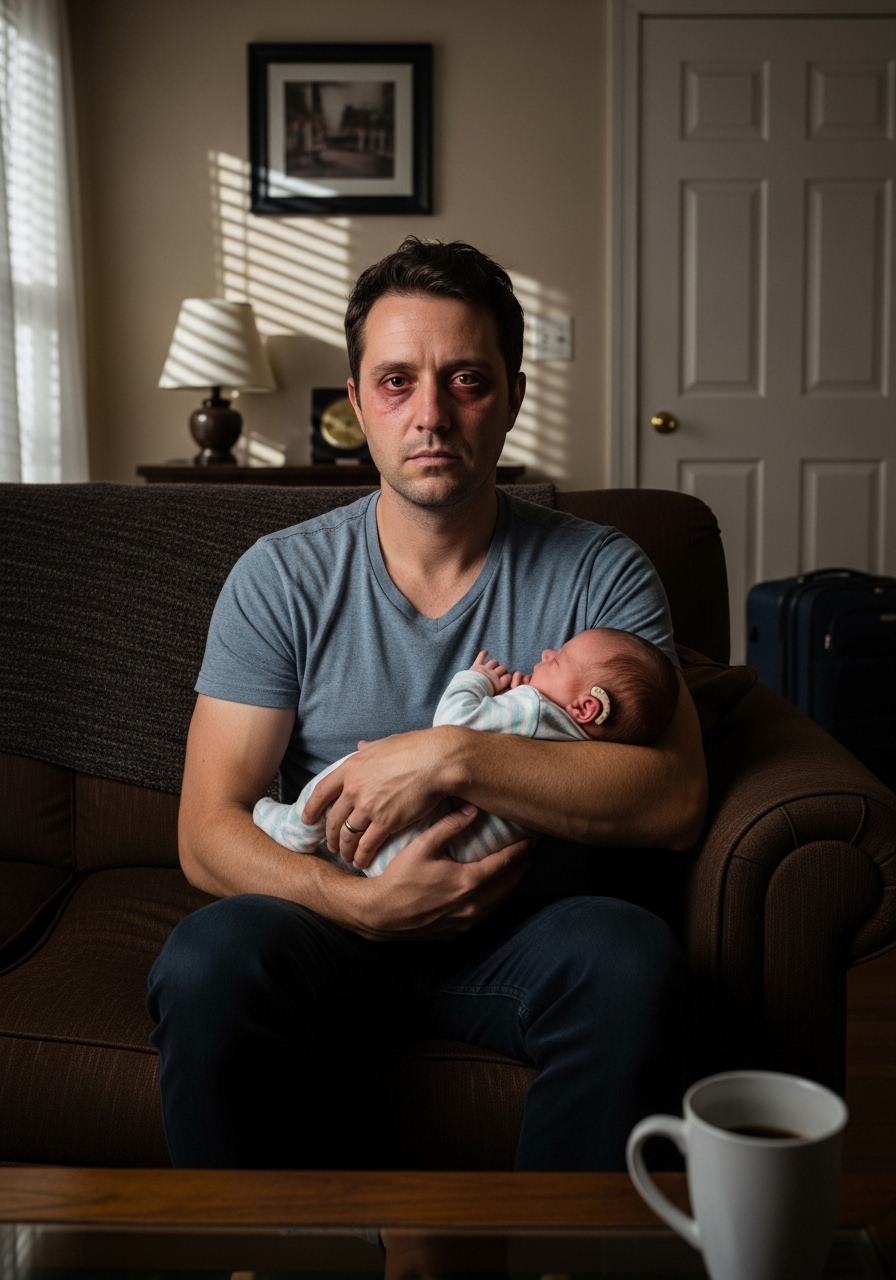
The sound of the door closing behind her is still clearer in my memory than my son’s first cry.
It was a sharp, final thud that echoed through our small apartment like a judge’s gavel.
Three days earlier, our son Noah had been born. The hospital room still smelled faintly of antiseptic and newborn powder when the doctor delivered the news.
He knelt beside our bed, speaking gently.
“Your son has profound hearing loss,” he explained. “But he’s healthy in every other way. With hearing aids, sign language, and early support, he can live a full, successful life.”
I squeezed my wife Elena’s hand.
“We’ll do everything he needs,” I said. “Right, honey?”
She pulled her hand away and stared at the baby in the crib.
“Thrive?” she whispered bitterly. “He can’t even hear us. This isn’t what I imagined.”
My stomach tightened.
“Elena… he’s perfect. He’s our son.”
Her face hardened.
“I can’t do this, Mark.”
Before I could react, she stood up. A suitcase sat beside the door — packed without my noticing.
“What are you doing?” I asked, panic rising.
“I didn’t sign up for this,” she said coldly. “A deaf child means therapies, stares, explanations… a broken life.”
“He isn’t broken!” I shouted. “He’s our child!”
But she only shook her head.
“You can keep the charity case.”
Then she walked out.
The door clicked shut behind her.
And just like that, she was gone.
Noah stirred in my arms, completely unaware of what had just happened.
His tiny blue eyes — the same shade as his mother’s — blinked up at me.
I sank to the floor, whispering lullabies he couldn’t hear.
Terrified didn’t even begin to describe what I felt.
I was a landscape architect with rough hands and absolutely no experience raising a baby alone — let alone a deaf one.
But there was no choice.
So I learned.
I enrolled in night classes for sign language, often arriving exhausted after sixteen-hour workdays. My fingers fumbled through signs while Noah cried silently in his crib at 3 a.m.
Money was tight.
Freelance jobs barely kept the lights on.
And when Noah started school, the challenges only grew.
Some administrators didn’t even try to hide their doubts.
“He’ll slow the other students down,” one said.
I fought them every step of the way.
And Noah proved them wrong every time.
He was brilliant, curious, and stubborn in the best way possible.
Over the years he taught me something powerful:
Silence isn’t emptiness.
It’s its own language.
Birthdays passed without Elena.
School events came and went without her applause.
When Noah was younger, he sometimes asked where his mother was.
By the time he turned eight, he stopped asking.
I never forced the conversation.
Some wounds heal better in quiet.
Twenty years later, Noah stood tall on a graduation stage.
Confident.
Independent.
Kind.
Everything Elena once believed he could never be.
I thought that chapter of our lives was closed forever.
But I was wrong.
One rainy evening, the doorbell rang.
When I opened the door, my heart nearly stopped.
Elena stood there.
She looked older but unmistakably the same — sharp eyes, confident posture.
“Mark,” she said, as if twenty years had been twenty days. “Let me in.”
I blocked the doorway.
“Elena? After two decades?”
Without answering, she shoved a stack of papers toward me.
“I’m back,” she said calmly. “And I have a demand.”
I stared at her in disbelief.
“Noah’s success,” she continued, “belongs to me too. I want half.”
I laughed bitterly.
“You abandoned us,” I said. “Get out.”
But she stepped inside anyway, water dripping from her coat onto the floor.
She looked around the house as if evaluating property.
“Nice place,” she said.
“What do you really want?” I asked.
She sat down heavily on the couch.
“I’m sick.”
My anger paused.
“Cancer. Stage three.”
The room went quiet.
“I want my son,” she continued. “He should move in with me and take care of me. It’s his duty. I gave birth to him.”
I stared at her, stunned.
“Duty?” I said slowly. “You called him defective and walked away.”
“People change,” she replied coolly. “And legally, I still have rights.”
My stomach turned.
“What do you mean?”
She tapped the documents.
“My lawyer says you isolated him from me. I deserve another chance. If Noah refuses, I’ll take this to court.”
“Get out,” I said, opening the door.
She smirked.
“See you in family court.”
The case moved quickly.
In court, Elena played the victim perfectly.
She cried on the stand, describing herself as a young, frightened mother overwhelmed by circumstances.
“I regretted leaving every single day,” she told the judge. “But Mark kept my son away from me.”
Some people in the gallery even looked at me with sympathy for her.
Then the judge turned to Noah.
“You’re twenty years old,” she said. “I want to hear from you.”
My heart pounded as Noah stood.
He raised his hands and began signing.
The interpreter beside him spoke his words aloud.
“Your Honor,” she said, “my mother left when I was three days old.”
The courtroom grew silent.
“As a child, I used to sit by the window and ask my dad if she was coming back.”
Elena leaned forward quickly.
“Noah, baby—”
But he didn’t look at her.
“My father worked sixteen-hour days,” he continued through the interpreter. “Then stayed up late learning sign language so he could tell me things like ‘I love you.’”
The gallery murmured softly.
“He fought teachers who said I couldn’t succeed,” Noah signed. “He believed in me when no one else did.”
Elena’s lawyer jumped up.
“Objection!”
“Overruled,” the judge said firmly. “Continue.”
Noah took a slow breath.
“She didn’t abandon a deaf baby,” he signed clearly.
“She abandoned a human being.”
The words landed like thunder.
“My father stayed for every fever, every challenge, every victory. Alone.”
Elena suddenly stood.
“That’s not true!” she cried. “I gave you life! You owe me!”
The judge slammed her gavel.
“Sit down.”
Noah signed one final sentence.
“Love isn’t a debt.”
Then he added softly:
“Goodbye.”
The judge barely paused.
“This court rules in favor of Noah. There will be no financial obligations and no forced relationship. Case dismissed.”
Elena exploded in anger as bailiffs escorted her away.
“This isn’t over!” she shouted.
But for us, it was.
That night, Noah and I sat on our porch like we had many times before.
Two beers.
A quiet sky.
After a long silence, he squeezed my shoulder.
“You were enough, Dad.”
My throat tightened.
“Couldn’t have done it without you,” I signed.
He smiled.
“I got an offer today,” he said. “GreenScape Architecture. They want me designing inclusive parks.”
I laughed proudly.
“Like father, like son.”
He nodded.
“No barriers. No limits.”
For the first time in twenty years, I felt completely at peace.
Because love doesn’t come back with demands.
It stays.
And it endures.