I used to believe that “home” was something you outgrew.
I left mine at eighteen with a scholarship, a suitcase, and a promise to never look back. I built a life in airports and conference rooms, where success was measured in promotions and frequent-flyer miles. By thirty-one, I was a Regional Director in Frankfurt. People didn’t ask if I was happy. They asked if I was available.
I was always available.
Until the phone rang.
“It was a stroke,” Aunt Karen said gently. “There was nothing they could do. She didn’t suffer.”
My mother was gone.
The House That Still Smelled Like Her
I don’t remember the flight home. I remember counting breaths. I remember gripping the armrest until my fingers ached.
When I pulled into the driveway of my childhood home, the porch light was still on — even though it was noon. My mother’s green raincoat hung crookedly by the door, exactly where she always left it.
For a moment, I couldn’t move.
Inside, everything looked smaller. Aunt Karen had already filled the kitchen with casseroles and lemon bars — my mother’s favorite. She tried to feed me, tried to talk, tried to keep things normal.
“Always the strong one,” she murmured.
Someone had to be.
The Woman Who Wasn’t Mourning
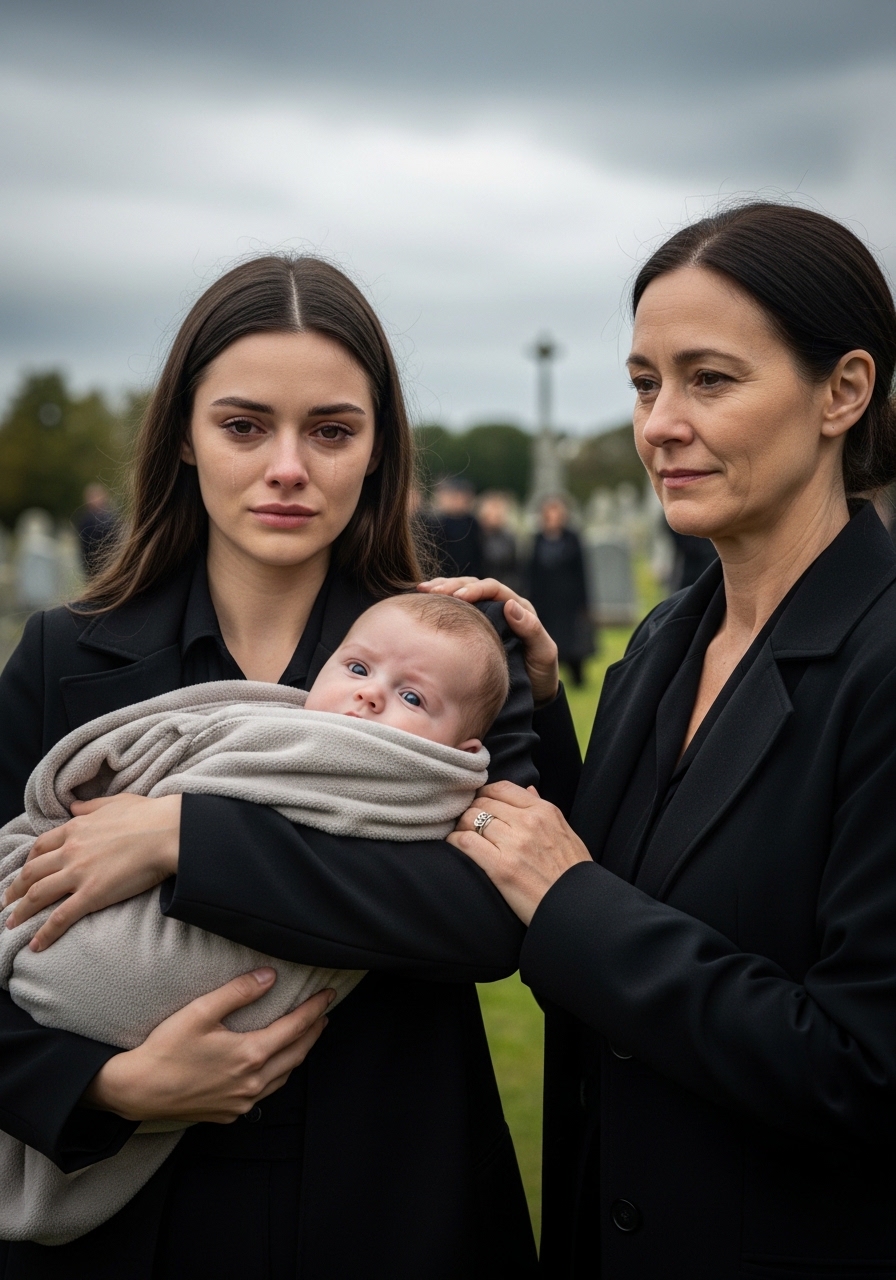
At the cemetery, people moved past me in soft waves of sympathy. I nodded, accepted hugs, barely heard the pastor’s words about sacrifice and devotion.
Then I noticed her.
A woman with tangled blonde hair stood a few rows back, holding a baby boy. She wasn’t looking at the casket.
She was looking at me.
Her gaze wasn’t curious. It was urgent.
I tried to ignore her.
When the coffin began to lower, she stepped forward.
Before I understood what was happening, she placed the baby into my arms.
“She wanted you to have him,” she whispered.
The Weight of a Stranger
The boy — warm, solid, real — gripped my necklace with sticky fingers and buried his face in my shoulder.
My body reacted before my mind did. I held him.
“What are you doing?” I hissed.
“I’m Brittany,” she said quickly. “Your mom’s neighbor. I helped her with fostering paperwork. This is Lucas.”
Fostering.
The word felt foreign.
“My mother never told me she was fostering a child.”
“She didn’t want to burden you,” Brittany replied. “But she asked that if anything happened… you’d step in.”
The ground shifted beneath me.
Apparently, my mother had been caring for Lucas because his mother couldn’t. Apparently, there had been meetings. Paperwork. A plan.
And apparently, I was the final step in that plan.
A Secret Written in Ink
Later, back at the house, I found the letter.
It was taped inside a kitchen cabinet, my name written across the envelope in her careful handwriting.
“Please don’t be angry,” it began.
“I wanted you to have a life that wasn’t heavy. But Lucas deserves stability. If something happens to me, give him a chance.”
Give him a chance.
I slid to the kitchen floor and cried for the first time that day — not just for my mother, but for the realization that she had been carrying a world I never bothered to see.
The Mother Who Was Still There
That evening, the doorbell rang.
Lucas’s biological mother stood on the porch — pale, exhausted, eyes rimmed red.
Her name was Carly.
She didn’t storm in. She didn’t argue. She just looked at her son like he was oxygen.
“I’m trying,” she said, voice breaking. “I just needed to see him.”
The anger I expected never came. What I saw instead was fear. Shame. Love tangled up with mistakes.
“I’m not taking him from you,” I told her. “I’m making sure he’s safe while you get back on your feet.”
Carly cried openly then. Not dramatic. Not manipulative. Just human.
It wasn’t about replacement.
It was about protection.
The Choice
After everyone left, the house grew quiet.
Lucas slept against my chest, his small hand fisted in my sweater. He smelled like baby shampoo and something sweeter I couldn’t name.
Aunt Karen stood in the doorway. “What about Frankfurt?”
I looked around the living room — at my mother’s faded curtains, at the framed photos of birthdays I had missed.
“My job will replace me,” I said slowly. “He won’t.”
And in that moment, the decision felt less like sacrifice and more like clarity.
What Family Really Means
I thought family was something you graduated from.
Something you honored on holidays and called once a week out of duty.
But holding Lucas that night, I understood what my mother had tried to show me without saying it outright:
Family isn’t about convenience.
It’s about showing up when it’s hardest.
My mother hadn’t trusted me because I was perfect.
She trusted me because she knew, beneath the polished career and the distance, I still had her heart.
And maybe she was right.
Lucas stirred in his sleep. I brushed the hair from his forehead and whispered, “We’re going to figure this out.”
For the first time in years, I wasn’t thinking about quarterly targets or flight schedules.
I was thinking about tomorrow morning — about bottles, and diapers, and court appointments, and the long road ahead.
It terrified me.
But it also felt like home.
And this time, I wasn’t running from it.