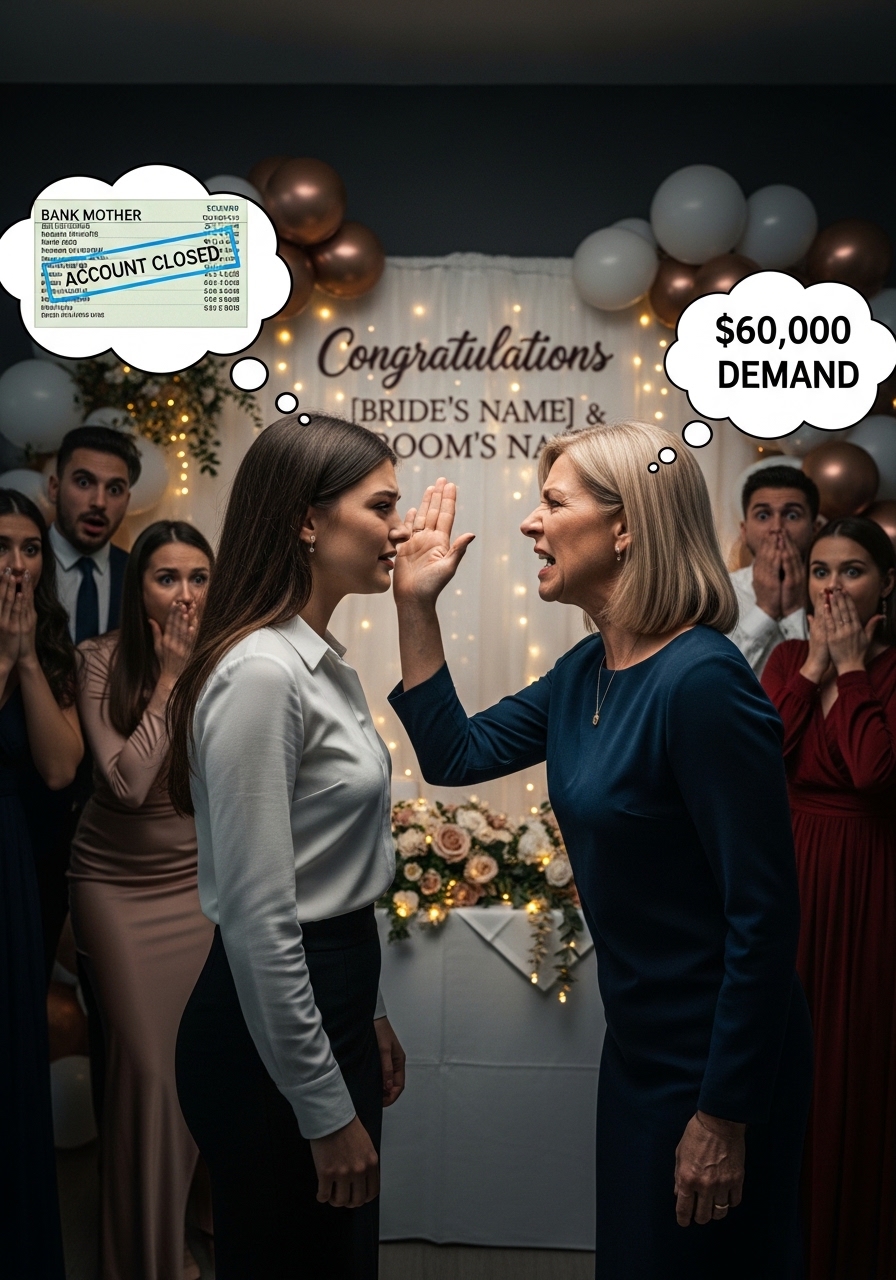
At my engagement party, my mother demanded I hand over the $60,000 settlement my father left me to my sister. When I refused, she slapped me in front of everyone like I was a disobedient child.
I stood up, looked her in the eye, and said calmly, “Now it’s your turn to lose everything.”
The room fell silent.
But she didn’t care.
She slapped me again—harder.
And that’s when I smiled.
Because she had no idea what I’d already done.
The room glowed with fairy lights and champagne. Friends, coworkers, and Ethan’s parents filled the space with warm chatter. The cake looked perfect. The playlist hummed softly in the background.
For a few minutes, I let myself believe I could have a normal beginning.
The first toast had barely ended when my mother appeared beside me, smiling like we shared a secret.
She looked polished as always—hair pinned perfectly, lipstick precise, laughter ready. My mother has always been excellent at looking like someone people should trust.
“Natalie,” she said quietly, leaning close, “we need to talk about the fund.”
My throat tightened.
Not because I didn’t know what she meant—but because I knew exactly where this was going.
The $60,000 wasn’t a mystery. It was the settlement from the car accident that killed my dad when I was nineteen.
I had never spent it.
For years it stayed in a separate account, untouched. Ethan and I planned to use it as a down payment after the wedding.
It wasn’t “extra money.”
It was the last thing my father left that didn’t feel like grief.
My mother’s hand clamped around my arm.
“Your sister needs it more than you do,” she whispered. “Chloe is drowning. You’re stable. You have Ethan. You can rebuild.”
There it was—the family math that never made sense.
Chloe makes a mess.
Natalie cleans it.
Chloe burns bridges.
Natalie becomes the bridge.
I glanced across the room at my sister.
She was laughing loudly, her wineglass already half empty, her designer purse hanging off her chair like a trophy.
She’d been “drowning” for ten years—credit cards, layoffs, impulsive moves, broken relationships.
And somehow it always became my problem.
When she noticed me looking, she lifted her glass in a small toast, like my money already belonged to her.
“I’m not giving her Dad’s money,” I said.
My voice was calm, but my chest burned.
Because that money wasn’t a number to me.
It was a midnight phone call.
A closed casket.
The empty seat at my graduation.
My mother’s smile didn’t move, but her eyes hardened.
“Don’t embarrass me tonight.”
Not “Are you okay?”
Not “Why do you feel that way?”
Just embarrassment.
Family, to her, was always a performance—and she expected me to keep the lighting flattering.
I tried to walk away.
She followed.
“You owe this family,” she hissed, still smiling for the guests. “If you don’t transfer the money by Monday, I’ll tell everyone what you really are.”
My heart slammed once.
“What I really am?” I asked.
Her gaze flicked toward Ethan, his parents, and the guests nearby.
“Selfish,” she said coldly. “Ungrateful.”
For a moment, I felt nineteen again—small and stunned.
Then something inside me snapped into place.
“Stop,” I said.
Not a plea.
A boundary.
She ignored it.
“Natalie,” she said louder now, just enough for nearby guests to hear, “don’t make this difficult. Help your sister.”
The nearby conversations slowed.
People were starting to watch.
I felt the old pressure—the one that used to make me fold.
The one that made me pay Chloe’s rent. Fix her credit cards. Cover her “emergencies.”
But something in me was different now.
Peace that requires surrender isn’t peace.
It’s silence.
“No,” I said clearly. “I’m done.”
The words felt solid.
For a second my mother looked stunned, like the script had changed.
Then her hand flashed.
The slap cracked across my face.
The room froze.
Someone gasped.
Ethan stepped forward instantly, anger flashing across his face.
I touched my cheek, shocked more by the audacity than the pain.
My mother stood there breathing hard, eyes bright, as if she’d won something.
That’s when I understood.
She wasn’t losing control.
She was trying to force it back.
So I stood up straight and spoke loud enough for everyone.
“Now it’s your turn to lose everything.”
Her face twisted with outrage.
Then she slapped me again—harder.
This time I tasted blood.
Behind her, Chloe made a small nervous laugh, unsure whether to enjoy the moment or fear it.
But I didn’t stumble.
Because earlier that morning, I had already ended her control.
Before the party, Ethan and I had sat at the kitchen table making calls I should have made years ago.
I moved the $60,000 into a new account at a bank my mother didn’t know about.
I removed her as my emergency contact.
I froze my credit.
I drafted a letter with a lawyer stating clearly: no more loans to Chloe. No more financial help. No more demands disguised as “family.”
On Monday, I wasn’t sending the money.
I was locking it away permanently.
When my mother raised her hand again, Ethan stepped between us.
“Do not touch her again,” he said calmly.
Then he added, “You need to leave.”
My mother tried to shift the narrative instantly.
“Look what she’s doing to me!” she cried loudly.
But the room had seen everything.
Ethan’s mother touched my arm gently.
His father offered me his jacket.
My friends moved closer without making a scene.
When my mother realized no one supported her, her face hardened with rage.
Chloe spoke up, her voice slurred slightly by wine.
“You’re really ruining the night over money?”
I looked at her.
“You ruined seven years,” I said quietly.
Then I turned to my mother.
“And you taught her she could.”
Venue security eventually escorted them out while my mother hissed threats the whole way.
Ethan kept a steady hand on my back.
After they left, the party didn’t recover immediately. Guests stood in stunned groups.
Someone asked if I needed a doctor.
I shook my head.
Then I took the microphone from the DJ.
“I’m okay,” I told everyone. “I’m sorry you witnessed that. But I’m not sorry I said no.”
The room slowly exhaled.
My friend Dana started clapping.
Others followed.
Not because of the drama—but because they understood what it meant to finally set a boundary.
Later that night, Ethan drove us home.
“You were brave,” he said quietly.
I stared at the streetlights sliding past.
“I was tired,” I replied.
And that was the truth.
On Monday, my mother called exactly as expected—raging, crying, threatening to tell everyone how “ungrateful” I was.
But the money was already out of reach.
The control was gone.
And that’s what I meant when I said it was her turn to lose everything.
Not her house.
Not her life.
Her control over me.
Once I stopped paying for my sister’s chaos and protecting my mother’s image, I didn’t feel the guilt I expected.
Only grief—for the years I spent confusing obligation with love.
If you can slap your daughter in public to take money left by her dead father, you don’t need her $60,000.
You need a mirror.
And I finally stopped being the one who held it for you.