When my fourteen-year-old son, Mason, asked to live with his dad after the divorce, I said yes.
Not because I wanted to. I didn’t. I wanted him with me every day, under my roof, where I could see his face and know if something was wrong. But I didn’t want to stand in the way of a father and son trying to reconnect.
So I let him go.
I told myself it was the right thing. That giving Mason space wasn’t the same as giving him up.
I didn’t realize how quietly it would break me.
At first, everything seemed fine. Mason called often. He sent selfies and videos — burnt waffles, pizza boxes, goofy smiles with his dad, Eddie. I saved every photo. Watched every clip more times than I’d admit.
I missed him, but I convinced myself this was healthy. He sounded lighter. Happier.
Then the calls slowed.
Texts turned into one-word replies.
Then silence.
And then the calls came — from his teachers.
One emailed about missing homework.
“He says he forgot. That’s not like him.”
Another called, voice lowered.
“He seems… disconnected. Like he’s here but not really.”
Then his math teacher.
“We caught him cheating during a quiz. He looked lost.”
That word lodged itself in my chest.
Lost.
Not defiant. Not careless. Just lost.
That wasn’t my Mason. He’d always been careful, thoughtful — the kind of kid who double-checked his work and apologized for getting a B.
I called him that night. No answer. I left a voicemail. Then another.
Hours passed.
I sat on my bed staring at the last photo he’d sent — him and Eddie holding up a burnt pizza like it was a joke.
It didn’t feel funny anymore.
I called Eddie. Carefully. Calmly. Walking that tightrope divorced moms know well.
His response was a sigh. Long. Dismissive.
“He’s a teenager, Claire. You’re overthinking again.”
That word hit something old.
He used to say it when Mason was a baby — when I was exhausted and crying on the bathroom floor while Eddie slept through it all.
“Relax. He’ll be fine.”
Back then, I believed him.
Now my son was still crying — just silently — and Eddie was still pretending nothing was wrong.
And my silence had consequences.
This wasn’t a baby with reflux.
This was a boy unraveling quietly in another house.
The next Thursday, I didn’t ask permission.
I drove to Mason’s school.
Rain fell in a soft, steady drizzle as kids spilled out, laughing and dodging puddles. Then I saw him — walking alone, shoulders slumped, each step heavy.
He slid into the passenger seat without a word.
And my heart broke.
His hoodie clung to him. Shoes soaked. Backpack hanging loose. But it was his face that undid me — sunken eyes, pale lips, his whole body curved inward like he was trying to disappear.
I handed him a granola bar. He stared at it.
The heater hummed. Rain tapped the windshield.
Then he whispered, barely audible,
“I can’t sleep, Mom. I don’t know what to do.”
That was the moment I knew.
Eddie had lost his job weeks after Mason moved in. He never told anyone. He tried to keep everything looking normal — same jokes, same routines.
Behind the scenes, it was falling apart.
The fridge was often empty. The lights flickered. Mason stopped using the microwave because it made strange noises. Eddie was gone most nights.
“Job interviews,” he said.
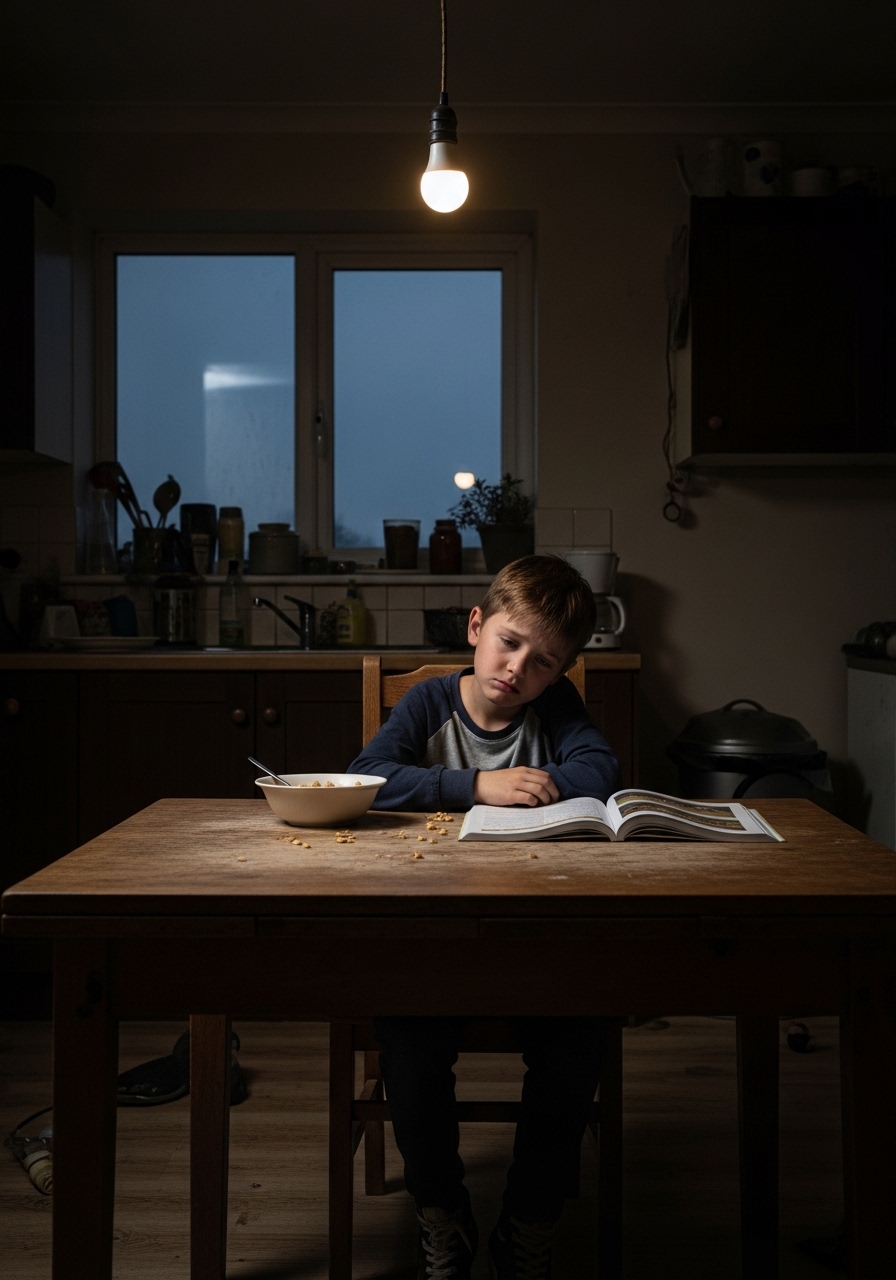
Mason ate cereal for breakfast — sometimes dry. Peanut butter for lunch. Crackers for dinner. He did homework in the dark, hoping the Wi-Fi would last long enough to submit it.
“I didn’t want you to think less of him,” Mason said. “Or me.”
He wasn’t lazy.
He was drowning.
Trying to hold his father together. Trying to protect both parents from breaking.
And I hadn’t seen it — not because I didn’t care, but because I thought staying out of it was respect.
That night, Mason came home with me. No court orders. No arguments. Just instinct.
He slept fourteen hours straight.
The next morning, he asked for his old robot mug — the chipped one.
When he asked, “Mom, can you make me something to eat?” I nearly cried.
We took things slowly.
I filed for a custody change quietly. I didn’t send him back — not until trust returned, not until Mason felt safe.
At first, he barely spoke. He drifted through the house like a ghost. I didn’t push. I just made the space soft. Predictable. Safe.
We started therapy — gently. On his terms.
I began leaving notes on his door.
“Proud of you.”
“You don’t have to talk. I see you.”
“You’re not alone.”
One morning, I found a note on my bedside table.
Thanks for seeing me. Even when I didn’t say anything. You’re the best, Mom.
A month later, he asked if he could stay after school for robotics club.
Two weeks after that, he brought home a bridge made of popsicle sticks. It collapsed instantly.
He laughed.
“I’ll build another one.”
That was my boy.
At the end-of-year assembly, they called his name.
“Most Resilient Student.”
He stood tall. Looked out at the crowd. Lifted one hand toward me — the other toward his dad, sitting quietly in the back.
Mason lives with me full-time now. His room is messy again. Alive again.
I find notes taped above his desk:
Breathe.
One step at a time.
You’re not alone.
I’ve forgiven myself for not seeing it sooner.
I know now that silence isn’t peace. Distance isn’t always respect.
Sometimes love is loud. Sometimes it shows up uninvited.
Mason didn’t need freedom.
He needed rescue.
And I’ll never regret reaching for him when he was slipping under.
Because that’s what mothers do.
We show up.
We hold tight.
And we don’t let go until the light comes back.