When my husband died, I thought grief would be the hardest thing I’d ever survive.
I was wrong.
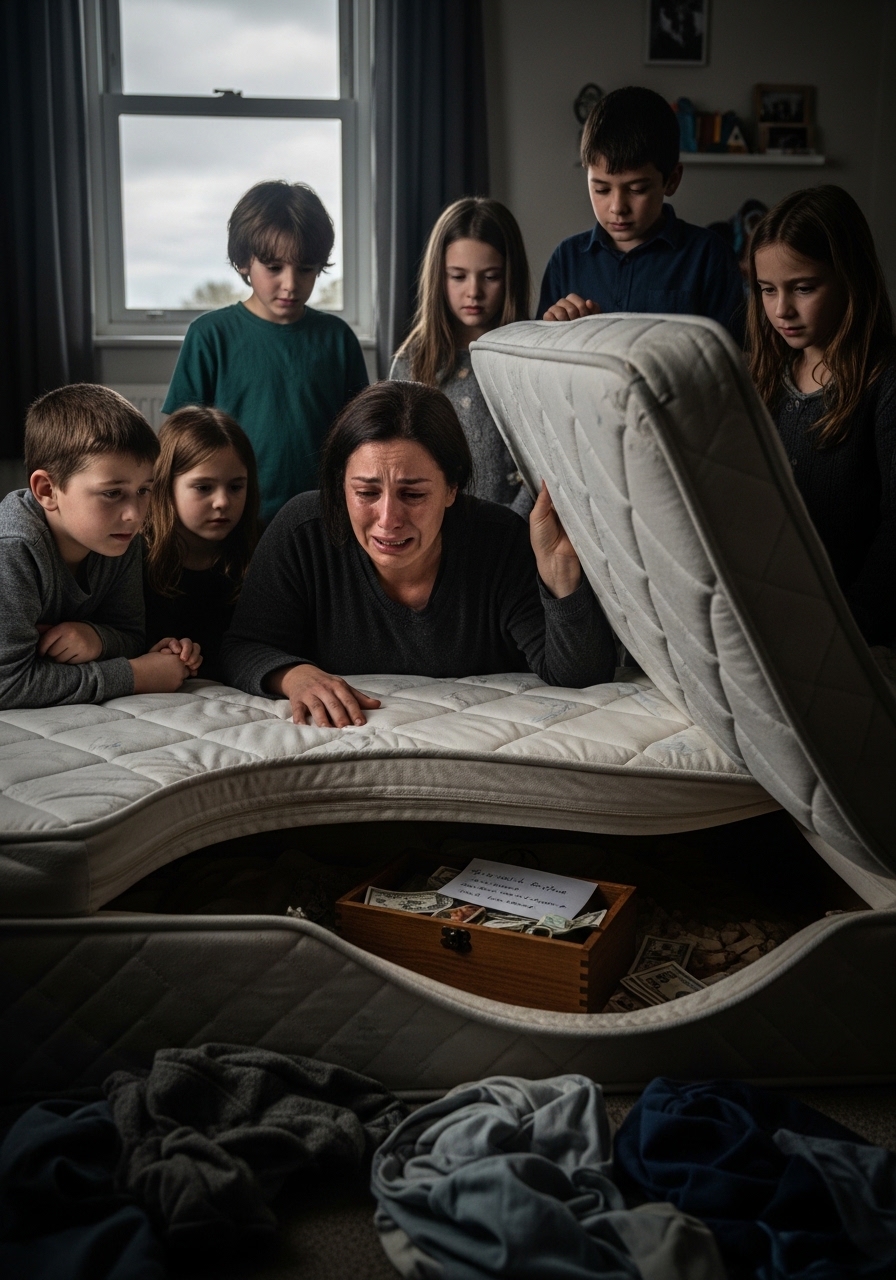
The truth came days later — hidden inside our son’s mattress — and it shattered what I believed I knew about the man I’d loved for sixteen years.
Daniel and I had been married for sixteen years when cancer took him from us.
We had six children: Caleb, ten; Emma, eight; twins Lily and Nora, six; Jacob, four; and baby Sophie, who had just turned two when Daniel passed.
Before the diagnosis, our life had felt ordinary in the best way.
Saturday mornings meant pancakes and cartoons. Daniel always flipped the pancakes too early, and Caleb would laugh, “Dad, you never wait long enough.”
Daniel would grin. “Patience is overrated.”
I used to roll my eyes — but secretly, I loved how steady he was.
He paid the bills on time. Fixed broken cabinet doors. Never forgot a birthday. He was a devoted father and a dependable husband.
Then, two years before his death, the doctor said the word that tilted our world.
Cancer.
I became the planner, the researcher, the scheduler. Daniel stayed calm in front of the kids, but at night he’d squeeze my hand and whisper, “I’m scared, Claire.”
“I know,” I’d tell him. “But we’re not giving up.”
Even on his worst days, he sat on the living room floor building Lego towers with the kids. He paused to catch his breath — but never let them see it.
I admired him. Trusted him. Believed I knew him completely.
Three weeks before I found the box, he died in our bedroom at two in the morning. The oxygen machine hummed softly beside the bed.
I pressed my forehead to his and whispered, “You can’t leave me.”
He managed a faint smile. “You’ll be okay. You’re stronger than you think.”
I didn’t feel strong. I felt like the ground had vanished beneath me.
After the funeral, I focused on survival. Packing lunches. Signing school forms. Smiling when I had to.
At night, when the house was quiet, I wandered through the rooms touching Daniel’s things. That’s when something began to bother me.
During his illness, Daniel had grown strangely protective of certain spaces. He insisted on reorganizing the attic himself, even when he could barely lift boxes.
At the time, I thought it was pride.
Now, it felt different.
Four days after the funeral, Caleb shuffled into the kitchen while I made breakfast.
“Mom, my back hurts,” he said.
“From baseball practice?”
“Maybe. It started last night.”
I checked him — no bruises, no swelling. I rubbed ointment into his lower back and told him to stretch before bed.
The next morning, he stood in my doorway, pale and frustrated.
“Mom, I can’t sleep in my bed. It hurts.”
That caught my attention.
I went into his room. The bed looked normal. I pressed down on the mattress — firm, intact. Then my palm brushed something hard beneath the padding.
Rectangular.
I flipped the mattress.
At first, everything looked fine. Then I noticed stitching near the center — darker thread, uneven, clearly done by hand.
A chill ran through me.
“Caleb,” I asked, “did you cut this?”
His eyes widened. “No! I swear!”
I believed him.
“Go watch TV,” I said gently.
Once he left, I grabbed scissors.
Part of me didn’t want to know. But I cut the seam anyway.
Inside the mattress was a small metal box.
I carried it into my bedroom and shut the door. I sat on the edge of the bed holding it for a long time before opening it.
Inside were documents, two unfamiliar keys, and a folded envelope with my name written in Daniel’s handwriting.
My hands shook as I opened it.
My love, if you’re reading this, I’m gone. There was something I couldn’t tell you while I was alive. I’m not who you thought I was — but I need you to know the truth.
My vision blurred.
He wrote about a mistake years ago. A difficult time. Someone he’d met.
He didn’t explain everything. Instead, he said the keys would lead me to answers. He begged me not to hate him before I knew the full story.
I sank to the floor.
“Oh my God, Daniel. What did you do?”
At the bottom of the letter, he’d written:
Use the smaller key. The first answer is in the attic. Please don’t stop there.
I stared at the keys.
“You planned this,” I whispered.
I almost didn’t go upstairs. But I knew I’d never sleep again if I didn’t.
In the attic, after nearly an hour of searching, I found a cedar chest at the back wall. The small key fit perfectly.
Inside were envelopes tied with twine, bank receipts, and something wrapped in tissue paper.
It was a newborn hospital bracelet.
Pink.
The date punched the air from my lungs — eight years earlier. The exact month Daniel and I had separated for three months after one of our worst fights.
The name read: Ava.
I opened the letters.
They were from a woman named Caroline.
She wrote about raising Ava alone. About waiting. About asking Daniel to choose.
Then I found Daniel’s response.
He loved Ava. He loved us. But he wouldn’t leave his family. He promised financial support — nothing more.
The bank receipts confirmed it. Monthly payments for years.
The final letter was addressed to me.
I told myself it was temporary. I was wrong. Ava didn’t ask to be born into my failure. The bigger key is for a safety deposit box. I know I don’t deserve forgiveness. I’m asking for mercy. Please meet her.
Rage cut through my grief.
“You don’t get to die and leave me riddles!” I shouted into the attic.
But I went anyway.
The address led me twenty minutes away — to a modest blue house.
When the door opened, my breath caught.
Caroline.
She had once lived three houses down from us. She’d brought banana bread when Emma was born.
Behind her stood a little girl with Daniel’s eyes.
“He died,” I said quietly. “But he left me a responsibility.”
Caroline cried. She said she never meant to destroy my family.
“You asked him to leave us,” I said.
“Yes,” she whispered. “I loved him.”
“He didn’t love you enough.”
That truth landed harder than denial.
“The payments will continue,” I told her. “But that doesn’t make us family.”
I looked at Ava.
“I’m angry,” I said. “I don’t know how long I’ll be angry. But none of this is her fault. And now, I get to choose who I am.”
When I drove home that night, the house felt quieter.
But for the first time since Daniel died, I didn’t feel powerless.
I felt like the one making the choice.