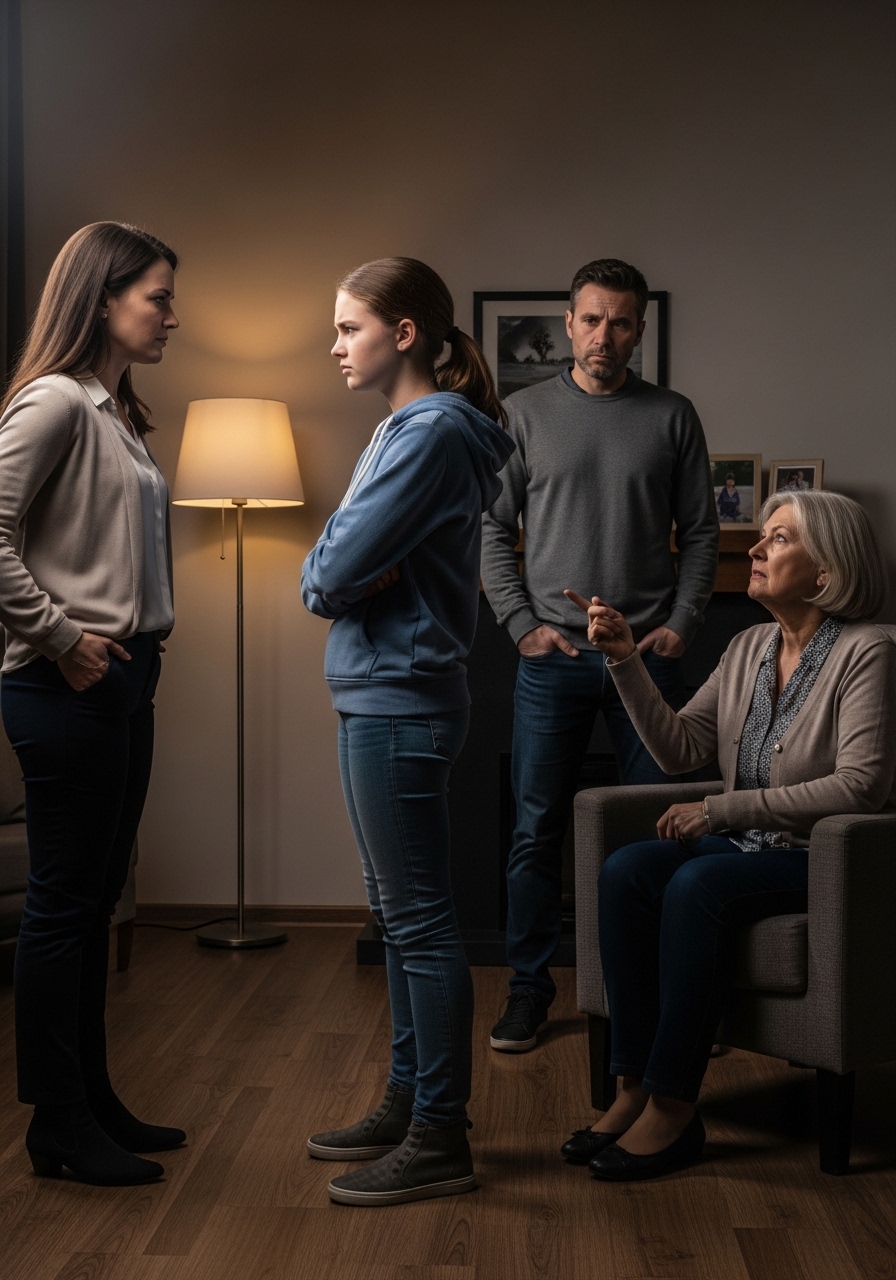
When my stepdaughter moved in with us, I genuinely wanted her to feel welcome. I opened my home and my routine, determined to make space for her and show her she belonged.
But it didn’t take long for things to change.
She began making demands—expecting separate meals, her laundry done for her, constant accommodation. At first, I tried to be patient. Then I gently explained that I wasn’t her personal maid, that we all shared responsibility in this house.
That’s when everything flipped.
She told my husband I was treating her unfairly. Suddenly, I wasn’t the woman trying to build a blended family—I was the problem. Overnight, I became the villain in a story I didn’t recognize.
What hurt most was that my husband didn’t defend me.
Instead, he told me I should “try harder” to make her comfortable. I was stunned. I had already bent over backward—adjusting schedules, cooking extra meals, doing more than my share. But she didn’t want inclusion. She wanted control.
Every time I said no, it became proof that I was cruel.
She cried to her grandparents. They called me cold and unloving. I felt like I was being gaslit by a teenager and abandoned by the one person who was supposed to have my back.
I started questioning myself.
Was I too harsh? Too rigid?
But when I looked at the reality, the answer was clear. I worked full-time, handled the house, managed meals—and all I was asking for was basic respect. She wasn’t expected to contribute much. Just to honor simple boundaries.
Yet every boundary became ammunition.
That’s when I understood: this wasn’t about kindness. It was about power. She wanted to see how far she could push—and when I didn’t fold, she painted me as the enemy.
The tension spread everywhere.
Family gatherings turned into minefields. Her side of the family treated me like a monster. My husband stayed quiet, afraid to upset his daughter. I felt isolated in my own home.
I wasn’t trying to be cruel.
I was trying to survive.
I needed partnership—not pressure. Support—not silence. But silence, I learned, can be louder than any accusation.
Eventually, I stopped trying to win anyone over.
I stopped cooking extra meals. Stopped folding her laundry. Stopped pretending everything was fine. The backlash grew louder—but I stayed firm.
I refused to sacrifice my sanity just to play the role of the “perfect stepmother.”
I had done my part.
My husband and I finally had a hard conversation. I told him plainly: I couldn’t keep living like this. If this marriage was going to survive, he had to step up.
He admitted the truth—he’d been avoiding conflict, hoping it would resolve itself.
It hadn’t.
We were both drowning.
He agreed to counseling, and slowly, we began rebuilding—not just our marriage, but the boundaries that should have existed all along.
Things aren’t perfect now. My stepdaughter still sees me as strict. Maybe even cold.
But I’m no longer trying to be her best friend.
I’m her stepmother—not her servant.
And that role comes with limits.
I’ve learned that saying no doesn’t make you cruel.
It makes you honest.
And honesty—even when uncomfortable—is the foundation of a real family.
I’m not the villain.
I’m the woman who refused to be erased.
And if that makes me unpopular, so be it.
I’d rather be disliked for my truth than loved for a lie.