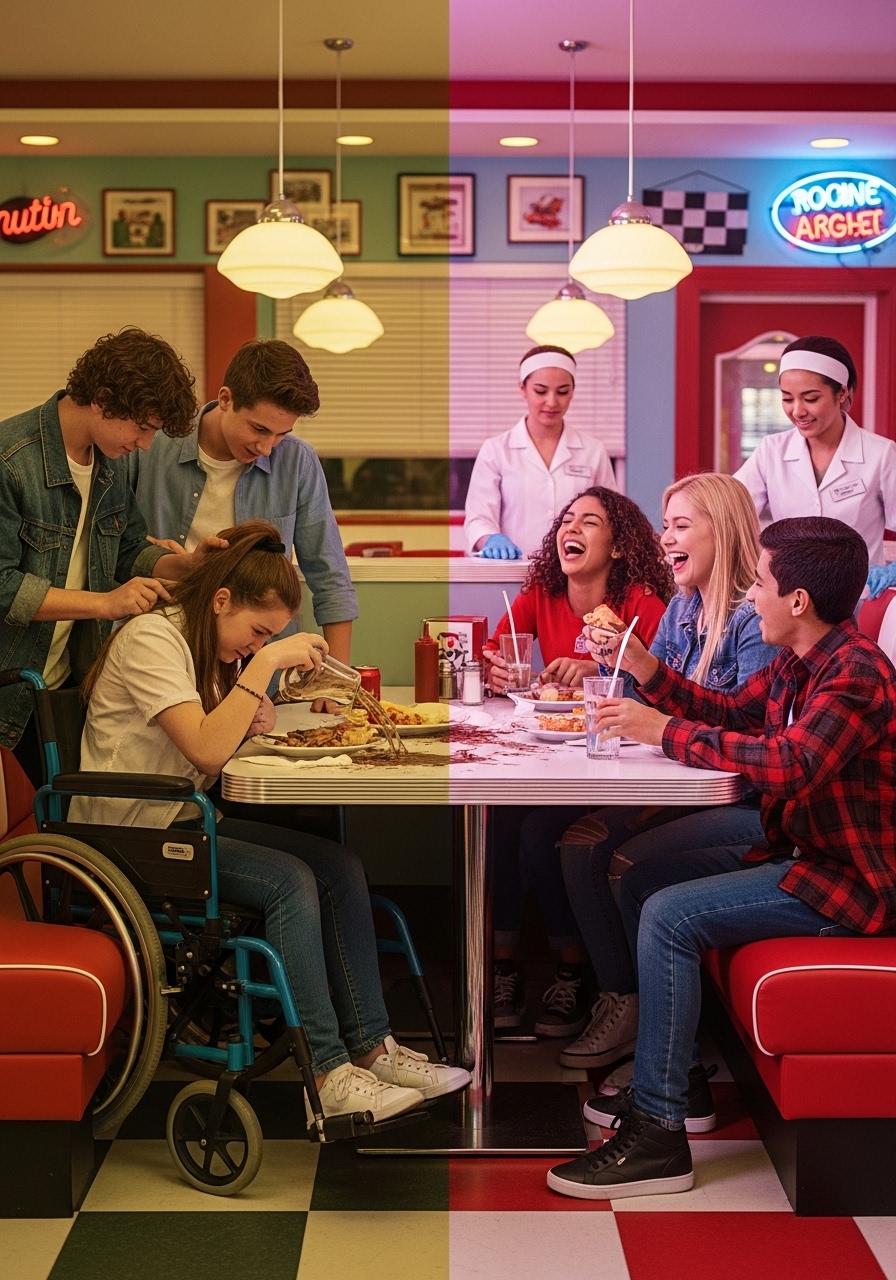
Morning sunlight bounced off the chrome counters of the diner, glinting against coffee pots and napkin holders. It was usually the kind of place where pancakes meant comfort and syrup smelled like home.
But that morning, one corner felt heavy—like the light couldn’t quite reach it.
Clara sat there quietly, her wheelchair tucked beside the table. A plate of pancakes rested in front of her, untouched. At sixteen, she was no stranger to stares or whispers. She’d learned how to endure them.
She hadn’t learned how to endure what came next.
At a nearby booth, a group of teenage boys watched her with cruel amusement. One of them laughed loudly, then “accidentally” knocked his plate to the floor. Pancakes slid across the tiles, syrup pooling like a mockery. Another boy nudged Clara’s wheelchair just enough to make it shake.
The diner froze.
Forks hovered midair. Conversations died instantly. The boys laughed—sharp, careless, proud of themselves.
Clara stared down at her hands, biting her lip as humiliation burned through her chest. Tears threatened, but she refused to let them fall.
No one spoke up.
No one moved.
In that moment, it felt like the cruelty of a few teenagers had swallowed the entire room.
Then—exactly one hour later—everything changed.
A low, thunderous rumble rolled through the parking lot. Motorcycles. One after another. The sound cut through the diner like a warning.
The door swung open.
A dozen bikers stepped inside, leather jackets creaking, boots heavy against the floor. Chains glinted. Faces were calm—but serious. The air shifted instantly.
They weren’t looking for breakfast.
Their eyes went straight to Clara.
The leader, a tall man with a salt-and-pepper beard, approached the booth where the boys now sat stiff and pale.
“Well,” he said evenly, his voice quiet but unshakable, “seems like someone forgot how to act in public.”
The boys shrank under his gaze. No threats. No raised voices. The bikers didn’t need to touch them—their presence alone was enough.
Then the man turned away from the boys and knelt beside Clara.
His expression softened.
“You’re safe now,” he said gently. “You’re not alone.”
The boys mumbled apologies, their confidence gone, and hurried out of the diner without another word.
Around them, the silence broke. People breathed again. Someone wiped their eyes. Others stared, ashamed they hadn’t acted sooner.
Clara felt something warm rise in her chest—relief, disbelief, and something more powerful.
For the first time that morning, she smiled.
Because in one unexpected moment, strangers had shown her what courage looked like—and proved that sometimes, justice doesn’t shout.
Sometimes, it simply shows up and stands beside you.