In 1979, Richard Miller’s life was defined by silence.
At thirty-four, he was already a widower. His wife, Anne, had died two years earlier after a long illness, leaving behind a small house filled with memories and an ache that never quite faded. Evenings were the worst. Richard would sit alone at the kitchen table beneath a flickering bulb, staring at peeling wallpaper while the clock ticked loudly enough to feel cruel.
Friends told him to move on. To remarry. To start over.
But Richard couldn’t imagine replacing the life he’d lost. All he carried forward was one promise Anne had whispered near the end:
“Don’t let love die with me. Give it somewhere to go.”
He didn’t know what that meant—until a rain-soaked night changed everything.
Driving home in his old pickup, the engine sputtered and died near St. Mary’s Orphanage on the edge of town. Looking for a phone, Richard stepped inside, shaking rain from his jacket. That’s when he heard it.
Crying.
Soft at first. Then layered. Uneven. Too many voices for one child.
He followed the sound down a dim hallway to a small room lined with cribs. Inside were nine infant girls—all with dark skin, wide eyes, and tiny hands reaching into the air.
Nine babies. Alone.
A nurse noticed his shock and explained quietly. They’d been found together on the church steps in the middle of the night, wrapped in a single blanket. No note. No names. Families were willing to adopt one or two—but never all.
“They’ll be separated soon,” she said gently.
The word hit him like a blow.
Separated.
Richard thought of Anne. Of her belief that family was built by choice, not blood. One of the babies locked eyes with him and reached for his sleeve. Another smiled. Something heavy and alive stirred in his chest.
“What if someone took all of them?” he asked.
The nurse shook her head. “Sir, no one could raise nine infants alone. People would think you’ve lost your mind.”
“I’ll take them,” Richard said.
That decision unleashed disbelief and resistance. Social workers called it reckless. Relatives begged him to reconsider. Neighbors whispered. Strangers stared. A white widower with nine Black babies didn’t fit anyone’s idea of “reasonable.”
Richard didn’t care.
He sold his truck. Anne’s jewelry. His tools. He worked double shifts at the factory, repaired roofs on weekends, waited tables at night. Every dollar went to diapers, formula, clothes. He built cribs by hand and strung laundry lines across the yard like banners of survival.
He learned which lullaby calmed which child. He taught himself to braid hair with clumsy fingers. At night, he lay awake counting nine steady breaths, terrified of losing even one.
The world judged him harshly. Parents whispered at school. Strangers glared in grocery stores. Once, a man sneered, “You’ll regret this.”
Regret never came.
Instead came laughter—nine voices filling the house at once. Came stormy nights when all nine curled against him for comfort. Came birthdays with crooked cakes and Christmas mornings wrapped in newspaper and joy.
They became known as the Miller Nine.
To Richard, they were just his daughters.
Each grew into her own spirit: the fearless one, the gentle one, the mischievous twins, the quiet observer, the protector, the dreamer. Together, they turned struggle into strength.
Years passed. Richard aged. His hair went gray. His back bent from decades of work. One by one, the girls became women—graduates, professionals, mothers—and left home to build their own lives.
The house grew quiet again.
But this silence was different.
It wasn’t empty. It was full.
On the night the last daughter moved out, Richard sat holding an old photo of nine toddlers lined up like pearls. He whispered, “I kept my promise, Anne.”
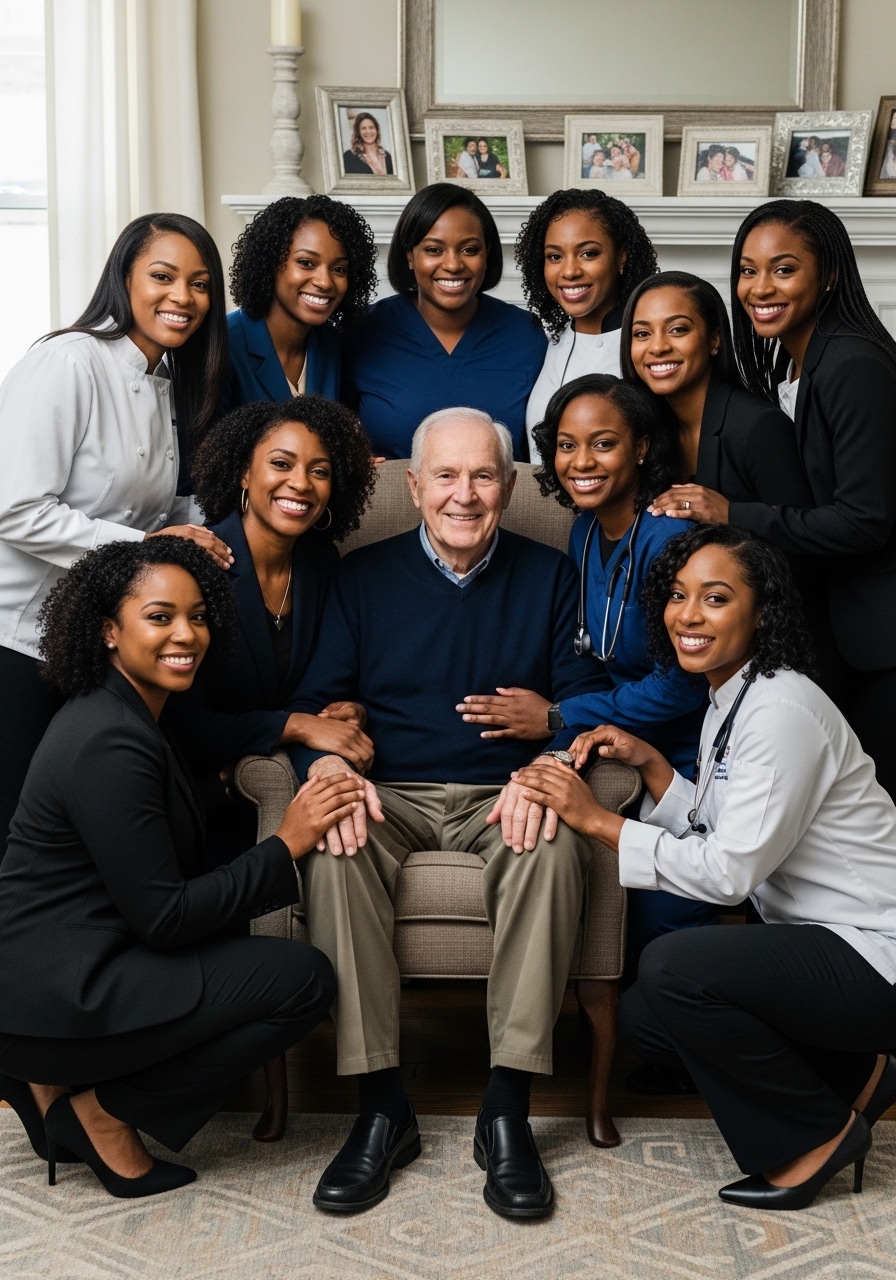
Decades later, in 2025, Richard sat frail but smiling in his armchair. Around him stood nine radiant women, hands resting gently on his shoulders. Cameras flashed. Headlines followed.
But none of that mattered to him.
One daughter leaned close and whispered, “Dad… you kept us together.”
Richard smiled through tears. “No,” he said softly. “We did. Love did.”
And for the first time in decades, he let himself cry—knowing the promise he once made in grief had grown into a living legacy.