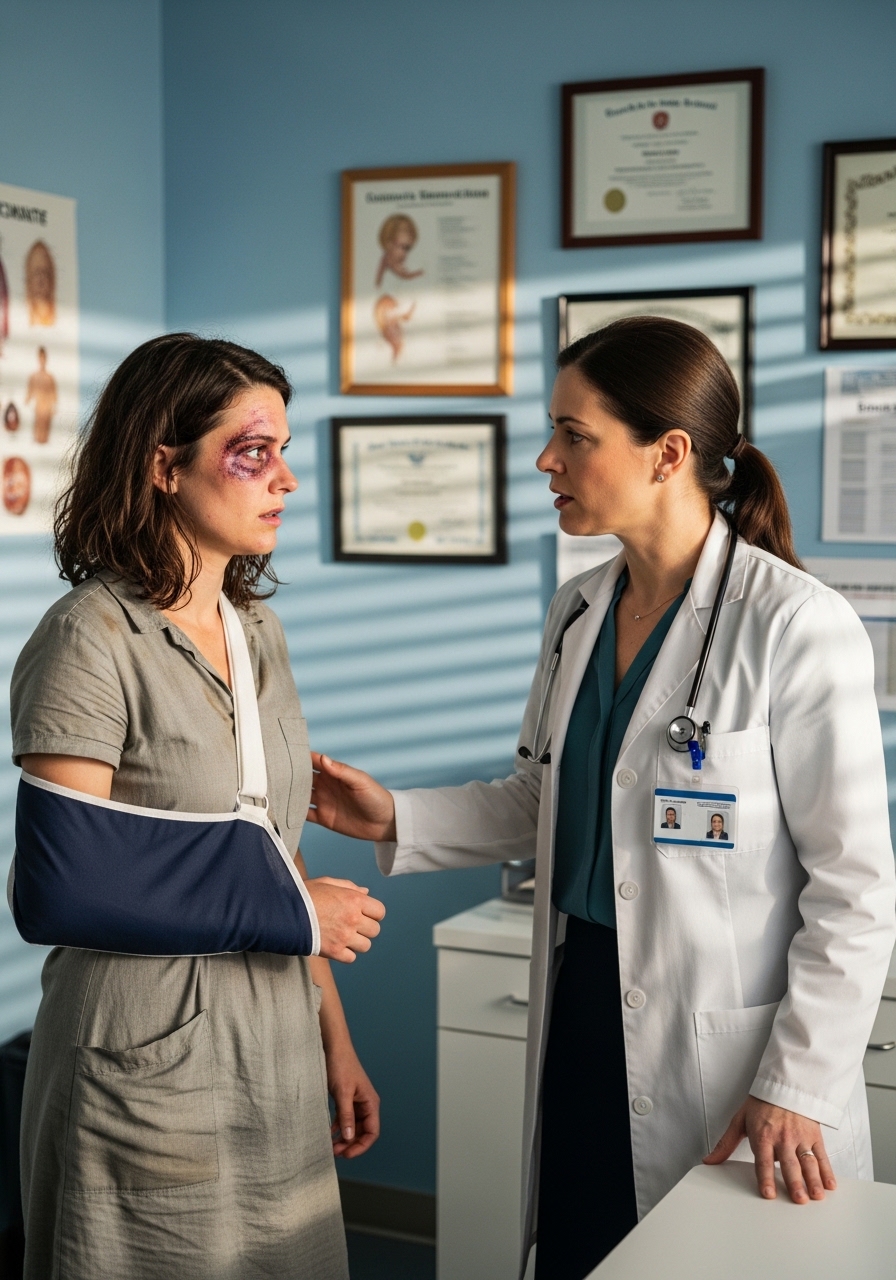
My name is Olivia Bennett, and for seven years I lived in a life that looked flawless from the outside.
A quiet suburban home in Colorado Springs.
A well-spoken husband with a respected career.
Friendly neighbors. Polite smiles. Perfect holiday photos.
Whenever someone asked how I was doing, I always answered the same way.
“I’m lucky.”
But luck had nothing to do with it.
Fear did.
My husband, Connor Briggs, was admired by everyone. People called him disciplined, reliable, impressive. They praised how calmly he spoke and how confidently he made decisions.
What they never saw was how his eyes changed when we were alone.
How his voice dropped into something cold and controlled.
How silence became a weapon.
He managed everything in my life. My clothes. My phone. My money. My schedule. If I stayed out too long, I owed an explanation. If I laughed too freely, I was corrected on the drive home. If I disagreed, the air in the room turned dangerous.
He was careful. He never hit my face.
He left marks where no one would see them.
Wrists gripped too tightly.
Shoves disguised as accidents.
Pressure applied just long enough to force obedience.
Afterward, he apologized. Stress, he said. Pressure at work. Promises it would never happen again.
I learned to read his moods like warning signs.
Every morning, I told myself I would leave.
Every night, I convinced myself to survive just one more day.
The day everything changed began like any other.
I made breakfast while Connor read the news on his tablet.
“You look tired,” he said without looking up.
“I didn’t sleep well.”
He set down his fork and stared at me.
“I don’t want drama today. Control yourself.”
“Yes,” I whispered.
After he left, I tried to steady myself. My heart raced. My hands shook. I told myself to sit down. To breathe.
But as I reached the stairs, dizziness washed over me.
The walls blurred.
My legs gave out.
I grabbed the railing—then everything went dark.
When I woke up, the world was white and humming. A hospital room. Machines beeping. My body felt heavy and wrong.
Connor stood beside the bed, holding my hand.
“There you are,” he said gently. “You scared me.”
A nurse nearby took notes as Connor spoke for me.
“She fainted on the stairs. She’s exhausted. I keep telling her to slow down.”
I tried to speak. My throat burned. No sound came out.
Connor squeezed my hand—not gently. A reminder.
“She gets confused,” he added calmly.
Then the nurse left.
A moment later, a doctor entered. His badge read Dr. Aaron Miles. He moved quietly but with focus. He checked my eyes. My breathing. He lifted the blanket.
His fingers paused on my arm.
Then my other arm.
Then my wrists.
Connor began talking faster.
“She’s clumsy. Always falling. She worries herself sick.”
Dr. Miles didn’t respond. He examined my neck. My ribs. His expression stayed neutral, but the room shifted.
He walked to the door.
“Secure this room,” he said evenly. “Call security. Contact law enforcement.”
Connor laughed nervously.
“That’s unnecessary. This is a misunderstanding.”
Dr. Miles turned back.
“There is no misunderstanding,” he said. “These injuries are not accidental.”
Connor stiffened.
“What are you accusing me of?”
“I’m stating facts,” the doctor replied. “Repeated trauma. Old and recent injuries. Patterns consistent with restraint and defense.”
Before Connor could move, two security officers entered and blocked him from the bed.
“This is ridiculous!” he shouted. “She’s my wife!”
“You will step outside,” Dr. Miles said calmly. “Now.”
Police arrived quickly. Connor argued in the hallway—threats, excuses, outrage. Then the door closed.
Silence.
Dr. Miles sat beside me.
“You’re safe here,” he said gently. “You don’t have to speak. But I want you to know—I believe you.”
Tears filled my eyes.
“He said no one would,” I whispered.
“He was wrong.”
A female officer arrived, then a social worker. Shelter contacts. Legal aid. Support services. No one rushed me. No one blamed me.
That night, I called my sister for the first time in six years.
“I’m coming,” she said through tears. “I’m on my way.”
Connor didn’t look at me as police escorted him past my room.
The man who controlled every breath I took had none left to control.
Recovery wasn’t easy. I was released into a safe residence. The quiet was overwhelming. Freedom felt unfamiliar—and frightening.
Therapy helped. I learned the words I had avoided.
Abuse.
Control.
Isolation.
I joined a support group. Women whose stories echoed mine. We cried. We laughed. We healed together.
The legal case moved forward. Medical records. Photographs. Expert testimony. Connor tried charm. Then anger. Then silence.
Evidence spoke louder.
The day the court granted a permanent restraining order, I walked into the sunlight alone—and steady.
I rented a small apartment near a park. Painted the walls blue. Bought furniture I liked. Cut my hair because I wanted to.
I walked outside without permission.
I laughed without fear.
Some nights were still heavy. Healing takes time.
I wrote a letter to Dr. Miles.
You believed me when I couldn’t speak. Thank you for saving my life.
He wrote back.
You saved yourself. I only opened the door.
Now, when I look in the mirror, I don’t see a victim.
I see a survivor.
A woman who chose herself.
If any part of this story feels familiar, remember this:
Fear is not love.
Control is not care.
Silence is not safety.
There are people trained to see what others miss.
There are hands ready to help.
There is a life beyond the walls someone else built.
My story began in darkness.
It continues in light.
And it’s only the beginning.