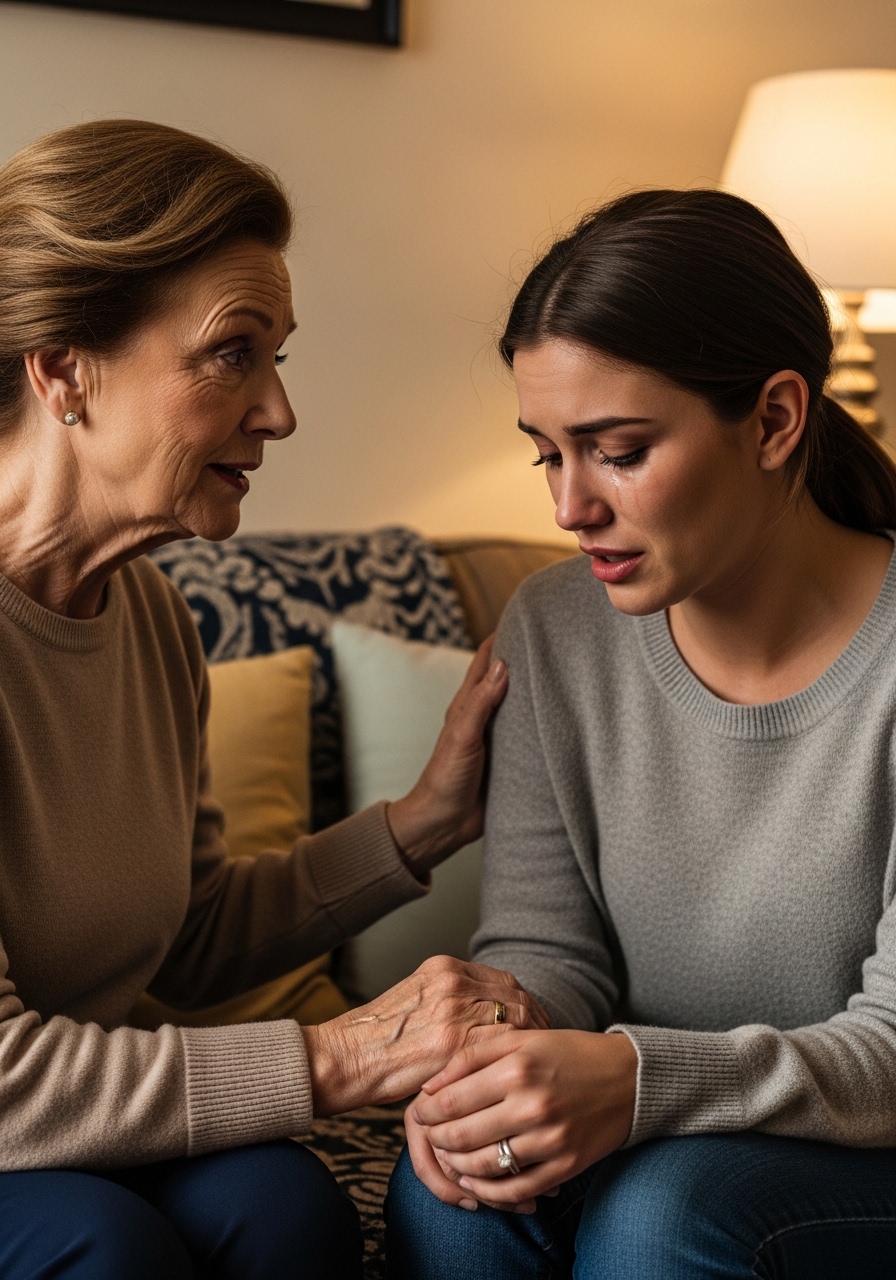
I hadn’t planned to tell my grandmother.
I hadn’t planned to stop by her house that afternoon.
But after what I saw on my husband’s phone, my hands shook uncontrollably. I couldn’t stay inside another second.
So I drove.
No makeup. No jacket. Hair wet from a shower I never finished. Eyes swollen like I’d been punched.
By the time I pulled into her driveway, the sky hung low and gray, making the world feel heavier.
Her house looked the same as always—white porch railing, flower pots that never died, the smell of warmth lingering in the air.
She opened the door before I knocked.
No questions. No judgment. She just pulled me into her arms like she had been waiting.
And in that embrace, I broke.
Not quietly. Not politely. The ugly, drowning kind of crying that only surfaces when someone finally holds you.
She held me until I could breathe, then guided me inside to her kitchen table—the same one I used to color on as a child.
She poured tea without asking, then sat across from me, waiting. Calm. Present.
I whispered, barely audible:
“He’s cheating… again.”
She didn’t gasp. Didn’t frown. Just nodded slowly, like she had suspected all along.
I wiped my sleeve across my face.
“I caught him before,” I continued. “Two years ago. He cried. Begged. Promised. Swore it was a mistake.”
I swallowed hard. “And I believed him.”
She stayed quiet.
I went on, because silence made the truth deafening.
“This time… I didn’t have to look. His phone lit up in the shower. A message popped up. I wasn’t snooping. I swear.”
“But it said, ‘Last night was perfect. I miss you already.’”
My stomach churned. “And there were pictures. Inside jokes. Hotel names.”
“The worst part,” I admitted, “was how comfortable he sounded. Like he wasn’t hiding. Like I didn’t matter.”
Her eyes darkened—not with anger, but understanding.
I laughed, a broken, bitter sound.
“I feel stupid,” I said. “Everyone must be laughing at me. I’ve been trying—cooking, staying patient, being enough. And he still… went looking for someone else.”
Finally, she spoke. Softly.
“How long has this been going on?”
“Since before we got married,” I whispered.
Hearing it aloud made the truth undeniable. My marriage wasn’t breaking—it had already been broken.
She stood silently, walked to the stove, and filled a small pot with water. She gathered three things: a carrot, an egg, and a scoop of coffee grounds.
I watched, confused, as she placed the carrot and egg into the boiling water, then poured hot water over the coffee grounds. She set a timer, and we sat in silence—the kind that feels like breathing.
When the timer went off, she removed them.
The carrot was soft. The egg was hard. The coffee had transformed, rich and fragrant.
She looked at me.
“When life gets hard,” she said quietly, “some people are like the carrot—hard outside, soft inside, but fall apart in the heat. Some are like the egg—soft inside, become hard, bitter, guarded. And some… become coffee. They take the heat and transform it.”
Her voice softened.
“So tell me, sweetheart… when you walk out of this marriage, what are you going to be?”
I couldn’t answer. No one had ever asked me what I would become. Everyone had only asked what I would do.
And in that moment, I realized it wasn’t his cheating that ruined me—it was how small I had become trying to keep him.
She pulled out an envelope and placed it before me. Inside: a bank statement and a key to a small apartment, fully paid for three months.
“I’ve been saving for you,” she said. “Because no woman should choose between dignity and survival.”
I left that night with one suitcase and my wedding ring, leaving him with a single sentence written on paper:
“I’m choosing coffee.”
He called. Texted. Showed up. But for the first time, he looked afraid—not of losing love, but losing control.
A month later, the divorce was final.
I moved into the small apartment my grandmother had secured. I mourned the marriage, the children I might have had, the years I wasted trying to be enough.
Slowly, I started breathing again. Teaching. Sleeping. Living.
Three months later, I returned to her kitchen. She was making tea. I sat, smiling.
“Well?” she asked. “What are you now?”
“I’m still learning,” I said, looking around her warm kitchen.
“But I think…” I paused. “I’m becoming coffee.”
She nodded, proud, and poured my tea like she already knew.