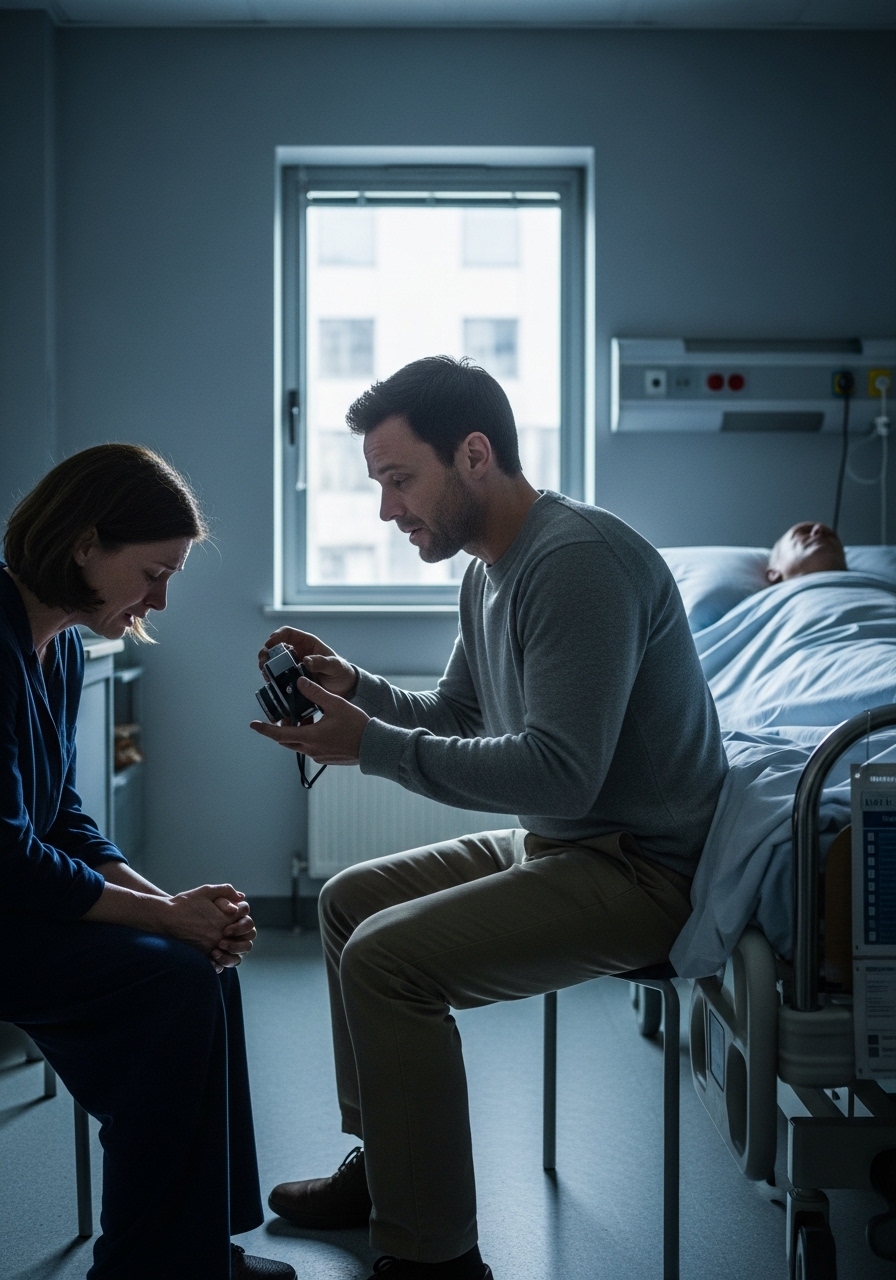
Diana believed she was counting down the final days of her husband’s life.
Instead, a stranger’s quiet warning exposed a lie so deep it rewrote everything she thought she knew about love, marriage, and trust.
The doctor had spoken gently, but the words were devastating.
“Stage four cancer. Metastasized. Weeks, at best.”
Fifteen years of marriage collapsed into a timeline measured in days. Diana stared at the wedding band on her finger, suddenly heavy with memories — slow dances in the kitchen, shared coffee at dawn, Eric’s reassuring hand on her back whenever life felt uncertain.
Outside the hospital, the weight of it all crushed her. She sank onto a cold bench, sobbing into her palms, grief swallowing every breath.
That’s when someone sat beside her.
A nurse in navy scrubs. Silver threaded through her hair. Eyes tired, sharp, knowing.
She leaned in, voice barely above a whisper.
“Put a hidden camera in his ward,” she said.
“He’s not dying. And you deserve the truth.”
The words hit Diana like lightning.
She wanted to dismiss them — to call them cruel, impossible. But doubt slipped in, quiet and relentless. By morning, she ordered the smallest camera she could find.
She hid it among the flowers in Eric’s room.
That night, Diana watched the live feed. For hours, nothing seemed wrong — nurses checking vitals, machines humming, Eric lying still.
Then, at exactly 9 p.m., the door opened.
A tall woman stepped inside, leather coat gleaming under the fluorescent lights. Eric sat up immediately. No weakness. No pain. He smiled, wrapped his arms around her, kissed her deeply — then slid a bundle of documents beneath his mattress.
Diana’s chest burned.
Her “dying” husband looked very much alive.
The next morning, Eric returned to his performance — shallow breaths, trembling hands, whispered complaints about pain. Diana played her role too, smiling tightly, holding his hand, already mourning a man who no longer existed.
That evening, she followed the woman.
Standing outside the ward, Diana heard everything.
“Once you’re officially declared dead,” the woman said, “the insurance transfers offshore. Then we disappear.”
Eric laughed softly. “Dr. Matthews faked the diagnosis. Cost me a fortune, but it’s worth it. Diana’s already planning the funeral.”
The woman — Victoria — laughed. “She won’t suspect a thing. You chose the perfect wife.”
Fifteen years of marriage reduced to a carefully planned scam.
Diana recorded every word.
The next day, she invited everyone — family, friends, coworkers, anyone who loved Eric. His hospital room filled with grief and whispered prayers. Eric played the frail husband perfectly, though fear flickered behind his eyes.
Then Diana stepped forward.
“Before we say goodbye,” she said calmly, “there’s something you all need to see.”
The TV screen came alive.
Footage of Eric embracing Victoria.
Audio of the fake diagnosis.
Their voices discussing insurance fraud and escape plans.
The room erupted.
Eric’s mother screamed. His father lunged forward. Victoria froze in the doorway, color draining from her face.
Police arrived within minutes.
Eric was handcuffed in front of everyone he’d deceived. Dr. Matthews lost his license that same day. Victoria was caught trying to flee the city.
The following morning, Diana filed for divorce.
She returned to the hospital bench where it had all begun. The nurse appeared again, as quietly as before.
“Thank you,” Diana whispered. “You saved me from a different kind of loss.”
The nurse nodded. “Some diseases don’t attack the body,” she said. “They grow in the heart — feeding on trust until there’s nothing left.”
Diana didn’t lose her husband to cancer.
She lost him to greed.
And in that loss, she found something unexpected — truth, strength, and the reminder that sometimes strangers protect us from the cruelty of those we love most.
As she drove home, her wedding ring rested heavy in her pocket. The sky burned orange with sunset, and for the first time in weeks, Diana could breathe.
One story had ended.
Another had just begun.