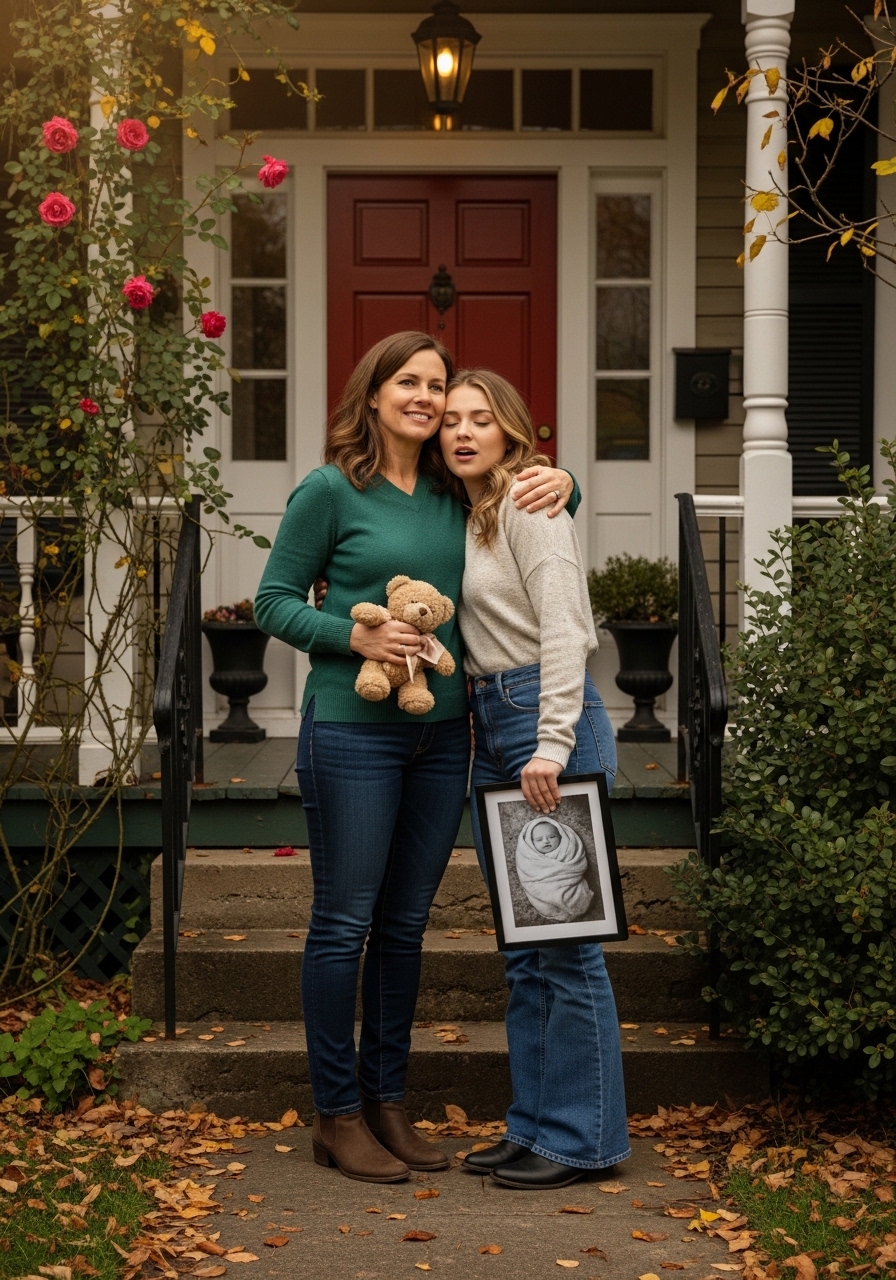
I was left on a stranger’s doorstep as a newborn. Twenty-five years later, the woman who gave birth to me knocked on that same door—and tried to take credit for my life.
My name is Isabel. I’m 25.
The woman I call my mother has used a wheelchair for as long as I can remember.
Long before I was part of her life, she was in her early twenties when a drunk driver slammed into her car. She survived, but the damage was permanent. Doctors told her she would never walk again. Never carry a child.
She cried once in the hospital. Then she decided she would still live.
She found an apartment, learned to drive using hand controls, became a paralegal, and built a steady, independent life. Children weren’t part of the plan anymore.
Until one freezing morning changed everything.
She was getting ready for work when she heard a thin, desperate cry outside her door. Not an animal. A baby.
She rolled to the door, opened it—and stopped cold.
A carrier sat on the doormat. Inside was a newborn, red-faced and shaking, wrapped in a cheap blanket. Beside her was a folded note.
“I can’t keep her. I have no choice. I’m sorry.”
That was all.
She called 911. The paramedics checked me and said I’d be okay. Social services would come soon. They asked if she wanted them to take me right away.
She looked at me and said, “I’m going to be her mother.”
Everyone told her she was crazy.
She was single. Disabled. “Unrealistic.”
She listened. Then ignored them.
She endured interviews, inspections, and thinly veiled doubts about whether a woman in a wheelchair should be allowed to adopt. Months later, the papers were signed.
It was always just us.
She named me Isabel.
She wasn’t “my adoptive mother.” She was simply Mom.
No extended family. No safety net. Just her and me.
She came to every school event, fought for ramps when there weren’t any, and never let anyone speak over her. At home, we did homework at the kitchen table. She taught me how to cook, how to be brave, how to recover from heartbreak without shame.
I never felt abandoned.
She told me the truth early. “Someone left you at my door,” she said. “From the moment I opened it, you were mine.”
I felt chosen.
When I left for college, she cried in the car and rearranged my dorm like it was a palace. Before she left, she squeezed my hand.
“You’re going to build something,” she said. “Don’t forget where you came from.”
During junior year, that “something” took shape.
My best friend Lena and I were venting about clothes—shirts that felt cheap, stiff, or see-through. So we started sketching our own. Simple designs. Soft fabric. No slogans.
We ordered a small batch and posted them online.
They sold out.
Orders poured in. Our dorm became a shipping center fueled by caffeine and hope. We named the brand Doorstep.
My mom was there from day one—folding shirts, reviewing contracts, answering emails when we were overwhelmed. She became our unofficial third partner.
After graduation, we rented a tiny office. No investors. No backup plan. Just grit.
A few months ago, I bought my first car. Paid in full.
I jingled the keys in front of my mom and told her Doorstep paid for it. She cried.
I thought that was the peak moment.
I was wrong.
One Tuesday morning, I opened the front door and froze.
A woman stood on the porch, mid-knock. Well dressed. Polished. She stared at my face like she’d memorized it.
“Isabel?” she asked.
She introduced herself calmly.
“I’m your biological mother.”
My stomach dropped.
She told me her name was Karen. That she’d been searching for me. That she’d heard about my company. That she always knew I’d be successful.
Then she said it.
“You wouldn’t have any of this without me. I chose where to leave you. I only want half your business—and your car. That’s fair.”
I didn’t scream.
I smiled.
I told her she was right. That she was connected to my existence. That I’d give her something.
Relief washed over her.
Then I opened the door wider.
“There’s one condition,” I said. “We do this with my mom present.”
Inside, my mother sat quietly at the table.
Karen thanked her—for “raising me well.”
My mom looked her straight in the eye. “You didn’t raise her. You left her.”
I pulled out a photo album and slid it across the table.
“Find one picture,” I said. “Any year. Any event. One moment where you showed up.”
She flipped pages. Faster. Slower. Then stopped.
“I don’t need photos,” she snapped. “I carried you for nine months.”
“No,” I said. “That was your choice. Motherhood is everything after that.”
I closed the album.
“You don’t get my business. You don’t get my car. You don’t get credit, money, or access to my life. If you contact me again, it will be harassment.”
She warned me I’d regret it.
I opened the door.
“Blood isn’t a free pass,” I said. “Love is. And you didn’t show up.”
She left.
When the door closed, my hands shook. My mom cried softly.
“I was afraid you’d choose her,” she whispered.
I hugged her.
“You opened the door,” I said. “You stayed. You’re my mom.”
That night, we sat with the album open between us—page after page of a life built on presence, not DNA.
Because family isn’t who gives you life.
It’s who shows up—and never leaves.