I didn’t understand the warning at first.
It was typed in elegant script on yellowed parchment, tucked inside my late aunt’s inheritance letter. Aunt Agnes had always been… unusual. Eccentric. Reclusive. And now she was gone.
She left me everything—her isolated, aging house miles from town, its sprawling grounds, even her old Model T Ford resting in the garage. I’d only visited the house a few times as a child, but each visit left me uneasy, like the walls were watching.
Most of the letter was practical. Detailed. Methodical.
But one short paragraph stood out.
“The attic is not for you. It holds only painful memories, things best left undisturbed. Promise me, my dear, you will never seek what lies above.”
I remember scoffing softly. Even in death, Agnes was dramatic. I assumed it was her final attempt at mystery—a theatrical farewell.
A month later, I moved in.
The house felt alive, heavy with silence. Floorboards creaked like whispered confessions. Shadows lingered longer than they should. I spent weeks cleaning, sorting through boxes of forgotten objects, feeling an odd pull toward this woman I’d never truly known.
My mother always spoke of Agnes with pity. “Poor Agnes. Such a lonely life.”
And then there was the attic.
A narrow staircase hidden behind a plain wooden door. Every time I passed it, I felt a chill—an insistent pull I couldn’t explain. Curiosity, I told myself. Nothing more.
But deep down, something else stirred. A sense that the answer to something important was waiting above me.
On a stormy Tuesday, with rain pounding the roof and wind screaming through the eaves, I gave in.
My heart raced as I touched the attic door. The warning echoed in my head. Painful memories.
I opened it.
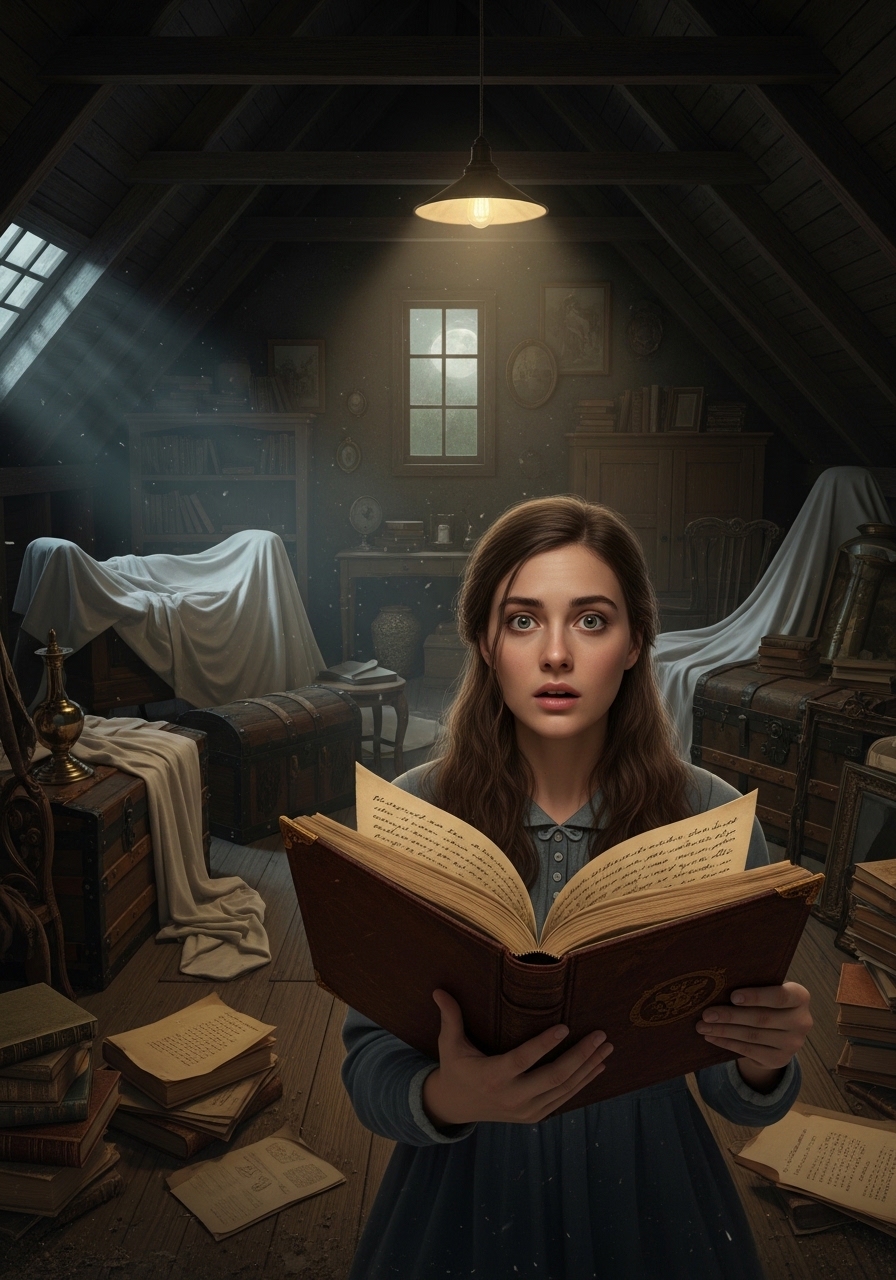
Dust coated the steep steps. Cobwebs clung to the railing. The air grew colder with every step. At the top, a single bare bulb flickered weakly, casting restless shadows across the room.
Boxes everywhere. Old furniture draped in sheets. Trunks of antique clothing. Nothing special.
Relief washed over me.
Until I saw it.
A small wooden chest, tucked beneath a pile of blankets. Plain. Unlocked.
Inside weren’t jewels or money—but documents.
The first page stopped my breath.
My birth certificate.
My name. My date of birth.
But my mother’s name wasn’t listed as mother.
It said witness.
And the biological parent’s name was Agnes.
My hands shook as I grabbed the journal beneath it—small, leather-bound, unmistakably hers.
The first entry, dated decades earlier, read:
“He left me. I was pregnant and terrified. My sister offered to take the baby, to raise her as her own. It’s the only way—for the child, for her, for all of us to survive the scandal.”
Page after page revealed the truth.
Agnes wasn’t my eccentric aunt.
She was my mother.
She wrote about watching me grow from a distance, about stolen visits, about pretending to be someone she wasn’t so I could have a stable life. About my “mother” carrying the secret for decades.
The final entry, written weeks before her death, broke me.
“She is so beautiful. I hope she never finds out. The pain would be too much. My dear, don’t seek what lies above.”
I collapsed against a trunk, the journal slipping from my fingers.
The warning wasn’t meant to protect her.
It was meant to protect me.
My entire life—my identity, my memories—shifted in an instant. The woman I mourned as an aunt was my true mother. The woman I called Mom had raised me knowing the truth.
And now, there was no one left to ask.
Only the dust.
Only the silence.
Only a truth so heavy it felt like the world had tilted beneath my feet.
It was the most heartbreaking inheritance I could have ever received.