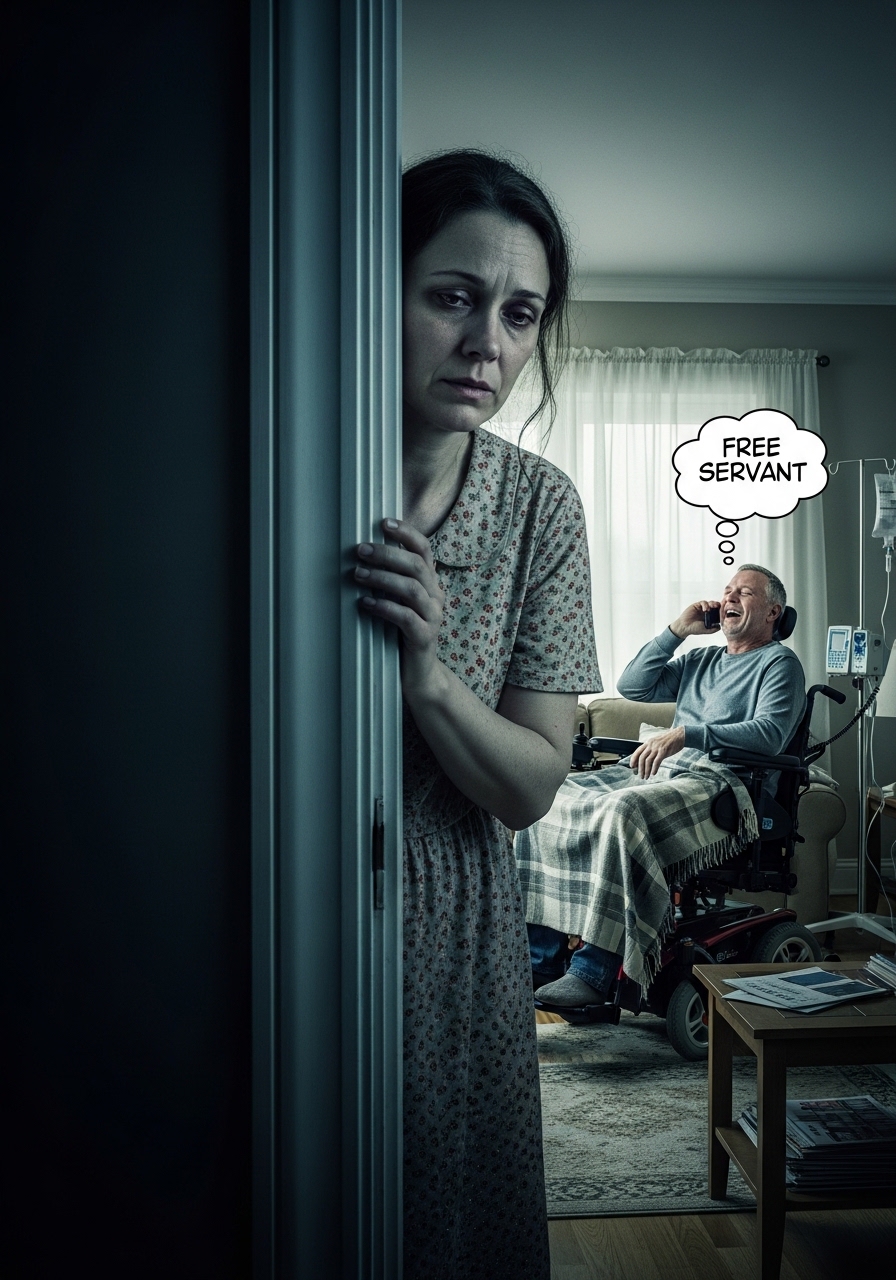
If someone says five years out loud, it sounds manageable. Like a chapter you simply turn.
But when those years are counted in hospital corridors, medication schedules, and the antiseptic smell that never quite leaves your clothes, time doesn’t move normally. It thickens. It presses against your chest. It becomes something you carry instead of live inside.
My name is Marianne Cortez. I’m thirty-two years old, and when I look in the mirror now, I barely recognize the woman staring back.
Her shoulders slope forward, permanently braced. Her eyes are rimmed with exhaustion sleep can’t touch. Her hands tell the real story—raw from constant washing, strained from lifting a body that was never meant to be carried alone, shaped by wheelchair rails and hospital bed frames.
Once, my life was ordinary. Hopeful.
I met my husband, Lucas, at a neighborhood fundraiser in Boulder. He had that rare charm that made people feel chosen. When he spoke, rooms leaned in. When he smiled, you believed it was meant just for you.
We married quickly. Children. Travel. A bigger house. A quieter life someday. The future felt solid.
It shattered on a mountain curve outside Golden.
A drunk driver crossed the median. Metal tore apart. Lucas lived—but the damage stole the lower half of his body.
The neurologist spoke gently, clinically. Permanent. No illusion of recovery.
I didn’t cry. I held Lucas’s hand and promised I wouldn’t leave. I told him we’d adapt.
I believed love meant endurance.
What I didn’t understand was how slowly sacrifice can hollow a person out.
The years became repetition. Alarms before dawn. Medication charts taped to the fridge. Insurance calls that went nowhere. Sleeping on the couch so I could hear him call. Learning how to lift without injuring him. Smiling while exhausted because people praised me for being “strong.”
One Tuesday—no different from any other—my alarm rang at 4:30 a.m. The city was dark and frozen quiet. I dressed for function, not dignity, and ran through the checklist in my head.
Lucas had been complaining about hospital food. He wanted pastries from a bakery nearby. I told myself something warm might make him feel less like a burden.
The bakery smelled like butter and sugar. For a moment, I pretended I was just another woman buying breakfast for someone she loved.
“Two cinnamon rolls,” I told the cashier. “And a box of plain pastries. Black coffee.”
I drove to the hospital imagining his smile.
Inside, a volunteer said Lucas was in the courtyard with another patient. I headed toward the glass doors—and stopped.
“You get used to it,” Lucas was saying. “People think it’s tragic, but honestly, it has advantages.”
Another man laughed. “Your wife does everything. That doesn’t bother you?”
Lucas answered easily. “Why would it? Marianne’s reliable. She doesn’t go anywhere. She has nowhere to go.”
I froze just outside their sightline.
The man chuckled. “Sounds like you landed well.”
“I did,” Lucas said. “Care without cost. No facility. No bills. Just patience and hope keeping her in place.”
“What about inheritance?”
Lucas lowered his voice, but not enough.
“My assets are secured for my son and my sister. Family stays family. Marianne thinks loyalty earns permanence.”
They laughed.
I stood there holding pastries that suddenly felt obscene.
Love had become convenience. Devotion had become leverage.
I didn’t confront him. I didn’t cry. I turned away and threw the bag into a trash bin near the exit.
In the parking lot, something settled inside me. Beneath the rage was clarity.
If I reacted emotionally, I’d lose everything.
If I waited, I could reclaim myself.
Lucas texted minutes later—complaining about hunger, asking where I was. I replied calmly that my car had stalled.
Instead of going home, I went to the county library. I opened my laptop. My hands were steady for the first time in years.
Over the following weeks, I became precise.
I kept caring for Lucas. Kept the routine. Kept playing the role he expected—while quietly gathering proof. Financial records. Insurance policies. Legal documents naming everyone but me. Conversations documented carefully and lawfully.
I called an old colleague, Natalie Grayson. She listened without interrupting, then gave me a name.
Evelyn Porter didn’t offer sympathy. She offered strategy.
By the time Lucas realized what was happening, it was already too late. Accounts frozen. Filings submitted. The narrative shifted—from abandonment to exploitation.
He accused me of cruelty. His relatives called it betrayal.
None of it held.
The day I moved out, I didn’t feel dramatic. I felt light. The door closing behind me wasn’t loss.
It was release.
Months later, the hospital called when Lucas was admitted again. I declined involvement. His care was now handled by those he’d chosen.
Today, I sit in a sunlit café Natalie and I opened together. I write during quiet hours and watch people pass—each carrying lives I no longer envy or fear.
I am no longer a shadow holding someone else upright.
I am whole again.
And dignity, once reclaimed, doesn’t need permission to exist.