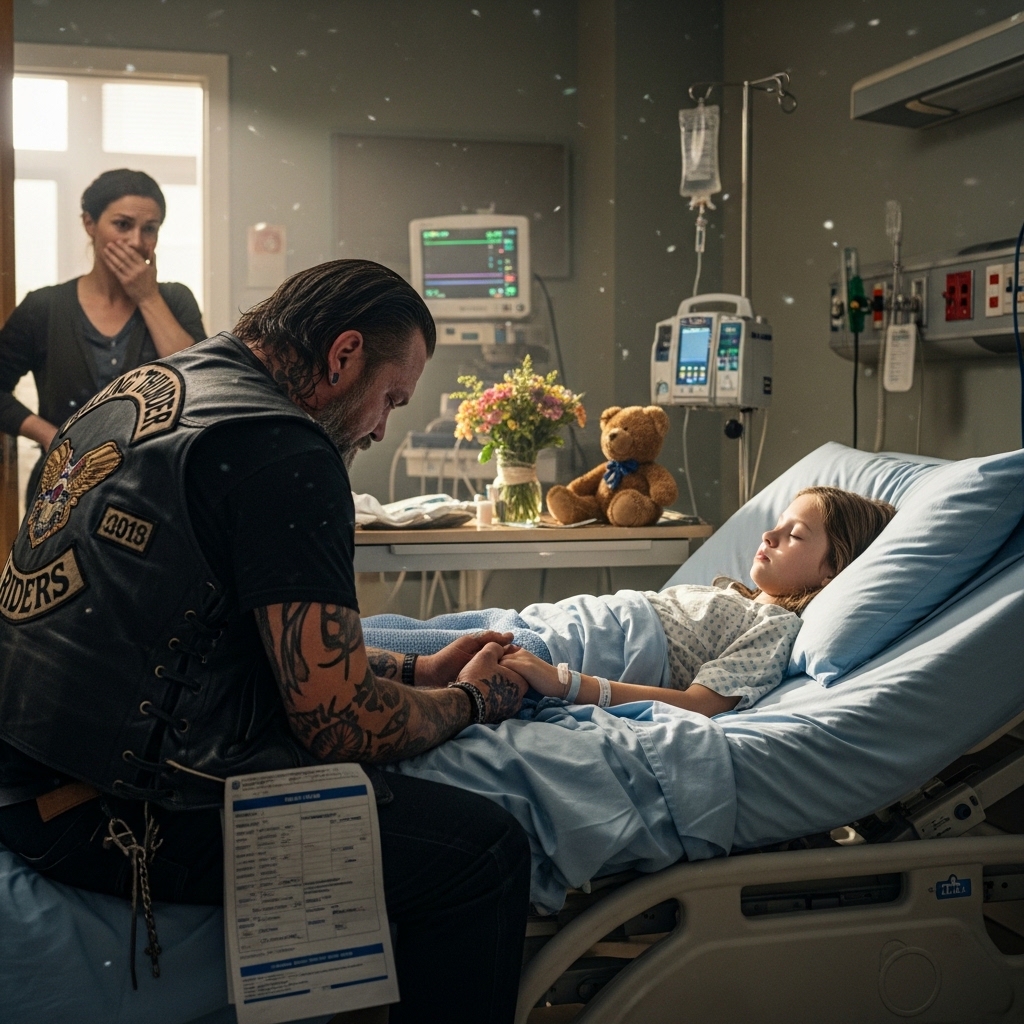
For six straight months, a massive biker with a gray beard walked into my comatose daughter’s hospital room every single day at exactly 3:00 p.m.
He stayed for one hour.
Held her hand.
Then quietly left.
And I — her mother — had no idea who he was.
My name is Sarah. I’m 42. My daughter Hannah is 17.
Six months ago, a drunk driver ran a red light and slammed into the driver’s side of her car. She’d been heading home from her part-time job at the bookstore, just five minutes from our house.
Now she was in room 223. A coma. Tubes, monitors, machines I didn’t even know existed.
I practically lived there.
Slept in the recliner. Ate from vending machines. Learned which nurse gave the warmest blankets (it was Jenna).
Time in a hospital doesn’t move normally. It’s just beeping machines and a clock that never seems to change.
And every day, at exactly 3:00 p.m., the same thing happened.
The door opened.
In walked a huge man in a leather vest and boots. Gray beard. Tattoos. Scarred knuckles.
He nodded to me respectfully, like he didn’t want to intrude.
Then he smiled at my unconscious daughter.
“Hey, Hannah,” he said gently. “It’s Mike.”
Sometimes he read from fantasy novels. Sometimes he just talked in a low, steady voice.
“Rough day, kiddo,” I heard him say once. “But I didn’t drink. So that’s something.”
Nurse Jenna greeted him like he belonged there.
“Coffee, Mike?”
“Yeah, thanks.”
Like this was normal.
He took Hannah’s hand in both of his and stayed until exactly 4:00 p.m. Then he carefully placed her hand back on the blanket, nodded to me, and left.
Every. Single. Day.
At first, I let it go.
When your child is in a coma, you don’t question kindness.
But weeks passed. Then months.
He wasn’t family.
He wasn’t a friend.
None of Hannah’s friends knew him. Her father didn’t know him.
Yet the nurses treated him like a fixture.
Finally, I asked Jenna, “Who is that man?”
She hesitated. “He’s… someone who cares.”
That wasn’t enough.
One afternoon, after his usual exit, I followed him into the hallway.
“Mike?” I said.
He turned. Up close, he was even bigger — but his eyes looked exhausted, not threatening.
“I’m Hannah’s mom,” I said.
“I know,” he replied softly. “You’re Sarah.”
My stomach dropped.
We sat in plastic chairs in the waiting area.
I didn’t soften my voice. “You’ve been holding my daughter’s hand for months. I need to know who you are. And why.”
He took a long breath.
“My name is Mike. I’m 58. I have a wife. A granddaughter.”
I waited.
Then he said it.
“I’m the man who hit your daughter. I was the drunk driver.”
Everything inside me went numb.
“I ran the red light,” he continued. “It was my truck.”
I stood up, shaking.
“You did this to her — and you come here every day like you belong?”
“I pled guilty,” he said quietly. “Ninety days in jail. Lost my license. Rehab. AA. I haven’t had a drink since that night.”
He didn’t defend himself. He didn’t argue.
“But she’s still in that bed,” he said. “So none of it fixes anything.”
I told him I should call security.
“You’d be right to,” he said. “I won’t fight it.”
Then he told me why he kept coming.
“I picked three o’clock because that’s when the accident happened,” he said. “I sit with her. I tell her I’m sorry. I read the books she likes. It’s not forgiveness. It’s accountability.”
He paused.
“My son died when he was twelve,” he added. “I know what it feels like to stand where you’re standing.”
I told him to stay away.
For the first time in months, 3:00 p.m. came — and the door stayed closed.
I thought it would feel like relief.
It didn’t.
A few days later, I went to an AA meeting on Oak Street.
Mike stood up when it was his turn.
“I’m an alcoholic,” he said. “And I’m the reason a seventeen-year-old girl is in a coma.”
He didn’t say our names.
Afterward, I told him, “I don’t forgive you.”
“I don’t expect you to,” he said.
“But you can come back,” I said. “I’ll be there.”
The next day, he hovered in the doorway.
“Is it okay?” he asked.
I nodded.
Weeks passed.
Then one afternoon, while he was reading, Hannah squeezed my hand.
Not a twitch. A squeeze.
The room erupted with nurses.
Her eyes fluttered open.
“Mom?” she whispered.
Later, she looked at Mike.
“You read dragons,” she said. “And you always say you’re sorry.”
She didn’t know yet what he’d done. Only that his voice had been there.
When she was stronger, we told her everything.
“I don’t forgive you,” she told him.
“I understand,” he said.
“But don’t disappear,” she added. “I don’t know what that means yet.”
Recovery was brutal.
Therapy. Pain. Tears.
Almost a year after the crash, Hannah walked out of the hospital — slowly, with a cane.
Outside the doors, she turned to Mike.
“You ruined my life,” she said.
“I know.”
“And you helped me not give up on it,” she said. “Both can be true.”
Now she’s back at the bookstore part-time. Starting community college.
Mike is still sober.
Every year, at exactly three p.m., we meet for coffee.
We don’t do speeches.
We just sit.
It’s not forgiveness.
It’s not forgetting.
It’s three people trying to move forward — without pretending the past didn’t happen.