The call came before sunrise, when the world was still quiet enough that the hum of my car engine felt intrusive. I glanced at the dashboard clock without really seeing it, my mind still tangled in contracts, projections, and the presentation I was supposed to lead before noon.
Mornings had always meant control to me—routines, productivity, the illusion that success could be managed if you stayed disciplined enough. I was adjusting my tie when my phone lit up with a name I never expected to see.
Silver Valley Regional Hospital.
For a split second, I considered letting it ring—not from indifference, but because my mind refused to accept that an emergency had anything to do with me. Something deeper than logic made me answer.
“Mr. Barnes,” a woman said, her voice trained for moments like this. “Your daughter has been brought in. You need to come right away.”
My throat tightened. “What happened?”
The pause told me more than words ever could.
“She’s stable for now,” she said carefully. “But she’s in critical condition.”
I don’t remember hanging up. I don’t remember deciding to drive faster than I ever had. My body moved on instinct alone, driven by a fear no financial risk or professional failure had ever come close to matching.
Grace was eight—small for her age, quiet in ways people mistook for politeness. She’d already lost more than any child should. And I had convinced myself she was resilient enough to endure whatever adjustments adulthood required of her.
That belief would haunt me.
Grace was six when her mother died after a long illness that drained the warmth from our home before it took her life. In the aftermath, I did what I did best: organized, planned, moved forward. I buried myself in work and called it stability.
People praised my composure. When I traveled more, stayed later, I told myself I was providing security.
That’s when Lauren Price entered our lives.
She spoke softly, dressed impeccably, and carried herself with controlled confidence. She offered to help with homework, bedtime routines, lunches. I felt relief and mistook it for happiness.
“She needs a woman in her life,” I told everyone—including myself.
Lauren smiled in a way that reassured everyone except, I would later learn, the one person who mattered.
I didn’t notice when Grace stopped asking me to read to her at night. I ignored the flinches, the silences. I blamed grief, because the truth required attention I wasn’t giving.
At the hospital, the air felt heavy with antiseptic and dread. The nurse’s expression after I said Grace’s name told me nothing would ever be the same.
A doctor met me outside the pediatric wing. “She’s awake,” he said quietly. “You can talk to her.”
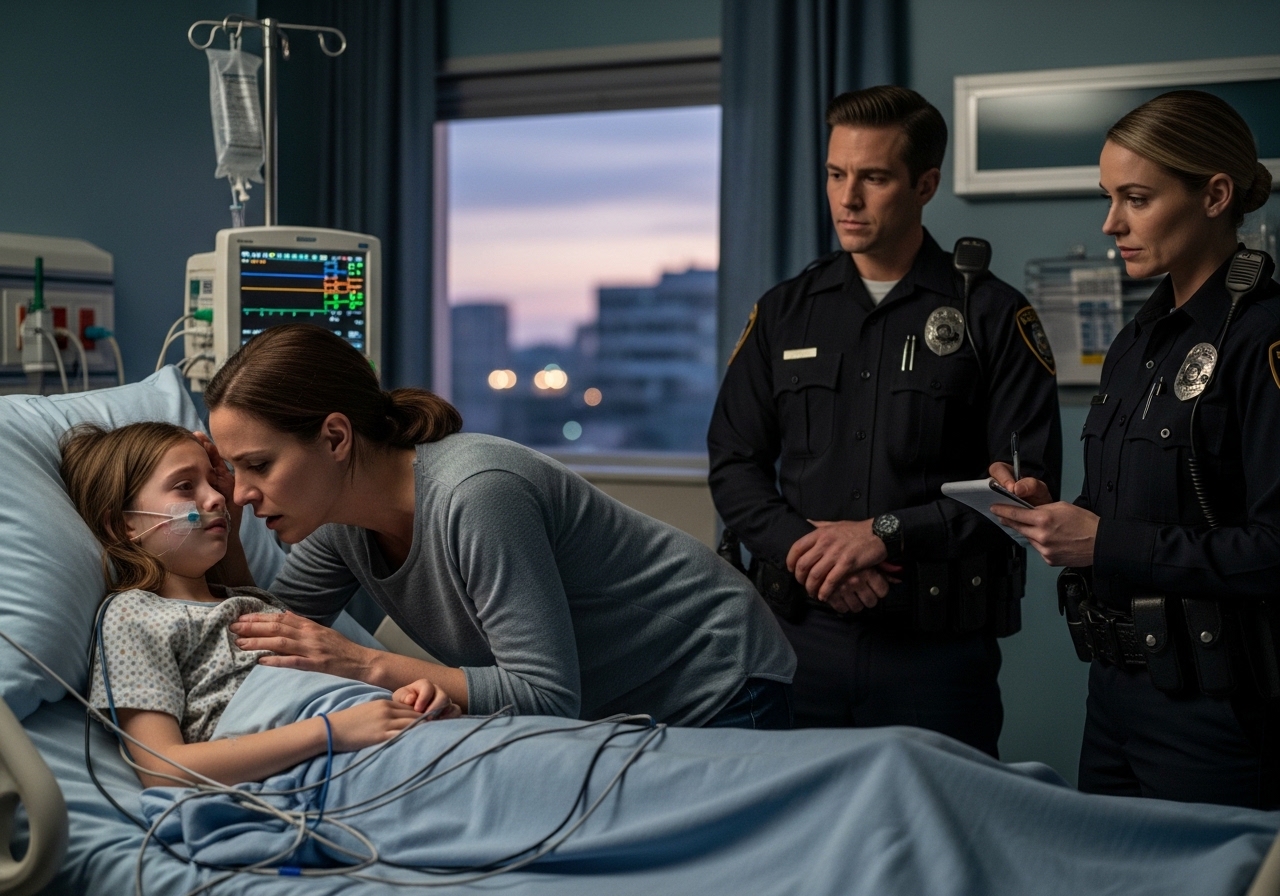
Grace looked impossibly small in the bed, her hands wrapped in gauze, her eyes darting to the door when she saw me.
“Daddy,” she whispered.
I dropped to my knees. “I’m here. You’re safe.”
She hesitated. “Please don’t let her come in.”
My chest tightened. “Who, sweetheart?”
“Lauren.”
Grace spoke carefully, as if the words themselves could get her in trouble. She told me about the pantry being locked, about hiding crackers under her bed, about learning to plan around hunger.
“She said I needed discipline,” Grace whispered. “She said I was spoiled.”
Then her voice dropped lower.
“She put my hands in the sink. The water was very hot. She said it would make me better.”
Something inside me shattered.
“She said if I told you,” Grace added, finally meeting my eyes, “you’d send me away because I was difficult.”
I held her face gently. “I’m so sorry I didn’t see it. I will never let anyone hurt you again.”
When Lauren arrived, escorted by police, she looked irritated—not worried. She smiled too quickly.
“This is a misunderstanding,” she said. “Children exaggerate.”
I stood slowly. My voice was calm in a way that surprised even me.
“You starved my daughter.”
She scoffed. “I was teaching boundaries.”
The officer cut in. “Medical staff confirmed non-accidental injuries.”
As handcuffs closed around her wrists, Lauren stared at me in disbelief. “You’ll regret this. You can’t do this alone.”
I didn’t answer. Grace’s grip on my sleeve told me everything I needed to know.
The weeks that followed were filled with therapy sessions, meetings, and quiet conversations where silence spoke louder than words. I resigned from my job. Sold the house filled with ghosts. We moved into a small apartment flooded with light and an always-open kitchen.
Grace hoarded food at first. Instead of correcting her, I sat on the floor and said, “There will always be enough.”
When she spilled a glass of milk one night and burst into tears, I knelt beside her. “Accidents happen. We clean them together.”
She stared at me, then laughed—a sound so rare it felt like a miracle.
Months passed. The scars on her hands faded. One afternoon she asked, “Do they look strange?”
I kissed each mark. “They show how strong you are.”
She leaned into me. “I love you, Dad.”
That was the moment I understood that everything I’d chased before was insignificant. Real success had nothing to do with titles or numbers—but with presence, protection, and the courage to face uncomfortable truths.
That morning call didn’t end my life.
It gave me a new one.