Stories Eagle — January 25, 2026
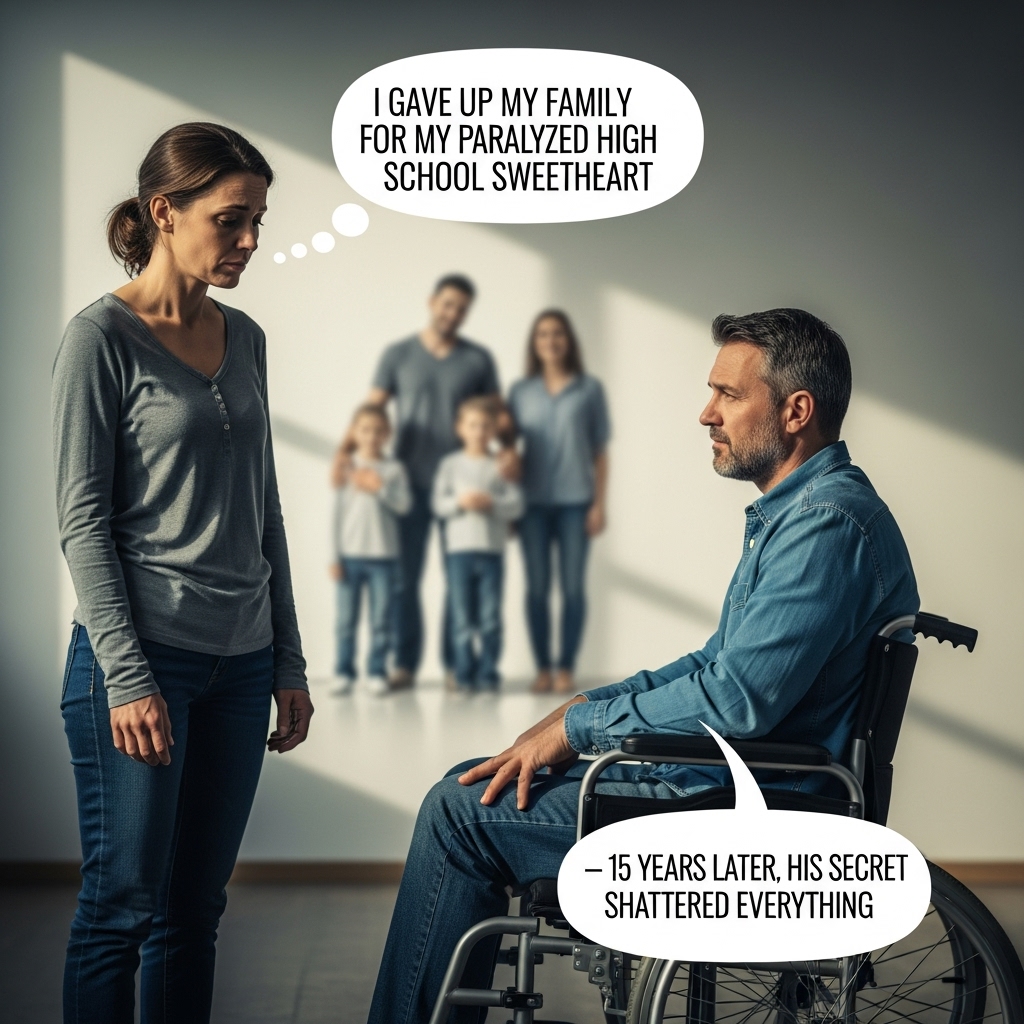
At seventeen, I chose my paralyzed high school boyfriend over my wealthy parents. They disowned me for it.
Fifteen years later, my past walked into my kitchen — and destroyed the love story I thought had survived everything.
I met my husband in high school.
He wasn’t flashy. There were no dramatic gestures or movie-style romance. Just a quiet certainty. The kind of love that felt safe. Familiar. Like home.
We were seniors, deeply in love, convinced the future would bend in our favor. We believed we were untouchable.
We weren’t.
A week before Christmas, everything collapsed.
He was driving to his grandparents’ house on a snowy night — or at least, that’s what I believed for the next fifteen years.
The call came while I was on my bedroom floor, wrapping gifts.
His mother was screaming into the phone. I barely understood her through the sobs.
“Accident.”
“A truck.”
“He can’t feel his legs.”
The hospital smelled like disinfectant and fear. Harsh lights. Endless beeping.
He lay in the bed, surrounded by wires and rails, a neck brace holding him still. His eyes were open.
“I’m here,” I whispered, gripping his hand. “I’m not leaving.”
The doctor pulled us aside.
“Severe spinal cord injury,” he said. “Paralysis from the waist down. We don’t expect recovery.”
His mother collapsed into tears. His father stared at the floor.
I went home numb.
My parents were waiting at the kitchen table, faces tight, like this was a business negotiation.
“Sit down,” my mother said.
“He was in an accident,” I told them. “I’m going to be at the hospital as much as I can—”
“This is not what you need,” she interrupted.
I stared at her.
“You’re seventeen,” she said. “You have a future. College. A career. You cannot chain yourself to this.”
“To what?” I snapped. “To my boyfriend who just got paralyzed?”
My father leaned forward. “You’re young. You’ll meet someone healthy. Successful. Don’t destroy your life.”
I laughed because it sounded absurd.
“I love him,” I said. “I loved him before the accident. I’m not abandoning him now.”
My mother’s eyes went cold. “Love won’t pay bills. Love won’t lift him into a wheelchair. You don’t understand what you’re choosing.”
“I understand enough,” I said. “I know he’d do the same for me.”
She folded her hands. “Then you do this without us. No financial help. No safety net.”
I stared at her. “You’d really cut off your only child for this?”
“We won’t fund you ruining your future,” my father said.
The argument went nowhere. I cried. I begged. They stayed calm and unmoved.
Finally, my mother said, “Him or us.”
My voice shook. “Him.”
The next day, my college fund was gone. My father handed me my documents.
“If you want to be an adult,” he said, “act like one.”
I lasted two more days in that house.
Then I packed a duffel bag — clothes, books, a toothbrush — and stood in my childhood bedroom, staring at the life I was leaving behind.
And I walked out.
His parents’ house was small and worn, smelling of laundry and onions. His mother opened the door, saw my bag, and didn’t ask a question.
“Come in, baby,” she said. “You’re family.”
I broke down right there.
We built a life from scraps.
I went to community college instead of my dream school. Worked coffee shops and retail. Learned things no teenager should — catheter care, transfers, insurance battles.
I convinced him to go to prom.
“They’ll stare,” he said.
“Let them,” I replied.
They did stare. But friends showed up. Made space. Made jokes. My best friend Jenna hugged me and teased him until he laughed.
We danced under cheap lights, his hands on my hips, and I remember thinking: If we can survive this, nothing can break us.
After graduation, we married in his parents’ backyard. Folding chairs. Costco cake. A clearance-rack dress.
No one from my family came.
I kept glancing at the street, hoping.
They never showed.
“In sickness and in health,” we promised each other — less a vow than a description of our lives.
We had a son a few years later.
I sent a birth announcement to my parents’ office.
No reply.
Fifteen years passed.
We struggled, but we made it. He earned a degree online, got a remote IT job. Calm, patient — the guy who could talk anyone through a computer problem.
We argued sometimes. Money. Stress. Burnout.
But I believed we were solid.
Until the day I came home early.
I opened the door and heard voices in the kitchen.
One was my husband’s.
The other stopped my heart.
My mother.
She stood at the table, furious, waving papers at him. He sat frozen in his wheelchair, pale.
“How could you lie to her for fifteen years?” she shouted.
“Mom?” I said.
She turned. Pain flickered across her face — then anger returned.
“Sit down,” she said. “You deserve the truth.”
My husband looked at me, eyes full of tears.
“I’m so sorry,” he whispered.
The papers shook in my hands.
Printed emails. Messages. A police report.
The date of the accident.
The route.
An address that wasn’t his grandparents’.
And Jenna’s name.
Messages from that night.
“Can’t stay long. Need to get back before she suspects.”
“Drive safe. Love you.”
My stomach dropped.
“He wasn’t driving from his grandparents,” my mother said. “He was leaving his mistress.”
I looked at my husband.
“Tell me she’s lying.”
He couldn’t.
Before the accident, he’d been seeing Jenna. For months. He panicked. Lied. Let me believe he was blameless — because he knew I’d stay.
And I did.
I gave up my family for a lie.
“You took away my choice,” I said quietly.
My mother apologized. For cutting me off. For staying silent. But my heart couldn’t hold that yet.
I told my husband to leave.
“Where am I supposed to go?” he asked.
I laughed once. Bitter.
“That’s what I had to figure out at seventeen.”
I packed for myself and our son.
This time, I wasn’t afraid.
My parents opened the door and saw their grandson for the first time. They broke down.
They apologized. Again and again.
I didn’t say it was okay.
But I let them help.
The divorce was painful but necessary. We arranged custody. Logistics. A fragile peace.
Our son knows the gentle version.
“Dad made a big mistake,” I told him. “Lying breaks trust.”
I still cry. I still miss the life I thought I had.
But I’m rebuilding — with work, a small apartment, and a slow, careful reconciliation with my parents.
I don’t regret loving him.
I regret that he didn’t trust me with the truth.
Love is brave.
But truth is how you survive.