Losing my parents changed everything. But it wasn’t until the will was read that I realized just how truly alone I was.
I always thought grief would crash over me like a violent wave. Instead, it trickled in slowly. A voicemail from a stranger. A sterile hospital waiting room at 3 a.m. Two police officers who couldn’t meet my eyes.
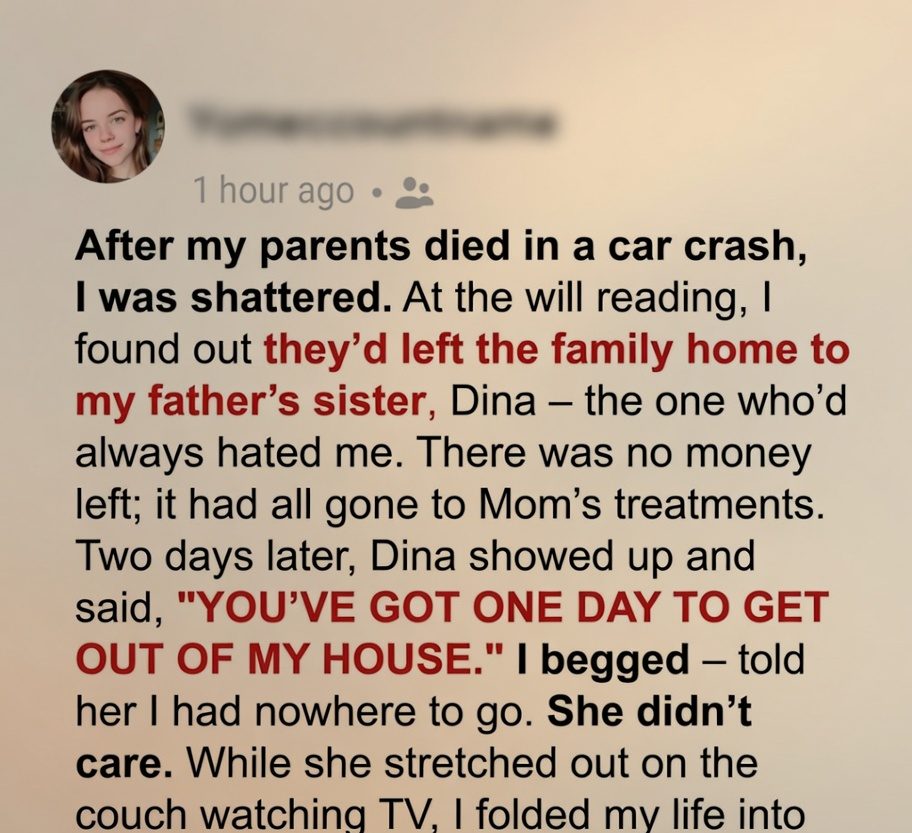
My name is Rachel. I’m 19. Last fall, my world shattered when my parents died in a car crash. One minute they were heading to dinner. The next, I stood in that cold hallway clutching cheap vending machine coffee, desperately wishing I could turn back time.
After the funeral, the house felt unbearably quiet. I kept expecting to hear Mom humming in the kitchen or Dad calling from the garage. I rarely left my room except to feed the cat and heat up frozen meals. Grief has a way of shrinking your entire world.
Then came the will reading.
I arrived in borrowed black slacks and a blazer that still carried my mom’s faint perfume. My hands shook so badly I twisted the hem of my shirt like a lifeline.
Across from me sat Aunt Dina — my dad’s sister, though I’d never heard him speak kindly of her. She wore a tight red dress, as if heading to a cocktail party rather than a meeting about her dead brother’s estate. She didn’t cry. She didn’t even pretend.
The lawyer cleared his throat. “According to the will, the house passes to Ms. Dina.”
I blinked hard. “I’m sorry… what?”
Dina smiled like a cat that had just swallowed the canary. “You heard him.”
“That’s not possible,” I said, my voice trembling. “My parents would never do that. She hated my mom. She barely spoke to us.”
The lawyer shifted uncomfortably. “This is what’s documented. The will appears valid and properly signed.”
I felt the air leave the room. “There has to be a mistake.”
“There’s no mistake,” Dina said, leaning back as if she already owned everything. “It’s my house now.”
I left the office completely numb, replaying every memory of my parents and trying to understand how this could happen. I kept hoping someone would call and say it was all a terrible clerical error. No one ever did.
Two days later, she showed up at the door.
I answered in pajamas and fuzzy socks. She skipped any small talk.
“You’ve got one day to pack and get out,” she said, arms crossed. “I want the place cleaned before I move in.”
My heart sank. “Dina, I don’t have anywhere else to go.”
She shrugged. “Not my problem.”
“I’m your niece.”
“Correction,” she said, stepping past me like she already owned the floor. “I’m your landlord now. And I want you out.”
I tried pleading. I offered to find a job, help with bills, do anything. She just rolled her eyes and flopped onto the couch.
“Can you move? You’re blocking the TV.”
So I packed.
I didn’t sleep that night. I moved slowly through the house, folding clothes into suitcases and wrapping photo frames carefully in towels. Every corner held memories: Dad teaching me to ride my bike in the backyard, Mom dancing with me in the kitchen, birthday parties with homemade cake and the warm smell of cinnamon.
Dina spent the night watching reruns, eating chips, and tossing occasional passive-aggressive comments.
“You always did have too much stuff.”
“I’m packing as fast as I can,” I whispered, not daring to look at her.
The next morning was dull and humid. I stood on the front steps with two suitcases and my mom’s dying peace lily from the kitchen window. My eyes burned, but I refused to let the tears fall in front of her.
I turned for one last look at the only home I had ever known. The windows, the porch swing, the cracked path to the mailbox — they all felt like ghosts now.
And that’s when I saw it.
A sleek black limousine glided down the street like something from a movie and stopped right in front of the house.
I frowned. Dina definitely didn’t have limo money — unless scamming her dead brother came with unexpected perks.
I was about to drag my bags down the driveway when the door opened.
“Rachel?”
I froze.
A tall man in a sharp gray suit stepped out. He had sharp cheekbones, neatly combed dark hair, and the kind of confident posture that spoke of money and good manners. He adjusted his tie and looked straight at me.
“Uncle Mike? Is that really you?”
I could hardly believe my eyes.
He smiled, softer now. “You’ve grown, kid. Last time I saw you, you were still into glitter pens and drawing cats on everything.”
I laughed through the confusion. “And you were the guy who gave me a fountain pen for Christmas when I was eleven. I thought it was a wand.”
He chuckled. “Not far off. Pens can be powerful. And this time, I brought a different kind of magic.”
I stared at him, still unsure if this was a dream. “What are you doing here?”
Uncle Mike held up his phone. On the screen was a photo that twisted my stomach. There was Dina, posing smugly in the doorway of our house, wearing oversized sunglasses and that awful leopard-print scarf she thought looked glamorous.
The caption read: “New beginnings! So proud to finally have what was meant for me.”
My chest tightened. “She posted that? Seriously?”
“I saw the Facebook post last night,” Mike said, slipping the phone away. “Your dad would have lost it. So I started digging.”
Before I could respond, two police cruisers turned the corner and pulled up to the curb. My eyes widened.
“What… what is this?”
Mike stayed calm. “Just stay close. It’ll be alright.”
The officers stepped out. We walked toward the house together — me, Uncle Mike, and two officers — like some unexpected parade of justice. I gripped the peace lily pot tighter. The petals trembled slightly in the breeze.
Dina opened the door just as we reached the porch. She wore an expensive-looking silk robe and held a mimosa like it was her morning routine.
Her face twisted. “Rachel? What are you doing here? You can’t just—”
“Don’t,” Mike said calmly, raising a hand. “Just don’t finish that sentence.”
He turned to the officers. “May I?”
One nodded.
Mike opened his briefcase and pulled out a thick folder. “This,” he said, flipping it open, “is proof that Ms. Dina submitted a forged will. The original never existed. We have confirmation the document was created after your parents’ death, and the signature was traced from a medical consent form.”
“What?” I breathed.
He continued steadily. “The lawyer who read the will was paid in cash and had no active license. We’ve tracked everything — bank statements, handwriting analysis, witness accounts. It’s all here.”
Dina’s drink sloshed. “This is ridiculous! You can’t prove anything!”
“Oh, but we already have,” Mike replied, his voice calm yet firm as steel.
I watched her deflate in real time. Her lips parted, then closed. Her eyes darted toward the officers, searching for an escape that wasn’t there.
One officer stepped forward. “Ms. Dina, we need you to come with us.”
She stammered, “I… I need to call someone—”
“You can do that from the police station,” the officer said, pulling out handcuffs.
She yelped as they cuffed her right there on the porch, spilling her drink over her pink slippers.
I stood there watching her squirm. I didn’t feel triumphant or angry. I just felt tired — the good kind of tired, like finally exhaling after holding your breath far too long.
As the cruisers drove away, Uncle Mike stood beside me and sighed deeply.
“I can’t believe she did that,” I whispered.
“She was always jealous of your dad,” he said quietly. “Even when we were kids. But this crossed every line.”
I nodded slowly, my fingers brushing the edge of the peace lily’s pot.
“You’re not alone, Rachel,” he added gently. “You’re not. I should have come sooner.”
Three months later, the case went to court. It turned out my parents had never made a will at all — they never expected to leave us so young. With no valid will, the court ruled I was the rightful heir. The house was mine. Dina’s name was erased from every document as if she had never touched it.
Her fake real estate listing disappeared. The keys she had bragged about were quietly handed back to me outside the courtroom.
Uncle Mike also sued her for legal fees, emotional damages, and fraud.
She didn’t just lose the house.
She lost everything.
I heard through a neighbor that she now lives in a cramped one-bedroom above a vape shop on the far side of town — flickering lights, no central air. A far cry from the luxury kitchen she used to flaunt online.
As for me?
I’m home.
That simple sentence still feels surreal. I sit in the living room where I once built blanket forts with Mom. The couch has a fresh cover, and the air smells like cinnamon again. I’ve started planting new flowers and fresh herbs in the kitchen — basil, lavender, rosemary.
And the peace lily?
It bloomed last week.
I stood staring at it for a long time. Its white petals opened like a quiet, stubborn sigh — just like me.
Uncle Mike visits sometimes with his thoughtful, slightly odd gifts: a vintage chess set, a fancy notebook. He even helped fix the leaky bathroom faucet last Sunday.
“You’re tougher than you think, Rachel,” he said, handing me a wrench. “Your dad would be proud.”
I smiled. “Thanks, Uncle Mike. For everything.”
He shrugged. “What are uncles for?”
I still miss my parents every single day. But I’m learning to build something new from the ashes — not just a home, but a real future.
And that peace lily stays right by the window, where it belongs.