Chapter 1: The Hostile Takeover
The sacred, restorative quietude of my Hudson Valley villa was the only thing that kept me sane. As a high-powered tech consultant specializing in global corporate security infrastructure, my life was a whirlwind of international flights, high-stakes boardroom negotiations, and constant digital warfare. My home, nestled on five acres of pristine, wooded land, was my fortress. I had designed every inch of it. I had custom-built the smart-home server that controlled the climate, the security gates, the reinforced windows, and the lighting.
It was my sanctuary. And as I pulled my sleek sedan into the long, winding driveway after a grueling, two-week deployment in Tokyo, all I wanted was a hot shower in my custom marble bathroom and a glass of wine in silence.
Instead, the tranquil air of the valley was shattered by the rhythmic, obnoxious thumping of heavy bass.
I stopped the car. Three bloated, gas-guzzling SUVs were parked haphazardly across the manicured gravel, completely blocking the entrance to my three-car garage.
My heart sank, a heavy, familiar dread settling into my stomach.
I hauled my luggage up the front steps and unlocked the heavy mahogany door. The interior of the house was a chaotic, unrecognizable nightmare. The pristine, minimalist aesthetic I had curated was buried under a mountain of cheap plastic toys, discarded shoes, and half-empty beer bottles. A gaggle of screaming toddlers I barely recognized were sprinting through the formal dining room, smearing sticky hands against the glass tables.
In the center of the living room, lounging comfortably on my custom, $15,000 Italian leather sofa, was Eleanor.
Eleanor was my mother-in-law. She was a vicious, status-obsessed woman who possessed absolutely no wealth of her own, but wore my success like a rented designer gown, constantly bragging to her country club friends about her son’s “magnificent estate.”
She didn’t even rise when I walked in. She simply looked over her wine glass, offering a tight, condescending smirk.
“Oh, Sarah. You’re back early,” Eleanor announced casually, not bothering to lower the volume of the terrible pop music blaring from my integrated sound system. “The cousins decided to stay for the season. The city was just getting too stifling for the little ones.”
“Stay for the season?” I repeated, my voice tight. “Eleanor, this is a private home. We didn’t agree to host a family reunion.”
“Well, Julian said it was fine,” she sniffed, waving a dismissive, heavily ringed hand. “And since space is a bit tight with the babies, I took the liberty of reorganizing your things.”
Reorganizing your things.
The words hit me like a physical blow. I dropped my suitcase in the foyer and sprinted up the sweeping glass-and-steel staircase, my boots echoing like thunder against the hardwood.
I burst into the master suite. My sanctuary.
My custom-made, king-sized bed had been stripped of its Egyptian cotton sheets. The mattress was shoved against the wall to make room for three cheap, inflatable air mattresses currently occupied by sleeping teenagers.
I tore open the doors to my massive, walk-in cedar closet.
It was empty.
My entire designer wardrobe—the bespoke suits, the vintage dresses, the expensive heels I had bought to mark every hard-won professional milestone over the last decade—was gone.
I stepped backward out into the hallway, my vision blurring with sheer, unadulterated shock. Sitting in a pile near the laundry chute were six heavy, black, industrial-sized Hefty trash bags. They were bulging awkwardly. I ripped one open. My silk blouses and tailored slacks were shoved inside, wrinkled and treated like literal garbage.
“What the hell is going on here?!” I finally screamed, the sheer audacity of the violation breaking through my exhaustion.
From the guest bedroom down the hall, Julian finally emerged.
Julian, my husband of three years. A man who claimed to be a “freelance venture capitalist,” but whose primary occupation was spending my money, making excuses for his lack of income, and letting his mother dictate our lives. He was holding a glass of cheap gin, the smell wafting down the hallway.
He didn’t look apologetic. He avoided my gaze, rubbing the back of his neck as if my presence were a massive inconvenience.
“Keep your voice down, Sarah, the kids are napping in the other room,” Julian sighed, leaning against the doorframe. “The family has had a rough fiscal year. Mark lost his job, and Chloe’s apartment had a plumbing issue. They needed a place to crash.”
“They shoved my clothes into garbage bags, Julian!” I yelled, pointing to the plastic sacks. “They took over my bedroom! Where exactly am I supposed to sleep?!”
Julian finally looked at me, his eyes cold and defensive. He was a weak man, emboldened only by the physical presence of his aggressive family downstairs.
“Eleanor suggested you’d be far more comfortable in the garden shed,” Julian stated, his voice devoid of any warmth or marital loyalty. “We put a cot out there for you. It has electricity. You’re always working on that laptop anyway; you probably won’t even notice the difference. Stop being so territorial, Sarah. It’s incredibly unbecoming of a wife.”
I stared at the man I had once loved. I looked at his pathetic, arrogant face, and the horrific reality of my marriage crystallized in a single, undeniable instant.
He didn’t view me as a partner. He didn’t even view me as a human being. I was just a utility. A bank account. A host for his parasitic family to feed on. He had physically discarded me from the home I bought, expecting me to quietly accept my exile to a shed so his mother could play the matriarch.
My heartbreak didn’t result in tears. It didn’t result in a screaming match. It instantly calcified into a cold, lethal precision. The compliant, exhausted wife died right there in the hallway.
And the architect of their ruin was terrifyingly born.
“The garden shed?” I asked softly, my voice dropping to a low, even register that should have absolutely terrified him.
“Precisely,” Julian snapped, turning his back on me and walking back into the guest room, emboldened by the sound of his family’s laughter echoing up the stairs. “Grab your bags and go. We’re having a toast on the balcony.”
I didn’t argue. I didn’t beg for my own bedroom.
I calmly picked up two of the heavy black trash bags containing my expensive clothes. I walked back down the stairs, past Eleanor, who smirked victoriously at my apparent submission. I walked out the back door, across the sprawling, manicured lawn, and opened the door to the dark, cedar-shingled garden shed.
Chapter 2: The Digital Guillotine
The shed was cold, smelling faintly of fertilizer and old wood. A cheap, canvas folding cot sat in the corner under a single, bare lightbulb.
I dropped the trash bags onto the dirt floor. I didn’t sit on the cot. I sat cross-legged on a large, plastic bag of potting soil.
Through the small, dusty window of the shed, I could see the massive, glowing rear facade of my villa. The floor-to-ceiling glass doors were open. I could hear Julian, Eleanor, and their extended family out on the expansive stone balcony. The clinking of my expensive crystal wine glasses drifted across the lawn, followed by Eleanor’s loud, triumphant, arrogant toast to “family sticking together.”
They were completely separated from reality. They were drunk on their own delusion of power.
They thought they had humiliated me. They thought they had kicked me out of my own life. They were entirely, fatally unaware that while they had remembered to take my bedroom, they had forgotten to confiscate the only weapon that actually mattered.
I reached into my sleek leather tote bag and pulled out my primary workstation laptop.
I flipped the screen open. The glow illuminated the dark, dusty shed, casting harsh shadows across my face.
I didn’t open a word processor to draft an angry email. I didn’t open a browser to search for divorce lawyers. I didn’t need a lawyer to execute the first phase of my retaliation.
My fingers flew across the keyboard. As the chief systems engineer for a global security firm, I hadn’t just bought the villa; I had wired its entire digital nervous system myself. The house didn’t run on standard, commercial smart-home hubs. It ran on a proprietary, military-grade central server architecture located in a locked, climate-controlled utility closet in the basement—a closet Julian didn’t even have the physical key to.
I bypassed the standard, user-friendly interface that controlled the lights and music. I opened a stark, black command-line terminal, diving deep into the root access of the villa’s mainframe.
I began to type lines of complex, encrypted code.
They wanted my house. I was going to give it to them. I was going to turn it into a technologically inescapable, freezing nightmare.
COMMAND: Override localized thermostat controls.
TARGET: Zones 1 through 5 (Main House).
SET PARAMETER: 45 Degrees Fahrenheit. Lock.
COMMAND: Override electronic perimeter security.
TARGET: Main Entry, Garage, Patio Doors, Reinforced Smart-Windows.
SET PARAMETER: Engage Deadbolts. Disable Internal Manual Override. Lock.
I watched the lines of code execute flawlessly, a brutal, silent digital strike launching from the shed directly into the heart of the mansion.
I paused, my finger hovering over the final, most devastating command. The one that would sever their ability to reverse what I had just done.
“Initiating full system encryption,” I whispered into the dark.
I hit ENTER.
A progress bar flashed across the screen. Encrypting Master Server… 20%… 50%… 100%.
SYSTEM LOCKED. REQUIRE 256-BIT RSA KEY FOR ACCESS.
I had just digitally severed the spinal cord of the entire house. The smart-panels on the walls inside the villa were now useless pieces of glass. The network was a black box.
I leaned back against the wooden wall of the shed, taking a slow, refreshing breath of the crisp night air. I closed my laptop, plunging the shed back into darkness.
I was completely unbothered by the fact that inside the glowing mansion, the high-end HVAC system had just violently shifted gears, pumping blasts of freezing, 45-degree air into every room. I didn’t care that simultaneously, every heavy, electronic deadbolt on the exterior doors had just slammed shut with a heavy, ominous, synchronized CLICK, sealing them inside.
Chapter 3: The High-Tech Prison
For the first twenty minutes, the family on the balcony didn’t notice the trap springing shut. They were too busy drinking my wine and celebrating my exile.
But as the chill of the autumn night began to set in, Eleanor shivered, wrapping her arms around her silk blouse. “Julian, it’s getting terribly brisk out here. Be a dear and open the patio doors. Let’s move the party inside to the living room.”
Through the window of the shed, I watched Julian confidently stride over to the massive, sliding glass patio doors. He grabbed the heavy stainless-steel handle and pulled.
The door didn’t budge.
Julian frowned, gripping the handle with both hands, yanking harder. His customized leather loafers slipped slightly on the stone deck. The heavy, reinforced glass remained entirely, stubbornly sealed.
“Julian, what is the holdup?!” Eleanor barked, shivering visibly now. “The babies are getting cold!”
“The door is stuck, Mom,” Julian muttered, a hint of annoyance in his voice. He reached over to the glowing, digital smart-panel mounted on the exterior brick wall, intended to control the patio locks and outdoor lighting.
He tapped the screen.
The screen didn’t display the usual menu of options. It displayed a single, pulsing, bright red lock icon.
“What the hell…” Julian whispered, tapping the screen harder. “The panel is frozen.”
Inside the villa, the booming bass of the terrible pop music they had been blasting abruptly died. A split second later, every single light in the house—the crystal chandeliers, the recessed kitchen lighting, the hallway sconces—flickered violently and went completely, suffocatingly dark.
The grand banquet was plunged into pitch-black confusion.
“Julian! Fix the breaker!” Eleanor shrieked, her voice pitching into a hysterical whine. “My guests can’t see the hors d’oeuvres! It’s freezing in here!”
I watched as the panicked shadows of Julian’s extended family began to scramble. Julian pulled out his smartphone, using the flashlight app to navigate the dark, freezing house. He rushed to the front foyer, intending to open the heavy mahogany front doors to check the external fuse box on the side of the house.
He grabbed the brass handles and threw his weight backward.
The doors refused to open. The electronic deadbolts, sunk deep into the reinforced steel doorframes, were fully engaged.
“The doors won’t open!” Julian shouted, panic finally bleeding rapidly into his voice. He ran to the living room, trying to unlatch the massive, reinforced smart-windows. They were sealed shut, locked down by the emergency perimeter protocol I had triggered.
“We’re locked in!” Chloe’s husband yelled from the kitchen, his breath visibly pluming in the freezing air. The temperature in the house was plummeting rapidly as the AC units roared at full blast, turning the luxury villa into a sprawling, $800,000 meat locker.
“Call the police!” Eleanor shrieked, genuine, hyperventilating terror replacing her arrogant entitlement. The toddlers began to wail loudly in the dark, terrifying house.
Julian desperately pulled out his phone, dialing 911 with shaking fingers. He held it to his ear, waiting for the ring.
He waited. And waited.
He pulled the phone away, staring at the screen in absolute horror. NO SERVICE.
Out in the garden shed, illuminated only by the faint, blue glow of my laptop screen, I wasn’t looking at the house controls anymore. I had anticipated his attempt to call for help. Ten minutes prior, I had remotely accessed the villa’s commercial-grade Wi-Fi routers, initiating a localized signal-jamming protocol that effectively created a dead zone over the entire property. They couldn’t call out. They couldn’t access the internet. They were entirely, completely cut off from the world.
With the physical trap securely locked, I moved on to the financial execution.
I opened a secure, encrypted browser window and logged into my offshore, high-yield corporate banking portal.
For three years, I had maintained a joint checking account with Julian. I deposited thirty thousand dollars into it every month to cover “household expenses” and fund his pathetic, non-existent venture capital projects. The account currently held roughly $200,000 in liquid cash.
I didn’t hesitate. With three rapid, emotionless keystrokes, I initiated an immediate, total wire transfer.
I systematically, methodically drained the joint account down to exactly zero dollars and zero cents. I routed the massive sum directly into my impenetrable, heavily guarded corporate trust—an entity Julian legally had absolutely zero access to, protected by the ironclad prenuptial agreement he had arrogantly signed, assuming he would never need it.
Next, I navigated to the credit card portals. I canceled his primary platinum card. I canceled his secondary black card. I canceled the gas cards.
I sat in the cold, dark shed, listening to the muffled, frantic screams of my in-laws echoing from the freezing, pitch-black mansion. I had just digitally, financially, and legally erased Julian’s entire existence, leaving him with exactly zero dollars to his name, trapped inside a freezing cage of his own making.
Chapter 4: The Eviction
I didn’t sleep that night. I sat in the shed, wrapped in a cashmere coat I had pulled from one of the trash bags, drinking from a bottle of water I had in my tote, watching the sun slowly begin to rise over the Hudson Valley.
It was 6:00 AM. The sky was painted in brilliant, cold hues of pink and orange.
Inside the house, the frantic banging and screaming had died down hours ago, replaced by exhausted, shivering silence. They had spent a terrifying, freezing night huddled together under expensive Persian rugs in the pitch-black living room, unable to escape the 45-degree chill.
It was time to end the siege.
I opened my laptop. With a few quick commands, I disabled the signal jammer, restoring cellular service to the property. Then, I bypassed the encryption on the front gate security protocol.
At exactly 6:05 AM, the massive, wrought-iron gates at the end of my sprawling driveway glided open with a smooth, mechanical hum.
Tearing up the manicured gravel driveway were three white-and-green Sheriff’s cruisers, their lightbars flashing silently in the dawn light. Following closely behind them was a heavy, black, unmarked van belonging to Aegis Tactical, a private, elite security firm I frequently contracted for corporate protection.
I had scheduled this emergency, hostile eviction dispatch late last night via an encrypted email to my lead attorney.
Simultaneously, as the cruisers parked in front of the house, I executed the final command line on my laptop.
The heavy, mahogany front doors of the villa unsealed with a loud, synchronized CLACK.
The doors slowly swung open.
Julian, Eleanor, and the extended family stumbled out onto the sprawling stone porch. They looked like a band of terrified, freezing refugees. They were wrapped in expensive throw blankets, shivering violently, their faces pale and exhausted.
Eleanor saw the Sheriff’s deputies stepping out of their vehicles and immediately began waving her arms hysterically.
“Thank God you’re here! Arrest her! She locked us in!” Eleanor screamed, her voice a hoarse, ragged croak, pointing a trembling finger toward the garden shed. “She tried to freeze us to death! That woman is a psychopath!”
The lead Sheriff’s deputy, a tall, imposing man resting his hand casually on his utility belt, completely ignored the screaming woman in the blanket.
He turned his attention to me.
I pushed open the door of the cedar shed. I didn’t look like a victim who had slept on a bag of potting soil. I was wearing a crisp, tailored trench coat over my designer slacks. My posture was perfect. My face was a mask of cold, unyielding, absolute authority.
I walked across the damp morning grass, my boots crunching on the gravel, and handed the lead officer a heavy, heavily stamped legal folder.
“Good morning, Deputy,” I stated clearly, my voice carrying over the shivering, shocked silence of my in-laws. “The people standing on my porch are currently trespassing on a property owned entirely by my corporate LLC. I did not invite them. I did not authorize their presence.”
Julian’s jaw dropped. “Sarah, what the hell are you doing?! We are married! This is my house too!”
I didn’t even look at him. I kept my eyes locked on the deputy.
“Inside that folder,” I continued, “is the original, certified deed to this estate, proving sole ownership. Also enclosed are the expedited, fault-based divorce papers I filed electronically at 3:00 AM this morning, citing extreme emotional abuse, financial exploitation, and attempted theft of property.”
The deputy scanned the heavy legal documents, nodding slowly. The paperwork was airtight. The legal trap was completely inescapable.
“You have exactly ten minutes to physically remove these trespassers from my land,” I commanded, my voice dropping to a glacial, terrifying whisper. “If they are not past the gates by 6:20 AM, I will press formal, felony charges for breaking and entering, and I will have my private security team physically throw them onto the highway.”
Julian stared at the divorce papers in the deputy’s hands. The last remaining drop of color violently drained from his face. The arrogant, entitled smirk he had worn yesterday when he ordered me into the shed was entirely gone. He realized, with absolute, crushing, hyperventilating terror, that he had no money, no leverage, and no home.
“Sarah, please!” Julian fell to his knees on the damp, freezing grass of the front lawn. He reached his hands out toward me, sobbing hysterically. “I’m sorry! I’m so sorry! My mom pressured me! I didn’t want to put you in the shed! Please, we have no money! Where are we supposed to go?!”
As the sheriff’s deputies stepped forward, their hands resting cautiously on their tasers, and began physically herding the weeping, shivering, panicked extended family toward their bloated, gas-guzzling SUVs, I looked down at the pathetic, broken man kneeling in the dirt.
“You should try the garden shed, Julian,” I whispered coldly. “I hear it has electricity.”
I turned my back on his screams, walking past the private security contractors, and stepped through the open mahogany doors, back into the quiet, beautiful sanctuary of my own home.
Chapter 5: The System Restored
Six months later, the contrast between the two diverging paths of our lives was absolute, staggering, and undeniably poetic.
In a bleak, cramped, two-bedroom apartment on the loud, industrial edge of the city, Eleanor sat bitterly on a cheap, sagging fabric sofa. The sprawling estate she used to brag about was a distant memory. The wealthy, high-society friends she had spent years trying to impress had entirely, ruthlessly abandoned her the moment the rumors spread that she had been legally evicted as a squatter by her own daughter-in-law.
Julian was a broken shell of a man. Without my massive income to subsidize his “venture capital” lifestyle, he was completely unemployable in the high-stakes tech world. He sat at a small, wobbly laminate dining table, weeping quietly over a final, fault-based divorce decree. The judge, presented with the ironclad prenuptial agreement and the evidence of his parasitic financial behavior, had denied him a single cent of spousal support. He was drowning in crippling legal debt, forced to take a minimum-wage data entry job just to keep the lights on in the depressing apartment he shared with his furious, blaming mother.
They were trapped in the exact reality they had created for themselves. The parasites had finally starved without their host.
Miles away from the depressing grey walls of their failure, the morning sunlight was streaming through the massive, pristine bay windows of my $800,000 Hudson Valley villa.
The house was immaculate. Within a week of the eviction, I had hired a professional, high-end cleaning crew to eradicate every sticky fingerprint, every trace of cheap gin, and every lingering memory of my in-laws’ presence. The custom Italian leather sofa was gleaming. My designer wardrobe had been meticulously dry-cleaned, pressed, and hung perfectly back in the restored, sprawling master suite.
I was sitting outside on the expansive stone patio by the infinity pool, wearing a comfortable cashmere sweater, sipping a hot cup of artisanal coffee.
The suffocating weight of my marriage was completely gone. There was no tension in the crisp autumn air. There were no frantic, shrieking demands from a narcissistic mother-in-law. There were no arrogant, condescending sneers from a weak husband.
There was only the immense, empowering weightlessness of absolute safety, and the quiet, beautiful knowledge that I had secured my wealth and my sanctuary entirely through my own intellect and unyielding boundaries.
I opened my laptop, resting it on the glass patio table. The screen illuminated, displaying a massive, multi-million-dollar cybersecurity contract my consulting firm had just secured with a federal agency.
I reviewed the final clauses, my mind sharp and brilliantly focused. The exhaustion that had plagued me for three years wasn’t from my demanding job; it had been from carrying the crushing, parasitic weight of a man who actively drained my energy to fuel his own ego. The moment I cut Julian out of my life, my professional and creative energy had skyrocketed.
I signed the final digital line of the massive tech contract, securing my company’s future for the next decade.
I leaned back, taking a slow, peaceful sip of my coffee. I was completely, blissfully unbothered by the fact that earlier that morning, a pathetic, rambling, begging email from Julian had arrived in my primary inbox. He had pleaded for a small loan, swore he had changed, and begged for a second chance.
I hadn’t read a single word of it. My highly tuned, automated spam filter—which I had specifically coded to recognize his IP address and email domains—had immediately, permanently deleted the message before I even logged on, erasing his voice from my digital universe forever.
Chapter 6: The Architect
Exactly one year later.
It was a warm, vibrant, flawlessly beautiful autumn evening. The leaves on the massive oak trees surrounding the property were painted in brilliant hues of gold, crimson, and burnt orange.
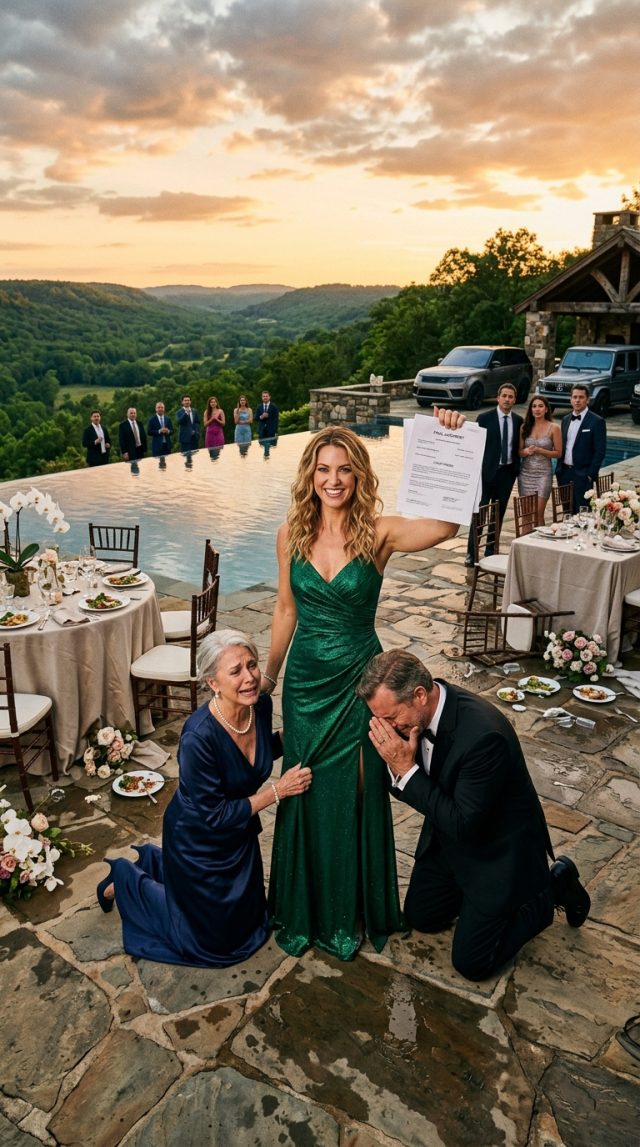
I was hosting a lavish, intimate dinner party on the sweeping, manicured stone terrace of my villa. The space was filled with soft, upbeat jazz music, the clinking of crystal wine glasses, and the genuine, unrestrained laughter of the chosen family, close friends, and brilliant colleagues who brought actual respect and joy to my life.
I was wearing a stunning, flowing emerald-green evening gown, looking vibrant, rested, and profoundly happy.
As I stood near the edge of the terrace, holding a glass of vintage, expensive red wine, my gaze drifted across the sprawling green lawn, settling for a brief, fleeting moment on the dark, cedar-shingled garden shed sitting quietly near the tree line.
I remembered the cold, damp smell of potting soil. I remembered the heavy, dead weight of those black trash bags containing my life’s milestones. I remembered the arrogant, cruel laughter of the people who thought they could discard me from my own empire and force me to live in the dirt.
They had thought they were forcing me into submission. They thought the humiliation of the shed would break my spirit, forcing me to surrender my assets and submit to their parasitic control.
They were entirely, blissfully unaware that they weren’t kicking me out of my house; they were simply handing me the golden, undisputed opportunity to lock them out of my life, and my bank accounts, forever.
The memory no longer held any pain, any betrayal, or any anger. It was just a closed chapter. A brilliant, flawlessly executed line of code on a balanced ledger.
I smiled, taking a slow, refreshing sip of my wine, the complex flavors blooming perfectly on my palate.
I had spent years building secure digital architectures, impenetrable firewalls, and complex security systems for faceless, multi-national corporations. I was an expert at protecting other people’s assets from hostile takeovers. But it took one cold night sitting in a garden shed to finally build an impenetrable, absolute firewall around my own self-worth.
As the terrace erupted into cheers when my lead engineer made a hilarious, heartfelt toast to our recent corporate success, I smiled, raising my glass to the fading sun. I left the dark, pathetic ghosts of my past permanently bankrupt and locked outside in the cold, stepping fearlessly into a brilliantly bright, self-made future where the greatest, most secure system I would ever build was the one that protected my own peace.