When the church doors finally opened, my fiancée wasn’t dressed in white. Instead, she stood there in a wedding gown made entirely from army shirts. The entire room fell silent. Then, halfway down the aisle, she stopped, turned to look at me, and said something that made me believe the wedding might be over before it even began.
For months leading up to that moment, Clara had been acting… different. Every evening after dinner, she would disappear into the spare room at the end of the hallway—a space she had transformed into her sewing room.
With our wedding just six weeks away, she had decided to make her own dress. At first, I didn’t think much of it.
“How’s the dress coming along?” I asked her one night.
She gave me a small smile. “It’s going to be really special.”
Then she walked down the hall, closed the door behind her, and within minutes, the steady hum of the sewing machine filled the house.
That sound became constant. Familiar. Like a second heartbeat echoing through the walls.
One night, I woke up at four in the morning, convinced it was raining outside. But it wasn’t rain—it was the sewing machine, still running.
The next morning, Clara came into the kitchen with her ponytail half undone and dark circles under her eyes.
I stared at her. “Did you even sleep?”
“A little.” She leaned in and kissed my forehead. “I’m okay.”
I didn’t believe her.
Whenever I tried to ask about the dress, she would brush it off lightly, almost playfully.
“Wait a little longer, Mark — our wedding is going to be unforgettable.”
“You haven’t even let your bridesmaids see it?” I asked her once.
“No.”
“My mom is going to faint over that.”
“She’ll survive.”
That was the other complication.
My mother and Clara had always managed to stay polite, but never comfortable. My mother valued tradition and structure. Clara tolerated it—until she didn’t. When pushed too far, she would go quiet, hold everything in, and then eventually erupt.
As the wedding drew closer, I couldn’t help but wonder: was Clara planning something sweet and memorable… or something far more explosive?
I should have asked more questions.
I know that now.
The morning of the wedding, I woke up feeling strangely calm.
At the church, everything was already in motion. Guests were arriving, voices murmuring, footsteps echoing softly across the floor. My parents sat in the front row—perfectly composed. My mother looked flawless, and my father wore that same unreadable expression he reserved for boardrooms and funerals.
I stood at the altar, hands clasped in front of me, trying not to overthink anything.
Then the doors opened.
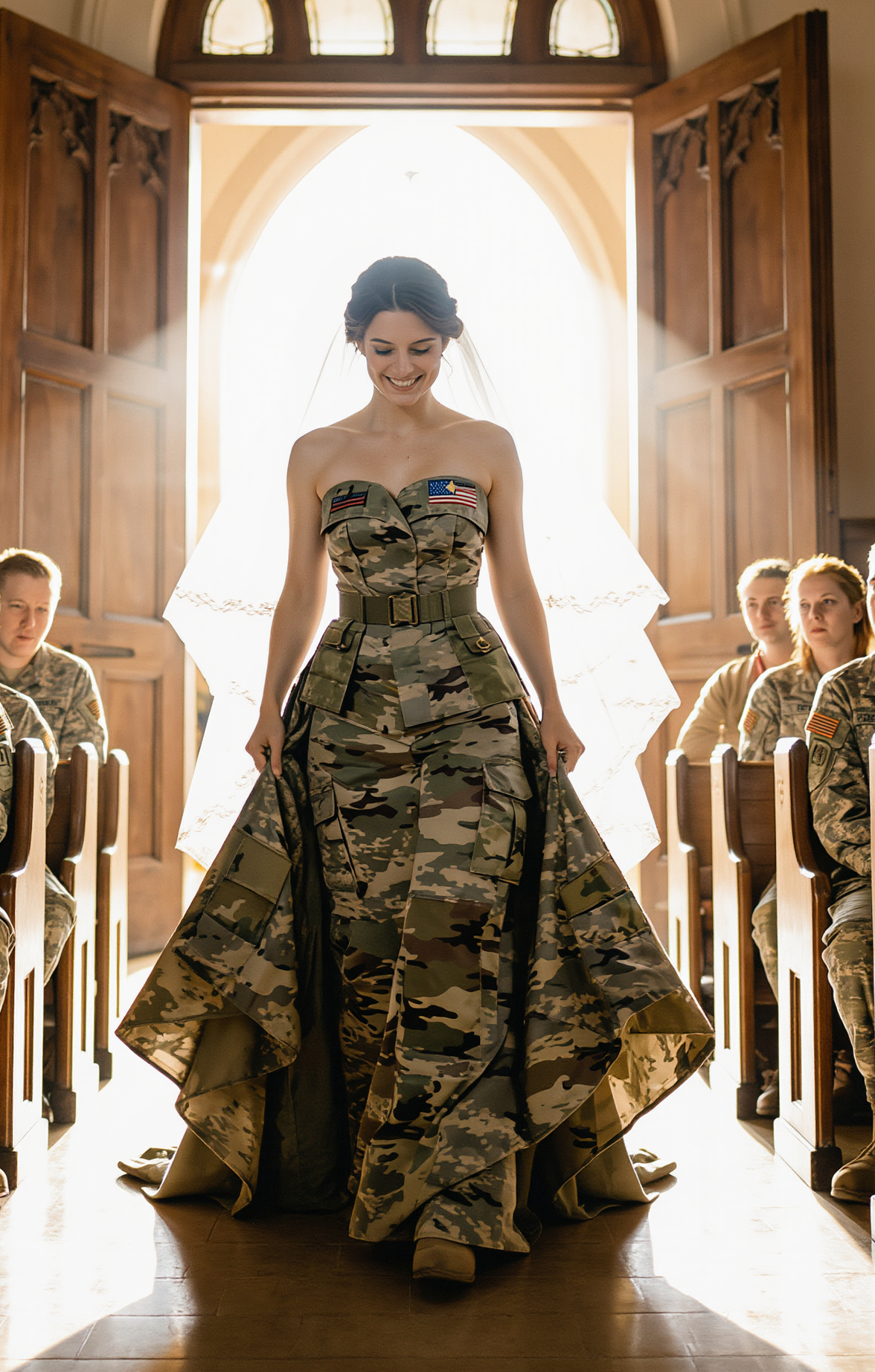
Clara stepped inside—and nothing could have prepared me for what I saw.
She wasn’t wearing white.
The dress itself was stunning in design, but it was made entirely from olive-drab army shirts. Not new ones, either—the fabric looked worn, aged, carrying history in every thread.
At first, a soft rustle moved through the church. Not quite a gasp—more like confusion settling over the crowd.
Then everything went completely silent.
Clara continued walking forward, one hand lightly lifting the skirt, her chin raised with quiet determination.
Halfway down the aisle, she stopped.
Then she turned to face the guests.
“I know this isn’t the dress people expected,” she said, her voice trembling slightly. “But love isn’t always satin and pearls.”
A few murmurs rippled through the room.
“My dad couldn’t be here today.” She gently smoothed her hands over the dress. “So I made sure he still walked me down the aisle.”
Someone sniffled. Then another. Quiet sobs began to spread through the crowd.

My knees nearly gave out.
Her father had died when she was sixteen—ki.lled in action overseas.
Something inside me softened instantly. I thought I understood. I thought this was her surprise.
Then she looked at me.
And the fear and sadness in her eyes made my chest tighten.
I frowned. “Clara?”
“Mark,” she said softly, “I’ll understand if, after what I’m about to say, you want to call off the wedding.”
My stomach dropped.
“What?”
She reached into the lining of her dress and pulled out a folded piece of paper.
“There’s one more reason I made this dress. Something I discovered while I was altering my dad’s shirts. A letter…”
Then she turned her gaze toward my parents.
My mother shifted uncomfortably in her seat.
My father didn’t react outwardly, but he avoided looking directly at her.
“Susan, Carl. When were you planning to tell me that you knew my father?” Clara asked, her voice sharp with restrained anger. “Or did you think you could hide the truth about your relationship and what you did to him forever?”
My heart started pounding wildly.
I stepped down from the altar. “Mom, Dad?”
“My dad wrote this,” Clara continued, lifting the letter. “He wrote it before he deployed, but for some reason, it was never sent. In it, he said he had given everything he could to your business. That he believed in it. That he believed in you.”
I turned to my parents. “What is she talking about?”
Neither of them answered.
“Do you want to hear more?” Clara said, walking further down the aisle. “He says here: ‘I’m doing this for my daughter, Clara. If something happens to me, I need to know she’ll be taken care of. I can’t tell you what a relief it is to know that you’ll ensure she gets her rightful share of the company if it ever comes to that.’”
Whispers began—quiet at first, then growing louder.
Clara reached the front and stopped, staring directly at my parents.
“My rightful share of the company?” she asked quietly.
My mother half-rose from her seat, then sat back down. “This is not the time.”
“Is it true?” I asked.
“Mark,” my father said sharply.
I looked straight at him. “Is it true?”
Clara spoke again, her voice calm but unwavering. “I didn’t come here to humiliate anyone. I came because I found out the life we’re standing in front of was built on something hidden from me.”
The entire church listened.
So did I.
I turned to her and nodded. “Please… I want to hear this.”
My mother finally spoke. “Clara, you are being wildly unfair.”
Clara let out a short, humorless laugh. “Unfair?”
“That letter is being taken out of context.”
“Then explain it.”
My mother glanced around the room—at the guests, the pastor, me—anywhere but Clara. “Certainly, but it’s a private matter, and this is hardly the place.”
“It’s too late for that,” I said firmly. “It’s not private anymore, and this has become the place. So please—start explaining. I want to know the truth. Did you know Clara’s father?” I turned to my father. “Did he invest in the company?”
My father kept his eyes on Clara. “He was a partner in the early stages.”
“Partner?” I repeated.
“Informally,” he said with a slow exhale.
My vision blurred slightly.
“Did you buy him out?”
“He didn’t ask to be bought out.”
Clara’s expression didn’t change. “Because he trusted you to transfer his portion of the company to me.”
Something inside me felt like it was tearing apart.
Then Clara said, more softly, “I can’t marry into this unless it’s named.”

I stepped back.
A collective breath swept through the church. People thought I was walking away—I could feel it.
For one second, maybe Clara thought so too. Her shoulders tensed just slightly—but I noticed.
And the truth is, for that one second, I didn’t know what I was going to do.
I just knew I couldn’t stand there the way I had been.
Then I looked at her.
At the dress she had made with her own hands. At the grief and pride stitched into every piece of it.
I looked into her eyes and saw everything—fear, strength, honesty.
It took courage to stand in front of a room full of people and speak the truth when that truth could cost you everything.
“I’ll name it,” I said.
I stepped forward to stand beside her.
“You were robbed, and you were lied to by my parents for years. And now that you’ve brought it into the open, they’re pretending it’s just a misunderstanding.”
“Mark…” my mother warned.
“No, Mom. You and Dad made a promise, and you broke it. Worse—you quietly profited from it for years.”
The silence in the church was absolute.
“You didn’t just cheat Clara out of what was hers,” I continued. “You cheated her father. You took advantage of him.”
My father’s expression hardened. “You do not understand the full story. There’s more to it than just a layman’s understanding of business.”
“Then you should have explained it before today. To Clara. She should have known years ago. Her mother should have known when she was struggling to raise her alone.”
He had no response.
I turned back to Clara.
Her eyes were bright, but dry. She wasn’t asking for help. She had already done the hardest part.
Now she was simply waiting to see if I would stand beside her.
I took her hand.
“This doesn’t end the wedding,” I said softly. “Not unless you want it to.”
The words seemed to ripple through the room.
“Mark…” she whispered.
“It does change things,” I continued. “We can’t pretend nothing happened.”
The pastor cleared his throat gently. “Will the wedding proceed?”
Clara nodded. “Yes. I still want to marry you, Mark.”
My mother sank slowly back into her seat. My father remained standing—but for the first time, he looked like a man who had lost control.
I turned to face the guests.
“My fiancée told the truth today because none of this means anything if it’s built on a lie. So here’s what’s going to happen—we’re still getting married. But not as some polished story that hides the truth.” I looked at Clara. “You deserve better than that.”
Her voice trembled. “So do you.”
“Then let’s start there.”
The pastor asked if we needed a moment.
Clara squeezed my hand. “No. I’ve had enough secrets to last me a lifetime.”
A few guests laughed softly through tears.
So we went on.
It wasn’t the ceremony we had planned. We cut half of it. The unity candle my mother insisted on? Gone. The reading my father was supposed to give? Gone.
There was no place for those things anymore.
Instead, we stood together—right in the middle of everything that had been exposed—and spoke only what was true.
Looking back, that was the real beginning of our marriage.
Not the vows. Not the kiss. Not even the signed document waiting inside.
It was that moment—when she stood in the aisle, holding that letter, telling the truth.
And when I chose to stand beside her.
A few months later, we finally managed to untangle her father’s shares from my parents’ business.
They were transferred into Clara’s name.
It didn’t fix everything.
But it was a start.