Twenty years after my mother walked out of my life, she showed up at my door with nothing but a grocery bag and demands. What she said next changed everything I thought I knew about forgiveness.
My childhood feels like watching someone else’s life through a dirty window. Most of it is blurry, but some parts are crystal clear in all the wrong ways.
I don’t even remember my father’s face. He left when I was still in diapers. The only proof he existed is his name on my birth certificate.
“Your daddy went away,” Mom used to tell me when I was little. “Sometimes people just go away, Stacey.”
I should have paid attention to that warning.
My mother, Melissa, is a different story. I remember her anger more than anything else. It filled our cramped little house like smoke from a fire that never went out. We lived in a tiny two-bedroom place on the wrong side of town. The wallpaper peeled, the carpet was stained, and the windows were so dirty they barely let in light.
Mom worked at the grocery store during the day and came home exhausted every night. “I can’t do this anymore,” she’d mutter while heating up another frozen dinner.
I was too young to understand what “this” meant. I thought she was talking about work or the broken dishwasher.
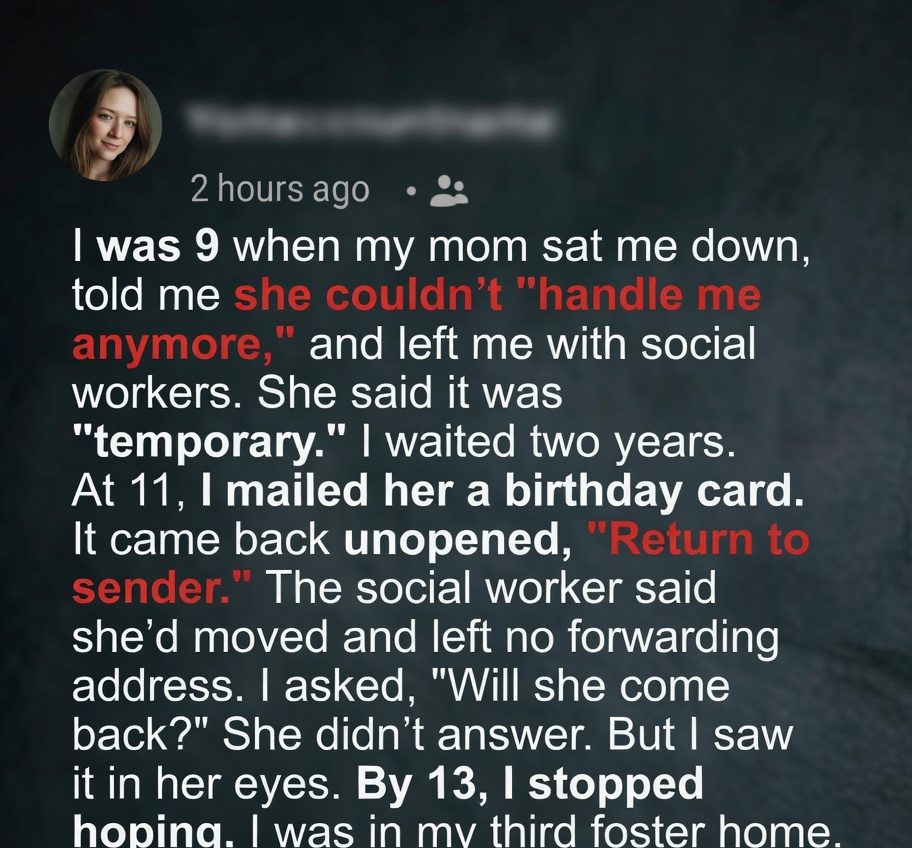
I was nine years old the day my world turned upside down.
It was a Friday in March. I’d aced a spelling test and came home excited to tell her. Instead, she was sitting at the kitchen table with papers spread out.
“Stacey, come sit down. We need to talk.”
I climbed onto the wobbly chair. “Mom, guess what? I got a hundred on my spelling test and—”
“Stacey.” She finally looked at me, eyes red. “I can’t handle you anymore.”
“What does that mean, Mommy?”
“I can’t take care of you. I tried, but I just can’t do it.” She pushed a paper toward me. I saw the word “custody” at the top. “Some nice people from social services are coming to get you tomorrow.”
“But I don’t want to go with strangers! I want to stay with you!”
“It’s just temporary,” she said, not looking at me. “Just until I can get back on my feet. Then I’ll come get you.”
The next morning, Mrs. Patterson came to the door. She had kind eyes, but I hid behind Mom anyway.
“It’s okay, sweetie,” Mrs. Patterson said. “I’m here to help.”
Mom packed my clothes in a garbage bag and handed it to me. “Be good, Stacey. I’ll see you soon.”
I believed her.
The children’s home was a big brick building with long echoing hallways. Every day I asked Mrs. Patterson the same question: “When is my mom coming back?”
“Soon, honey,” she’d say. “These things take time.”
For two whole years, I held onto that word. Soon.
When I turned 11, I saved my allowance and sent her a pretty birthday card with flowers and gold letters. Inside I wrote: “I miss you. Please come get me soon. Love, Stacey.”
Two weeks later, it came back stamped “Return to Sender.”
Mrs. Patterson found me crying in the hallway, holding that returned card.
“She moved, didn’t she?” I asked.
“I’m sorry, sweetie. She didn’t leave a forwarding address.”
By 13, I stopped asking. I had learned that hope was dangerous. I learned to make myself small, unnoticeable, acceptable.
At 27, I had my own daughter. Emma came into the world screaming and perfect, with big eyes that looked at me like I hung the moon and stars just for her.
The moment I held her, I made a vow that burned in my chest: Never would she feel unwanted. Never would she feel unseen. Never would she feel unloved.
Two years later, life was good. Really good. Jake and I had a house in a quiet neighborhood. The walls were warm colors, family photos hung in the hallway, and Emma’s toys created the most beautiful mess.
“You’re such a good mom,” Jake would tell me.
“I’m trying to be,” I’d say, because I was making it up as I went along, determined to give Emma everything my mother had failed to give me.
Everything was perfect until that knock on the door.
It was a regular evening. Jake was working late, and I’d just gotten Emma down for the night. I was settling in with a cup of tea when I heard it.
Knock. Knock. Knock.
When I opened the door, an old woman stood on my porch. She was thin and frail, with gray hair that needed a trim and clothes that had seen better days. She held a grocery bag with store-brand cookies.
But it was her eyes that stopped me cold. I knew those eyes. They were my eyes, staring back at me from a face that had aged 20 years.
“Hi,” she said softly. “You have to help me!”
“Excuse me?”
“I’m homeless. I don’t have anyone else. And you… you’re my only child.”
I looked at her from head to toe. The woman who had walked out of my life two decades ago was standing on my doorstep like she belonged there.
“Why are you here now?”
“I need help,” she said, shifting the bag. “Please, Stacey. I don’t have anywhere else to go.”
She didn’t ask how I was. Didn’t ask about my life, my job, or my family. She didn’t comment on the nice house or the family photos visible behind me. She just stood there like I owed her something.
Like 20 years of silence meant nothing.
Like abandoning a nine-year-old girl was normal.
I should have slammed the door in her face. Instead, I stepped aside and let her in.
Maybe it was because my therapist talked about breaking the cycle. Maybe it was because I wanted to look Emma in the eye someday and say I’d tried. Or maybe it was because that little girl inside me still remembered waiting for her mom to come home.
“Come in,” I said.
She stayed on the couch that first night. Then somehow, she ended up in the guest room. What was supposed to be one night turned into one week, then two.
At first, she seemed grateful. She helped with dishes and made small talk about the weather. But slowly, her true nature showed through.
“I never had help like this when I was your age,” she said one morning over coffee. “I had to figure everything out on my own.”
“You mean when you were raising me?” I asked.
She stirred her coffee and didn’t answer.
The comments got worse. Little digs disguised as observations.
“Maybe if you weren’t so difficult back then, things would have been different,” she said one day while watching me struggle to get Emma to eat her vegetables.
“Difficult? I was nine years old.”
“You were always crying about something. Always needing attention.”
The breaking point came a few days later.
I’d left work early for Emma’s doctor’s appointment. When I got home, I found them in the living room. My mother was sitting on the floor next to Emma, whispering to her while Emma played with blocks.
“Your mom was a really tough kid, you know,” I heard her say. “She used to scream and cry for no reason at all.”
Emma looked up, confused.
“Sometimes,” my mother continued, “you have to step back from people who hurt you. Even family.”
“Emma, go to your room and play,” I said calmly.
After Emma was gone, my mother smiled at me like nothing had happened. Like she hadn’t just tried to poison my daughter against me.
That night, after Emma was asleep, I packed my mother’s belongings in the same garbage bag she had used for my clothes twenty years ago.
“You need to leave,” I said, setting the bag by the front door.
“What? You can’t just kick me out. I’m your mother!”
“No,” I said. “You’re a woman who left a kid behind and came back for shelter, not forgiveness.”
“Where am I supposed to go?”
“There’s a shelter three blocks down on Main Street. I already called. They have a bed available.”
She grabbed the bag and headed for the door, then turned back. “You’ll regret this. Family is all you have in this world.”
“No,” I said. “Love is all you have. And you gave up the right to mine a long time ago.”
After she left, I sat in Emma’s room and watched her sleep.
I thought that was the end of it. But I was wrong.
Last month, I decided to send my mother a birthday card. Just like I had when I was 11, except this time, I was the one in control.
I picked out a plain white card and left it completely blank. No return address. No signature.
Just a small note inside that said, “Sometimes you have to step back from people who hurt you.”
I wonder if she understood the message. I wonder if she remembered saying those same words to my daughter.
But mostly, I don’t wonder about her at all anymore.
Because I finally learned what my mother never could: that being a parent isn’t about what you need from your child. It’s about what you’re willing to give them.
And I’m willing to give Emma everything. Including protection from people who would hurt her, even if they share her blood.
The cycle ends with me.