When I married Julian and moved into the house he had shared with his late wife, I walked through the front door ready to be the “restorer.” I told myself I would bring a fresh start, a clean slate, and a sense of normalcy back to a home frozen in grief for three years.
But the house resisted me. It still breathed with the memory of the woman who came before me — her taste in curtains, her way of drying herbs, and most stubbornly, her dog.
Barnaby, an aging Golden Retriever with cloudy eyes and a tail that hit the floor like a steady heartbeat, was a living shadow. He slept in the hallway outside my fourteen-year-old stepdaughter Maya’s room every night. He followed her from room to room, the silent sentry of her sorrow, as if he alone understood the weight of her loss.
Every time I saw that dog, a cold insecurity bit at me. To me, Barnaby wasn’t just a pet — he was a living reminder that I was an interloper. As long as he was there, I would never measure up to the ghost of the woman before me.
So while Julian was away on a three-day business trip, I made a decision I called “practical.” I listed Barnaby for sale and handed him over to a family three towns away.
The Breaking Point
The moment Maya walked home from school and saw the empty corner where Barnaby’s bed used to be, the air left her lungs. She didn’t scream. She collapsed onto the kitchen tiles, her backpack sliding off her shoulders, and let out a thin, broken sound that made my skin crawl. She clutched Barnaby’s old leather collar to her chest, sobbing with violence that shook her whole body.
Instead of feeling moved, I felt a surge of irritation — the defensive anger of someone who knows they’ve done something cruel but refuses to admit it.
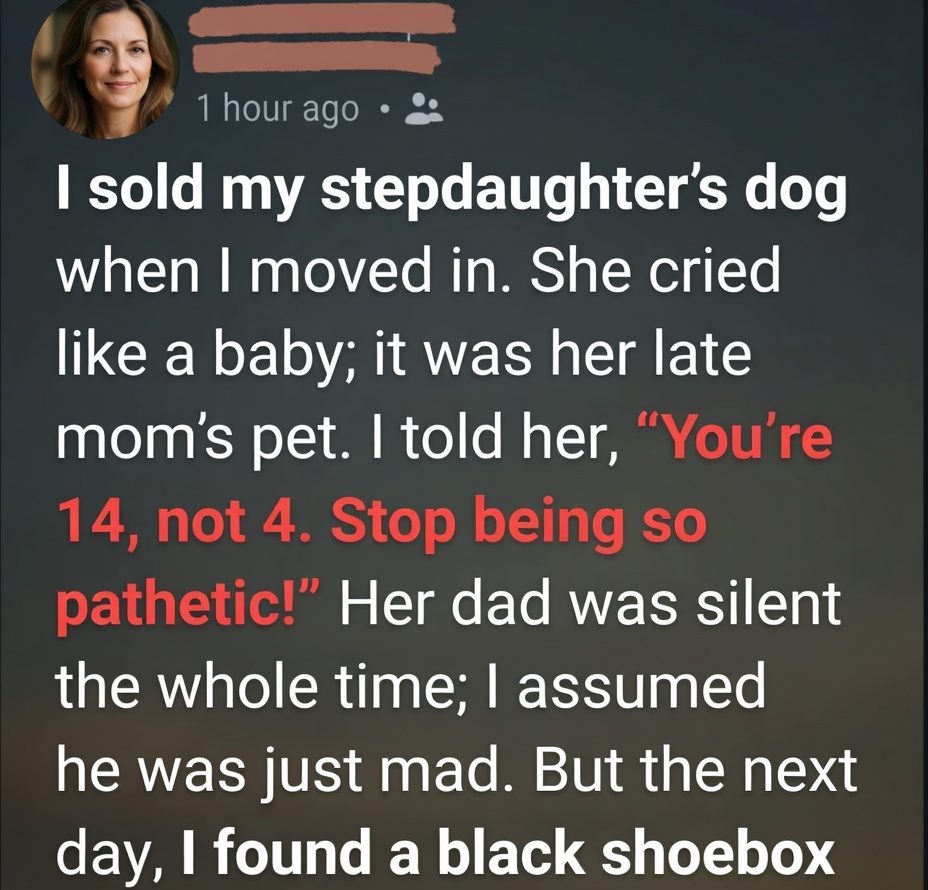
“You’re fourteen, Maya, not four,” I snapped, my voice echoing off the newly organized countertops. “Stop being so pathetic. He was just an old, shedding dog. We’ll get a new one — one that actually fits this family.”
She looked up at me, her eyes red and swimming with a betrayal so deep it felt like a physical wall. She didn’t say a word. She scrambled up, ran to her room, and the slam of her door felt like a verdict.
The Black Shoebox
Julian came home late that night. The house was a tomb. Maya didn’t come out for dinner and didn’t even acknowledge his arrival. I sat in our bedroom, heart racing, waiting for the explosion. But Julian moved through the house in heavy silence that made me more nervous than any shout.
The next morning, while obsessively vacuuming under our bed to clean away the last of the phantom dog hair, my hand hit something solid. I pulled out a black shoebox. My name was scrawled on the lid in the uneven handwriting of a teenager trying to be neat.
I sat on the floor and lifted the lid. Inside was a kaleidoscope of effort. Maya had spent weeks creating collages. There were photos of Julian and me on our wedding day, bordered by hand-drawn flowers. Pictures of the three of us at a diner with little captions: “The New Team.” Sketches of the house with bright yellow suns.
And in the center of almost every page was Barnaby.
I turned the pages and found birthday wishes in neon markers: “I hope you like it here.” “I wanted you to feel welcome, even if it’s hard sometimes.” “From your new family.”
The realization hit me like a blow to the chest. I hadn’t been fighting a ghost. I had been fighting a girl who was trying to build a bridge. She hadn’t been using the dog to keep me out — she had included Barnaby in the photos to show I was being invited into their most sacred circle.
The Architecture of a Home
I was still sitting on the floor clutching a page of the scrapbook when Julian walked in. He saw the box and stopped. A small, sad smile touched his face — a look of profound grief and disappointment that withered my pride instantly.
“So you found it,” he said quietly. “Maya worked on that for a month. She was so nervous about giving it to you for your birthday next week. She wanted you to feel like you belonged — that you weren’t just a replacement, but a part of us.”
He leaned against the doorframe, his voice dropping to a whisper. “When you sold her dog… she didn’t just lose a pet. She lost her faith in you. She threw that box in the trash that night. I couldn’t let it go, so I hid it. I thought maybe one day you’d understand.”
The air felt heavy and suffocating. I broke down, sobs racking my chest as I realized I had traded a girl’s heart for a clean hallway. I ran to Maya’s room and threw myself onto the floor by her bed. She was curled in a ball, still holding that collar.
“I’m so sorry,” I gasped through my tears. “Maya, I was so wrong. I was so scared of not fitting in that I didn’t even see you trying to pull me in. Please… please forgive me.”
She didn’t answer for a long time. Then she slowly sat up and looked at the scrapbook in my hand. The hardness in her face flickered, then broke. She leaned into me, burying her face in my shoulder, and for the first time since I’d moved in, we cried together.
The Return of the Sentry
I spent the next six hours on the phone. I tracked down the family who had bought Barnaby. I told them the truth — that I had made a catastrophic mistake — and offered them triple what they had paid. They heard the desperation in my voice and agreed to bring him back.
When that old dog trotted through the front door and let out a low, happy “woof” before leaning his entire weight against Maya’s legs, the light that returned to her face was the most beautiful thing I had ever seen.
I learned a brutal, necessary lesson that day. You cannot manufacture a family through force or by erasing the past. A family isn’t a structure you build from the outside — it’s an ecosystem you nurture from the inside. It is built on the ruins of pride and the foundations of humility.
Now, when I see Barnaby sleeping in the hallway, I don’t see a reminder of what I’m not. I see a guardian of the love we are finally building — together.