Growing up, my father always felt like a locked door I could never quite open.
He wasn’t cruel. He didn’t shout. He simply lived at a distance—careful with his words, guarded with his emotions, impossible to fully understand. For years I chased the smallest signs of approval: a nod after a good grade, a quiet “That’s fine” after a school recital.
I would have given anything for warmth.
But warmth never came.
When my mother died, I expected something inside him to break. I believed grief might finally crack the wall around him and reveal the man hidden underneath.
It didn’t happen.
At the funeral, he stood quietly off to one side of the living room, hands folded, jaw set tight. He barely spoke to anyone. He barely cried.
Watching him, anger rose in my chest.
It didn’t look like he had just lost his wife.
It looked like he hadn’t lost anything at all.
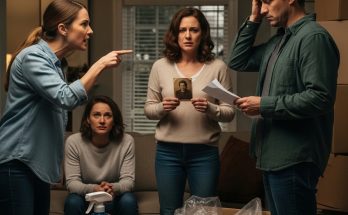
A few days later, while going through my mother’s belongings, I found an envelope buried deep inside her purse. My name was written across the front in her familiar handwriting.
For a moment, I just stared at it.
Something inside me whispered that whatever was inside wouldn’t be simple.
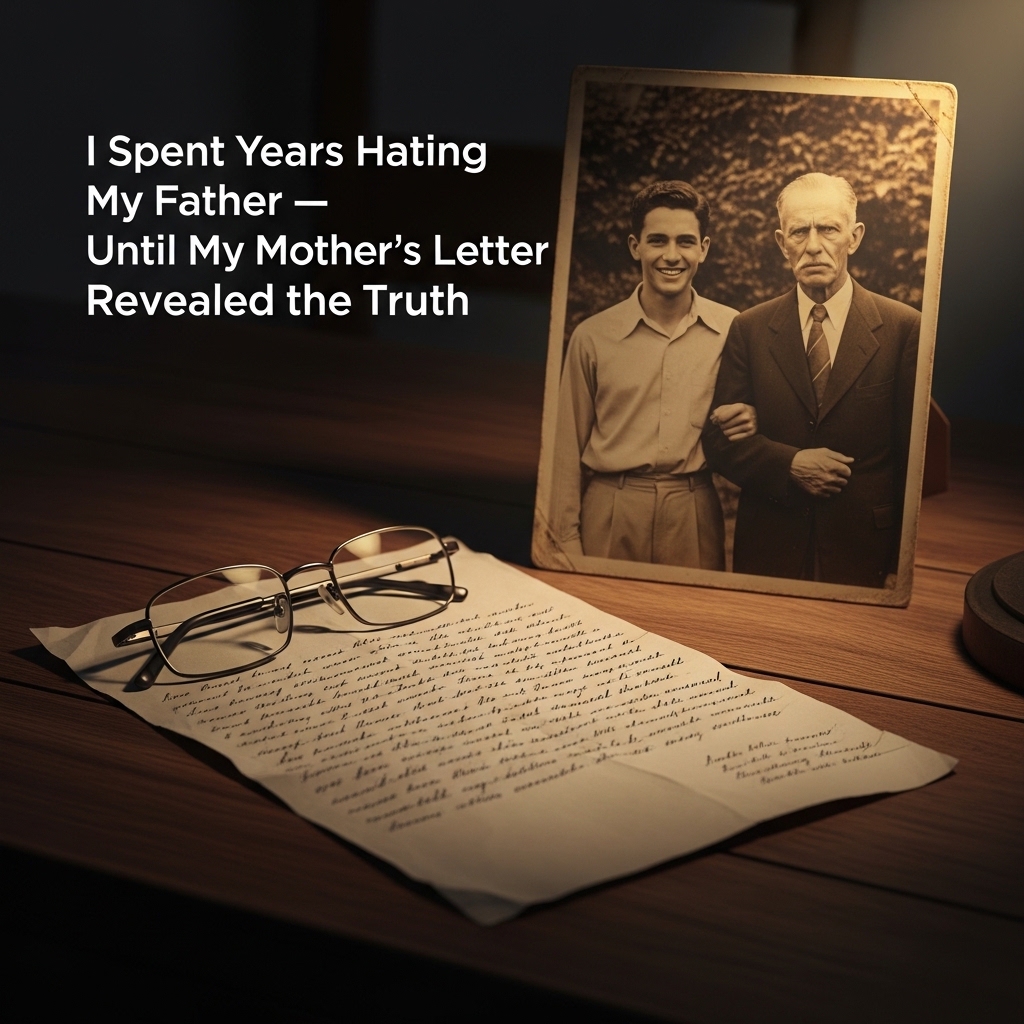
The envelope held two things: a short letter and an old photograph.
In the picture, my mother stood beside a man I didn’t recognize. She was smiling in a way I had never seen at home—bright, carefree, almost younger.
My pulse started racing as I unfolded the letter.
The message was short and painfully direct.
If you’re reading this, you deserve to know.
The man who raised you isn’t your biological father.
The room seemed to tilt around me.
I slid down the wall, the paper shaking in my hands. Suddenly every memory felt unstable. My childhood. My last name. Even my reflection in the mirror.
Nothing felt certain anymore.
I called my aunt almost immediately. My voice cracked before I could even finish asking the question.
She stayed quiet for a long moment.
“Your mother made us promise,” she finally said softly. “He wasn’t your father by blood. But he was the one who stayed.”
The one who stayed.
Those words echoed in my mind when I finally confronted him.
He didn’t deny it. He didn’t get angry. He didn’t even seem surprised.
Instead, he slowly lowered himself into a chair like a man who had been waiting years for a storm he always knew would arrive.
“I knew from the beginning,” he said quietly.
I stared at him in disbelief.
“You knew?”
He nodded.
“She told me before you were born.” His voice was steady, though something fragile trembled beneath it. “I thought I could move past it. I thought if I loved you enough, it wouldn’t matter.”
He paused before continuing.
“But she cheated on me,” he said quietly. “And I never truly forgave her.”
It was the first time I had ever heard bitterness in his voice.
“When she died,” he added, and this time his words cracked, “I realized I still loved her. I carried that anger for years. But losing her… that was worse.”
He rubbed his eyes, but tears escaped anyway.
“And you,” he whispered, “you look just like her. Every single day I saw her face. And every time I remembered you weren’t mine by blood… it hurt.”
I had never seen him cry before.
Never seen him fall apart.
The distant, unreadable man from my childhood suddenly looked smaller. Not cold. Not heartless.
Just tired.
A man who had been carrying something heavy for decades and never learned how to put it down.
I didn’t know what to feel.
There was anger. Confusion. Grief layered on top of grief.
But there was also something else.
Because regardless of what the letter revealed, he had been there for everything. Every scraped knee. Every school pickup. Every late-night fever.
He signed permission slips. He paid the bills. He showed up.
He might not have been my biological father.
But he had been my dad in every way that mattered.
Standing there, watching him finally break, I realized something I had never understood before.
Love isn’t always loud.
Sometimes it’s quiet, complicated, and tangled in pain.
I still don’t know how to untangle all of it.
But I know this much:
Blood might explain where I came from.
It doesn’t erase the man who raised me.