Matthew was only thirty-three when the headaches began.
He blamed stress at first—long hours, lack of sleep. He was always the steady one: reliable job, new house, fresh marriage. He kept telling me not to worry.
Then he collapsed in the kitchen one afternoon.
Two weeks later came the diagnosis: an aggressive neurological disease. Rare. Fast. Merciless.
The doctor spoke carefully—progressive decline, limited time. I watched Matthew’s wife, Claire, standing beside him.
She didn’t cry.
She didn’t take his hand.
She asked only one question: “How long?”
When the doctor explained eventual loss of mobility, speech, awareness, she went quiet.
That night, back home, she looked at Matthew—weak on the couch—and said words I’ll never unhear:
“I won’t waste my life watching you turn into a vegetable.”
Calm. Not angry. Not hysterical. Finished.
Two days later she moved out.
Matthew didn’t beg her to stay.
He just said, “It’s okay, Mom. She didn’t sign up for this.”
But I had.
I sold my house within a month. Every piece of jewelry my late husband gave me. My savings. My car. I moved into Matthew’s home to care for him full-time.
The disease moved faster than we feared.
Tremors first.
Then weakness.
Then nights when pain stole his breath and left him shaking.
I learned to administer medications, lift him without hurting him, cook food soft enough to swallow.
When he couldn’t stand, I bathed him.
When he couldn’t sleep, I sat in the dark telling stories from when he was five—when he used to fall asleep on my shoulder.
There were nights I broke down in the bathroom so he wouldn’t hear.
But in front of him I was strength.
I was calm.
I was his mother.
When the machines slowed in the hospital room and the nurse stepped back, I was the only one holding his hand.
He squeezed my fingers once.
Then he was gone.
The funeral was small.
Claire came—black dress, distant but composed. People whispered. Some judged her. Some didn’t.
Legally she was still his wife.
Matthew had been too weak at the end to change his will.
Everything—the house, accounts, remaining assets—went to her.
Three days later she told me she planned to sell the house.
“You’ll need to find somewhere else,” she said, avoiding my eyes. “I can’t afford to keep it.”
I didn’t argue.
I had nothing left to fight with.
I packed slowly: clothes, photos, a few small things that held memories.
While cleaning Matthew’s bedroom one last time, I knelt to check under the bed.
That’s when I saw it.
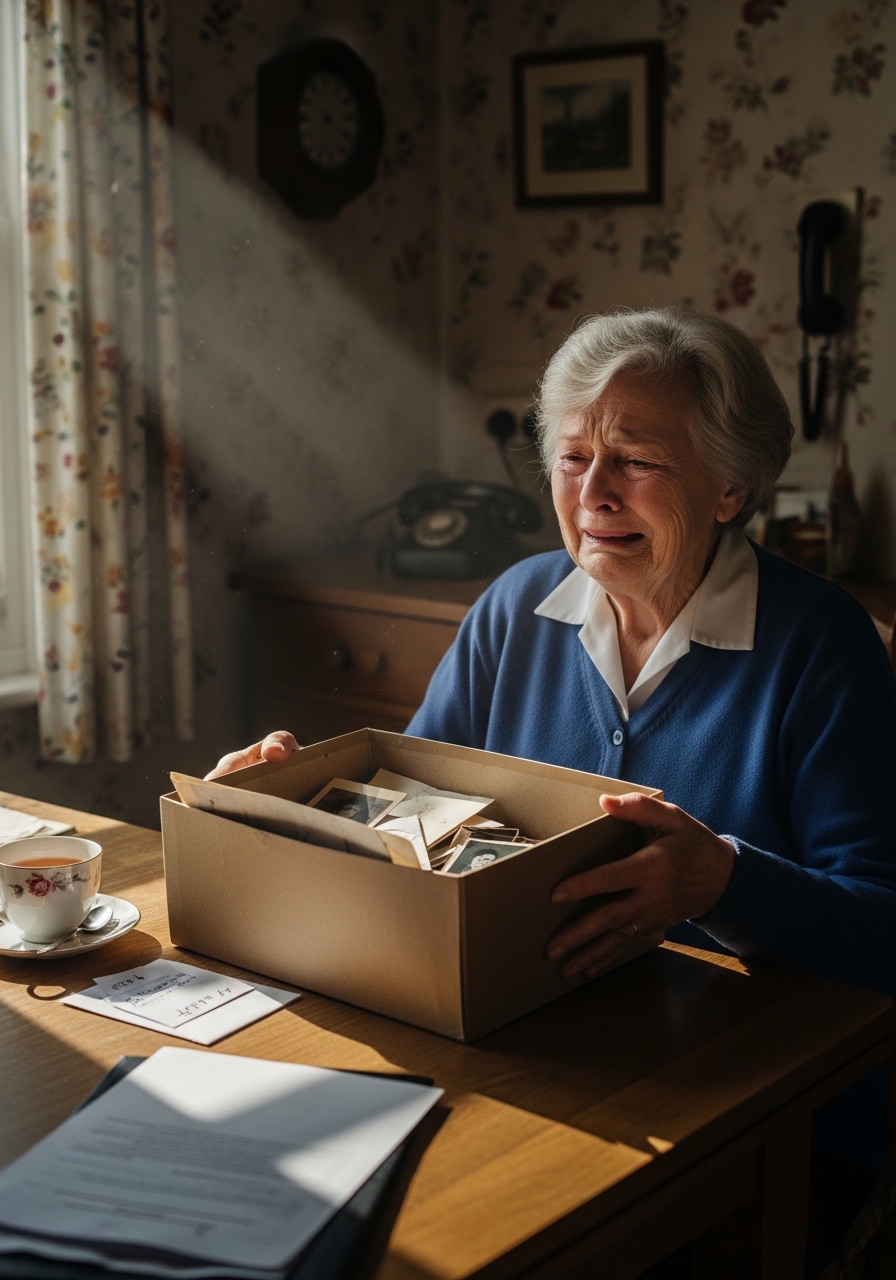
A shoebox, pushed far back, taped shut.
Ordinary-looking.
I almost left it.
But something made me pull it out.
Inside were neatly organized folders.
Insurance policies.
Separate from his will.
Recently updated.
Beneficiary: not Claire.
Me.
There was also a letter.
My hands shook as I unfolded it.
Mom,
If you’re reading this, you found the box. I didn’t tell you because I knew you’d try to talk me out of it.
You already sold your house for me. You gave up everything without hesitation.
Claire and I were having problems long before I got sick. I knew she might not stay. I don’t blame her. But I needed to make sure you were protected.
You’re the only one who never left.
Please use this to rebuild your life. And please don’t feel guilty. Loving me was never a burden.
I love you more than I ever said out loud.
— Matthew
I sat on the floor and cried for the first time since he died.
Not from grief.
From understanding.
He had seen everything.
He had prepared quietly.
The insurance payout was enough to replace what I’d sold—and more.
I didn’t tell Claire right away.
There was no need.
Weeks later the house sold. The estate settled. She moved away.
Months after that she called.
Her voice was softer.
“I didn’t know he had policies,” she said. “He never told me.”
“He didn’t tell me either,” I replied. “He just made sure.”
Silence stretched.
“I was scared,” she admitted. “I didn’t know how to watch someone disappear like that.”
“I know,” I said.
I don’t hate her.
Illness reveals people.
Some stay.
Some leave.
Matthew didn’t leave me unprotected.
With the money I bought a modest home near the park he used to love. I set aside part for small grants to families caring for terminally ill loved ones—medications, equipment, respite care.
Because I know what it costs.
Not just financially.
Emotionally.
Physically.
Every time I open the drawer where I keep his letter, I remember something important:
The shoebox wasn’t about money.
It was about gratitude.
It was his way of saying, I saw you.
And that is something no inheritance could ever replace.