For most of my life, I despised my older sister.
To me, she represented everything I refused to become—uneducated, buried in debt, and working endless hours as a cleaner while I moved forward in the world of academics. While I studied in classrooms and dreamed of a successful future, she scrubbed floors and emptied trash bins.
Whenever she called, her voice carried a warmth that irritated me. It felt like a reminder of the gap I believed existed between us—a gap I was proud of.
The day she called to congratulate me on being accepted into university, something inside me snapped.
Instead of thanking her, I lashed out.
“Don’t bother,” I said coldly. “Just go clean toilets. That’s what you’re good at.”
For a moment, there was only silence on the other end of the phone—thick, heavy silence that seemed to fill the air between us.
But I didn’t care.
I hung up feeling victorious, convinced I had finally put her in her place.
Three months ago, she died.
They said it was sudden. An illness. Something that came without warning.
I didn’t cry.
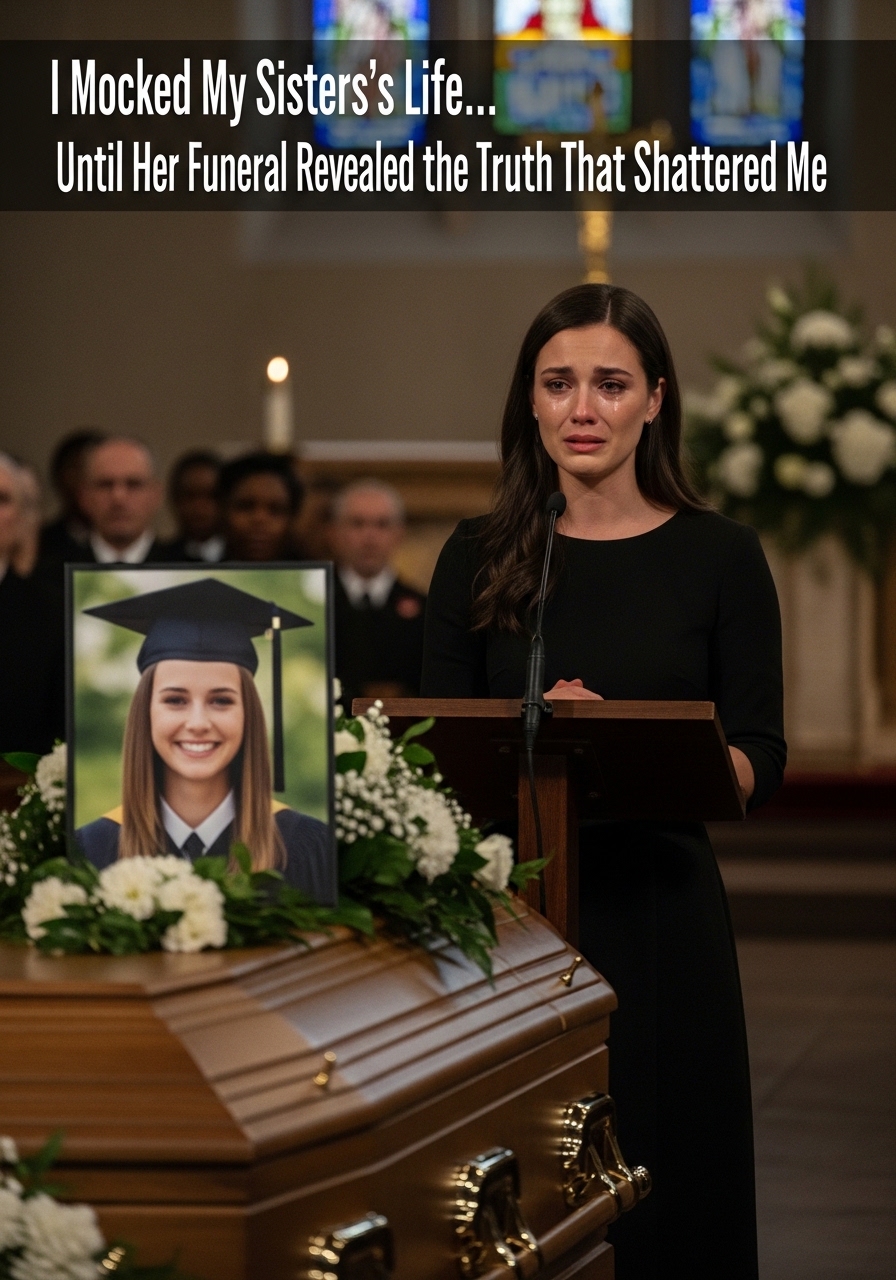
At her funeral, I stood stiffly with my arms folded, watching mourners gather around her coffin. Some sobbed openly. Others clutched tissues with trembling hands.
Their grief felt exaggerated to me, almost theatrical.
I couldn’t understand why they were so devastated.
Then my aunt approached.
Her eyes were swollen from crying, but beneath her sadness there was something else—something sharp and deliberate. She placed a hand on my shoulder and leaned closer.
“Now it’s time for you to know the truth,” she whispered.
I frowned, impatience rising inside me. I didn’t want speeches. I didn’t want emotional stories meant to glorify the dead.
But my aunt continued, her voice trembling.
“When your parents died, you were too young to understand,” she said. “Your sister was only eighteen. She gave up her chance to continue school—gave up her future—so that you could have one.”
Her words struck me like a physical blow.
“She worked those cleaning jobs to pay for your tuition,” my aunt continued softly. “Your books. Your meals. Every debt she carried was because she was supporting you.”
The air seemed to disappear from my lungs.
I shook my head quickly, refusing to believe it.
“No,” I muttered. “That’s not true. I earned my place.”
But my aunt’s gaze didn’t waver.
“She never told you because she didn’t want you to feel guilty,” she said. “She wanted you to succeed freely. Every insult you threw at her, she kept quiet because she believed your future was worth the pain.”
Suddenly the coffin in front of me felt different.
It was no longer just a polished wooden box.
It felt like judgment.
Memories flooded back with painful clarity.
Her tired smile when she handed me pocket money.
Her worn shoes, the soles almost gone.
Her rough hands, cracked from cleaning chemicals.
The nights she came home late, shoulders heavy with exhaustion, the faint smell of bleach clinging to her clothes.
And there I had been—comfortable at my desk, studying under warm light, never questioning how that life was possible.
I had believed her life was pathetic.
In reality, it had been the foundation of mine.
Shame crashed over me so fiercely I could barely remain standing.
I wanted to scream. I wanted to claw at the ground. I wanted to go back in time and swallow every cruel word I had ever thrown at her.
But the moment that haunted me most was that final phone call.
My harsh voice.
Her silence.
Did she cry after I hung up?
Did she forgive me anyway?
I will never know.
When the funeral ended and people slowly began to leave, I stayed behind.
The cemetery grew quiet as the last footsteps faded away.
Eventually, I walked toward her grave.
The flowers were still fresh, their sweet scent mixing with the damp smell of newly turned soil. I knelt beside the stone and pressed my forehead against its cold surface.
“I’m sorry,” I whispered.
The words broke apart in my throat.
“I didn’t know. I should have known. You gave me everything… and I gave you nothing but contempt.”
A gentle breeze passed through the cemetery, brushing softly against my face.
For a fleeting moment, it carried what felt like an echo of her laughter—the same laughter I had once dismissed as simple and unsophisticated.
Now it sounded like the purest thing in the world.
Only then did I begin to understand.
My sister had lived a life of quiet heroism.
It was the kind of heroism people rarely notice—the kind hidden behind ordinary jobs and silent sacrifices.
And I had never bothered to look closely enough to see it.
Days passed. Then weeks.
But the guilt refused to fade.
Back at university, surrounded by classmates who admired my intelligence and ambition, I felt hollow. Their praise sounded empty in my ears.
Every achievement now felt stained.
Every success rested on a sacrifice I had never acknowledged.
I began visiting her grave regularly.
I spoke to her as if she could hear me.
I told her about my classes, the professors I admired, the challenges I faced in my studies. I confessed my regrets and apologized again and again.
I asked for forgiveness—even though deep down, I knew she had probably forgiven me long ago.
One evening, my aunt handed me a worn envelope.
“She wanted you to have this,” she said quietly.
Inside was a letter written in my sister’s uneven handwriting.
“Little brother,” it began.
“I know you don’t think much of me. That’s okay. I only want you to succeed. If you ever wonder why I work so hard, it’s because I believe in you. Don’t waste your chance. Live fully—for both of us.”
I read the letter over and over again.
My tears soaked the fragile paper.
She had known about my contempt.
She had felt it.
And yet she had continued loving me anyway.
Her love wasn’t fragile.
It was fierce.
It endured everything.
It was unconditional.
And I had been too blind to see it.
Now, when I walk across campus, I carry her with me.
Every step I take, every lecture I attend, every exam I sit—it belongs to her just as much as it belongs to me.
I no longer despise my sister.
Instead, I despise the version of myself who failed to recognize her worth.
She was never uneducated.
She was never a failure.
She was a teacher of sacrifice, a scholar of love, and the guardian of my future.
Her grave carries her name.
But in my heart, a deeper truth is carved there:
She gave me everything.
And I gave her nothing.
I cannot change the past.
But I can live in a way that honors what she gave me.
That is the only redemption left to me. 💔