My mom passed away when I was sixteen.
The house felt hollow without her laughter, without the faint scent of her lavender perfume drifting through the hallway. In the days after the funeral, relatives came and went with quiet voices and awkward sympathy. But once the last car pulled away, it was just me standing in a home that no longer felt like mine.
Before she died, Mom placed something in my hands.
Her heirloom necklace.
A delicate gold chain with a teardrop emerald surrounded by tiny diamonds. It had belonged to her grandmother.
“This is for you,” she whispered softly. “Not because it’s expensive… but because it carries our story.”
I wore it to her funeral. It rested against my heart like a promise.
A few months later, I moved in with my dad and his new wife, Marianne. Dad had remarried two years before Mom passed away. I’d never really warmed up to Marianne. She tried—cooking my favorite meals, asking about school—but every smile from her felt like a reminder of what I’d lost.
I kept the necklace inside a velvet box in my dresser drawer. I rarely wore it. It felt too sacred for ordinary days.
One afternoon, I came home from school, opened the drawer—and froze.
The velvet box was gone.
At first I thought I had misplaced it. I searched everywhere, tearing through my clothes, checking every drawer and shelf, even under the bed. My heart pounded so loudly it filled my ears.
“Marianne!” I shouted.
She came upstairs, wiping her hands on a dish towel. “What’s wrong?”
“My necklace,” I said, my voice shaking. “It’s gone.”
Her brow furrowed. “What necklace?”
“My mom’s emerald necklace. It was right here.” I pointed to the empty space like it was evidence.
She looked confused. “Honey, I haven’t touched your things.”
The word honey only made me angrier.
“You’re the only one home during the day,” I snapped. “Who else would take it?”
Her face went pale. “I would never steal from you.”
Dad came home to chaos. I was crying, Marianne was shaking, and accusations hung in the air like smoke.
“She took it,” I insisted. “She hates that I still talk about Mom.”
“That’s not true,” Marianne said through tears. “I’ve never tried to replace her.”
Dad’s jaw tightened as he looked between us. I saw the moment his decision formed.
“Marianne,” he said quietly, “if you took it, just give it back. We can fix this.”
Her shoulders sagged, like something inside her had cracked.
“I didn’t.”
But Dad had already chosen a side.
He asked her to pack a bag and stay with her sister until things were “sorted out.” I watched from the staircase as she left, clutching her purse like it was the only thing keeping her steady.
At the time, I felt justified.
Until the next morning.
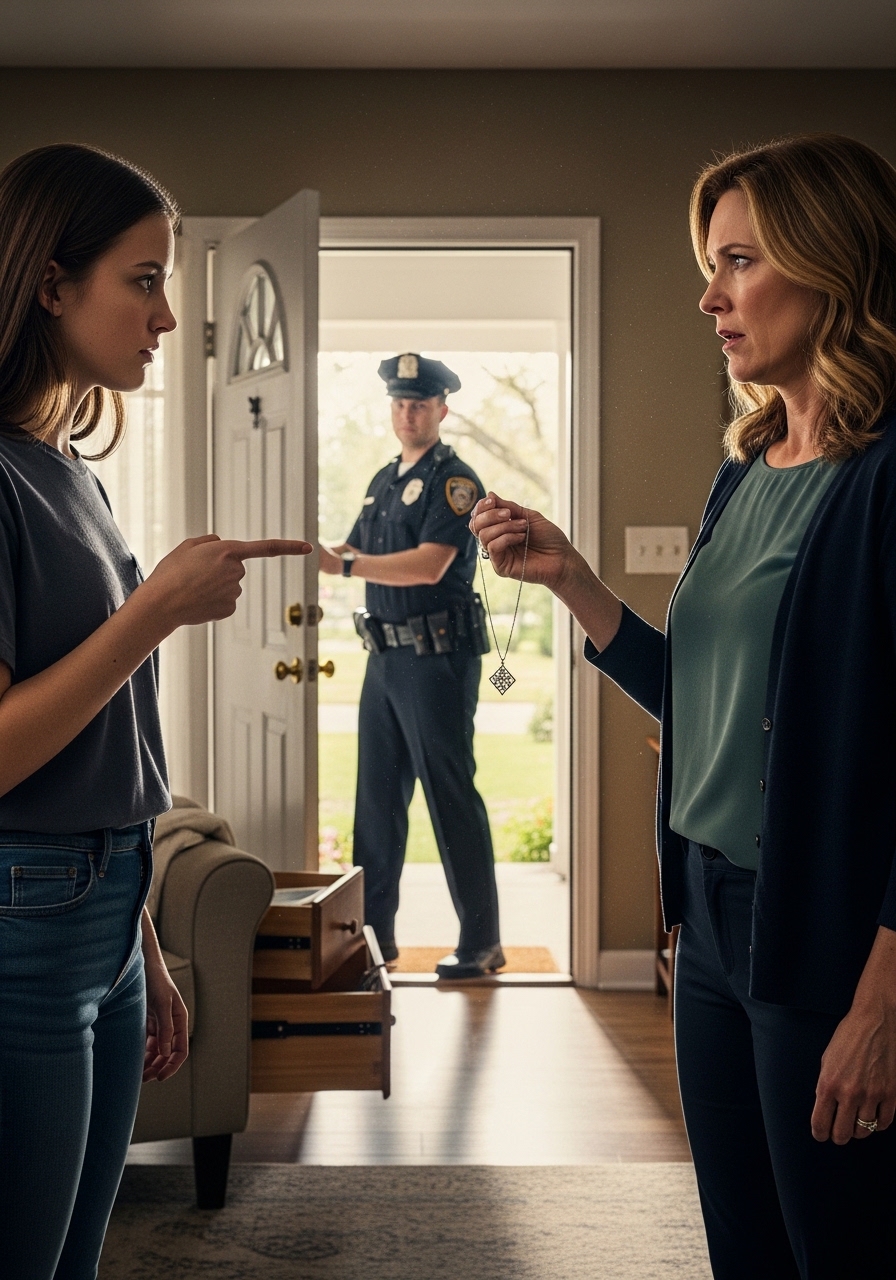
A sharp knock on the door startled both of us. Dad opened it to find two police officers standing outside.
“Mr. Collins?” one asked.
“Yes?”
“We need to speak with you and your daughter.”
My stomach dropped.
They stepped inside. The female officer spoke gently.
“We received a report about a missing necklace.”
“Yes,” I said quickly. “My stepmother stole it.”
The officers exchanged a glance.
“That’s why we’re here,” the male officer said. “We located the necklace early this morning.”
“What?” Dad and I said at the same time.
“It was pawned yesterday afternoon,” he continued. “The shop owner flagged it because of its value and the inscription on the clasp.”
My chest tightened. “Inscription?”
“Yes,” he said. “It reads: ‘For Lily, with all my love. – Mom.’”
Dad looked at me. The room suddenly felt too small.
“We reviewed the pawn shop’s security footage,” the officer added. “The person who sold it showed identification.”
“Marianne?” I whispered.
He shook his head.
“It was a teenage girl.”
My vision blurred.
“That’s impossible.”
He turned a small tablet toward us.
There, grainy but unmistakable, was me.
And suddenly I remembered.
The day before, in a storm of grief and anger I didn’t understand, I had taken the necklace from the drawer. I’d convinced myself it hurt too much to keep it. Seeing it reminded me of everything I’d lost.
I had walked to the pawn shop in a daze.
Then I’d come home.
And forgotten.
Or maybe I hadn’t forgotten.
Maybe blaming Marianne had simply been easier than facing what I’d done.
“I… I don’t remember,” I stammered, though the truth was already rising.
Dad stared at me, shock slowly turning into heartbreak.
The officer’s voice softened.
“Grief can make people act in ways they don’t understand.”
I collapsed onto the couch, sobbing.
“I thought she took it,” I cried. “I wanted it to be her.”
Dad dismissed the officers after they explained the necklace would be returned. The shop owner agreed not to press charges given the circumstances.
The silence afterward felt unbearable.
“I asked her to leave,” Dad said quietly. “I chose you without question.”
Guilt burned in my chest.
“I’m sorry.”
That afternoon we drove to Marianne’s sister’s house. When she opened the door, her eyes were swollen from crying.
I couldn’t even look at her.
“It was me,” I whispered. “I sold the necklace. I don’t even know why. I’m so sorry.”
For a long moment she just stared at me.
Then, to my surprise, she pulled me into a hug.
“I know you’re hurting,” she said gently. “I would never take something that precious from you.”
I cried harder than I had at the funeral.
The necklace was returned the next day. I held it differently this time—not just as a memory of my mother, but as a reminder of how grief can twist love into suspicion.
And how forgiveness can slowly stitch a broken family back together.