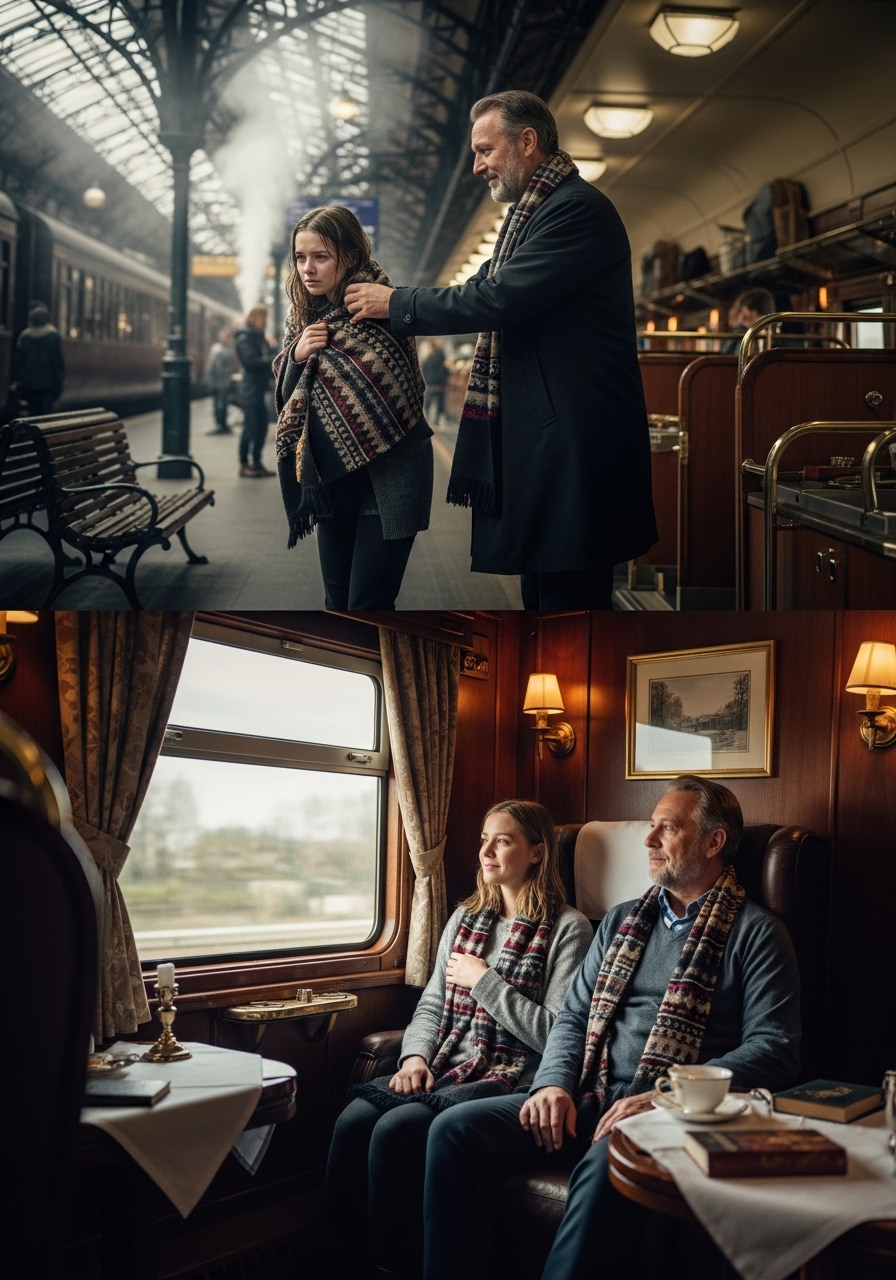
I gave my scarf and the last $100 in my wallet to a freezing girl outside a train station, thinking it was just a small act of kindness.
Three hours later, when I boarded my flight, she was sitting beside me in first class.
And what she told me next completely changed everything.
I stood at the head of a long glass conference table, facing twelve board members whose expressions were so cold they could have frozen lava.
Taking a steady breath, I clicked to the first slide of my presentation.
“Good morning,” I began. “My name is Erin, and I’m here because I believe no young person should ever end up on the street fighting just to stay alive.”
A few members exchanged skeptical looks.
I kept going.
“My project is a transitional support program for teenagers aging out of foster care. We provide temporary housing, job training, and long-term mentorship so they can build stable lives.”
Silence.
Not one nod. Not one smile.
Still, I pushed forward.
Slide after slide, I explained how the program had already helped dozens of teens get jobs, finish school, and avoid homelessness. I showed numbers, projections, and testimonials.
Finally, I reached the last slide.
“I’m asking for seed funding to expand our pilot program from thirty youths to two hundred,” I said. “With your support, we can give these young people a real chance at life.”
One of the board members cleared his throat.
“We’ll be in touch.”
That was it.
No questions. No discussion.
Just a polite dismissal.
I thanked them for their time and walked out, already knowing I’d probably never hear from them again.
That foundation had been my last real chance at funding.
What I didn’t know was that the real interview hadn’t even started yet.
I went back to my sister’s apartment, where I had been staying during the trip.
The moment she saw my face, she sighed.
“That bad?”
I sank onto the couch.
“I don’t think it went well,” I admitted. “Who knew it would be this hard to convince people to help kids who literally have nowhere else to go?”
She sat beside me and squeezed my shoulder.
“You’ll figure it out,” she said. “You always do.”
The next morning arrived far too quickly.
It was one of those brutal winter mornings where the wind cuts straight through your coat.
I said goodbye to my sister and headed toward the train station to catch a ride to the airport, dragging my suitcase behind me.
That’s when I saw her.
A girl, maybe seventeen or eighteen, curled up on a bench near the station entrance.
She had no coat — only a thin sweater.
Her backpack was tucked beneath her head like a pillow.
Her lips were blue, and she was shivering so hard I could see it from twenty feet away.
Something inside me refused to let me walk past.
Maybe it was instinct.
Maybe it was because I had spent the entire previous day talking about homeless teenagers.
Either way, I stopped.
I crouched beside the bench.
“Hey,” I said gently. “You’re freezing.”
She blinked up at me, startled.
Her eyes were red, either from the cold or from crying.
There was a fragile look on her face, like someone who had been trying to stay strong for too long.
Without thinking, I unwound my scarf.
My mom had knitted it years ago, before Alzheimer’s slowly stole those memories away from her.
I wrapped the scarf around the girl’s shoulders.
She tried to protest weakly, shaking her head.
I held it in place.
“Please,” I said softly. “Keep it.”
She whispered a quiet “Thank you.”
At that moment my rideshare driver pulled up and honked impatiently.
Before getting into the car, I reached into my wallet.
Inside was a single $100 bill — my emergency travel money.
I hesitated for only a second before handing it to her.
“Get yourself something warm to eat,” I told her. “Soup, breakfast… anything.”
Her eyes widened.
“Are you sure?”
“Absolutely.”
She clutched the money and scarf like they were priceless treasures.
I gave her a small wave before climbing into the car.
I assumed that was the end of it.
Just one small act of kindness between two strangers in a cold world.
But three hours later, everything changed.
My sister had surprised me by using her airline miles to upgrade my seat.
“You deserve something nice after that meeting,” she insisted.
So I boarded the plane and made my way to first class.
And then I froze.
Because sitting in the seat next to mine…
was the girl from the train station.
But she looked completely different.
Gone was the trembling girl wrapped in a thin sweater.
Now she looked polished and composed, wearing a tailored coat that probably cost more than my monthly rent.
Two men in black suits stood beside her — the unmistakable look of professional security.
One of them leaned toward her.
“Miss Vivienne, we’ll be right outside if you need anything.”
She nodded calmly.
Like this level of attention was completely normal.
Then she turned toward me.
And time seemed to stop.
I nearly dropped my coffee.
“What… what does this mean?”
She gestured toward my seat.
“Sit down, Erin.”
I blinked in confusion.
“How do you know my name?”
She folded her hands neatly in her lap.
“Because this,” she said calmly, “is the real interview.”
My stomach dropped.
“I’m sorry… interview for what?”
She opened a folder and slid a document toward herself.
“Yesterday you presented a proposal to our foundation requesting funding for a transitional support program for foster youth.”
My brain struggled to keep up.
“My family owns that foundation,” she continued. “And this is your follow-up evaluation.”
I stared at her.
“You mean… the board meeting…”
“Yes.”
She flipped through the folder.
“You gave a stranger — me — your scarf and $100 without asking questions.”
She looked up, her expression cold.
“Some people would call that generosity. I call it gullibility.”
Heat rushed to my face.
“You were freezing.”
“I was a test,” she replied flatly. “And you walked right into it.”
I clenched my jaw.
“So what was I supposed to do? Walk past you?”
She continued scanning the papers.
“You’ve built your entire career helping people who constantly take from society. Doesn’t it ever occur to you that kindness just makes people easier to manipulate?”
Her voice felt like a blade cutting through every belief I had.
I was trapped beside someone who thought compassion was weakness.
Finally, my patience snapped.
“Look,” I said firmly, “if you think you can shame me for helping someone in need, then you’ve already made your decision.”
I pointed to the scarf around her neck.
“But you shouldn’t be this young and already convinced kindness is a flaw.”
The cabin fell silent.
For the first time, she stopped moving.
Then she slowly closed the folder.
“Good.”
I blinked.
“Good?”
Her entire expression softened.
“That was the test.”
My confusion deepened.
“I needed to see if you would defend your values when challenged,” she said.
“Most people crumble the moment their motives are questioned. Or they admit charity is just about tax breaks.”
She lightly touched the scarf.
“You helped me before you knew who I was. That matters more than any presentation.”
My heart pounded.
“What are you saying?”
She extended her hand toward me.
“The foundation will fund your program.”
For a moment, I couldn’t even speak.
Everything from the past twenty-four hours spun through my mind like a storm.
Finally, I shook her hand.
“Let’s build something good together,” she said.
I looked at her — the girl who had completely turned my day upside down.
“Thank you,” I said quietly.
Then I added with a tired smile:
“But next time… maybe just send an email.”
She laughed.
“Where’s the fun in that?”