I’m 32, and the worst part of that night wasn’t the accident.
It was the silence.
Earlier that evening, there had been a crash reported near the highway interchange about fifteen minutes from our house. I noticed the flashing lights on my drive home from work but didn’t think much of it.
Accidents happen.
It wasn’t personal.
Until my phone rang.
It was Mia — a college friend who now works as a nurse at County General Hospital.
Her voice sounded careful. Too careful.
“Don’t panic,” she said.
Which, of course, made me panic immediately.
“But your husband is here. In the ER.”
My stomach dropped so fast I had to sit down.
“What? Why didn’t he call me?”
There was a pause.
“I thought he had.”
But he hadn’t.
No missed calls.
No texts.
Nothing.
I called him instantly.
Voicemail.
I tried again.
Voicemail.
I tried to explain it away. Maybe his phone was damaged in the crash. Maybe he was unconscious. Maybe he simply couldn’t reach it.
But something felt wrong.
Not medically wrong.
Emotionally wrong.
I drove to the hospital shaking so badly I had to grip the steering wheel with both hands. The fluorescent lights in the ER waiting room made everything feel unreal, like I had stepped into someone else’s story.
At the front desk, I gave his name.
The nurse checked the computer and nodded.
“Yes. He’s stable. Room 418.”
Stable.
That word should have reassured me.
Instead, it made my chest tighten.
As I walked down the hallway, I heard voices coming from behind his door.
One of them was a woman’s.
Soft. Familiar in tone, though I couldn’t place it.
I stopped.
I don’t know why I didn’t just knock and walk in. Maybe instinct. Maybe fear of confirming what my gut already suspected.
The door hadn’t fully closed.
There was a small gap.
I looked through.
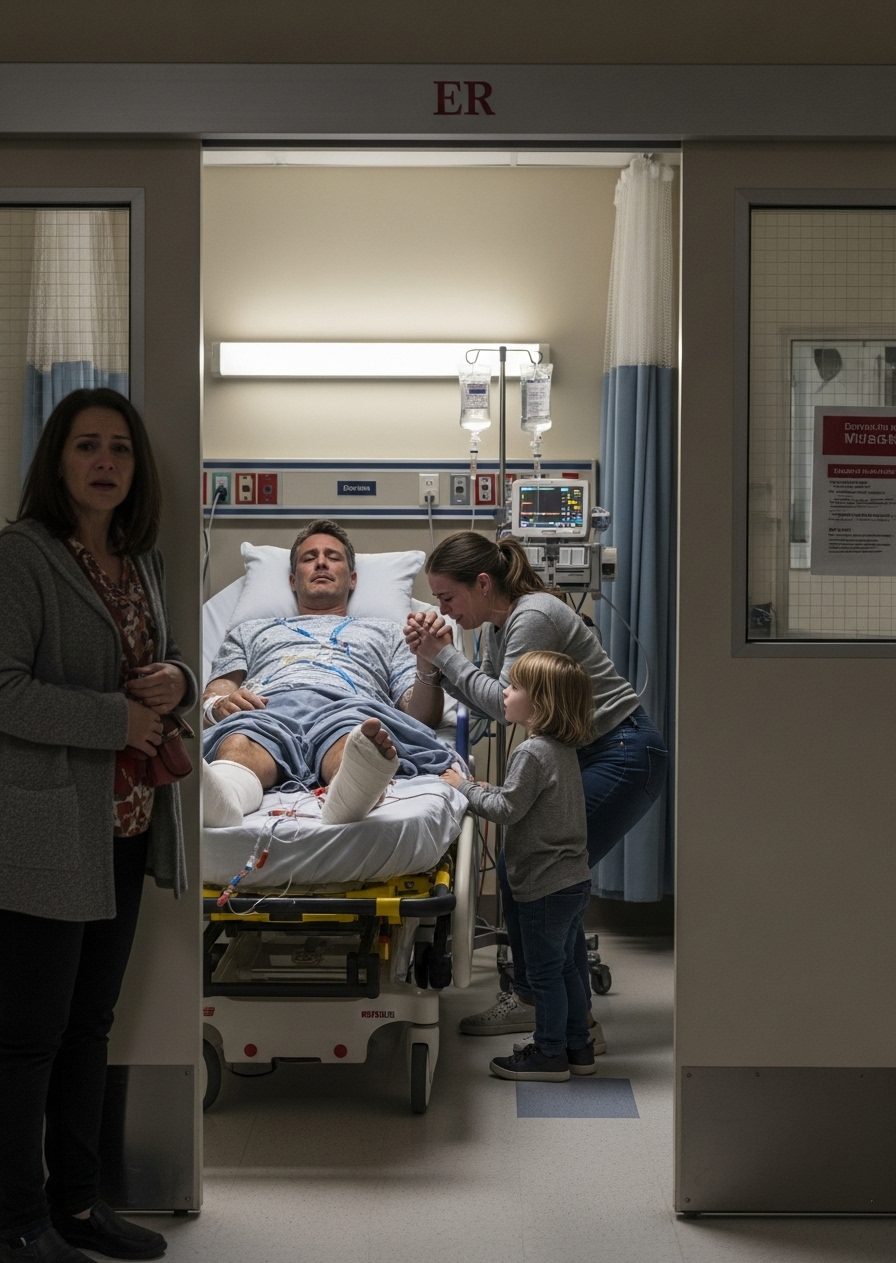
He was sitting upright in bed, his arm bandaged and a small cut above his eyebrow. He didn’t look critically injured.
He looked comfortable.
And sitting beside him, holding his hand, was a woman I had never seen before.
She wasn’t hospital staff.
No scrubs.
No badge.
Just jeans, a cardigan, and eyes red from crying.
“I was so scared,” she whispered.
“I know,” he replied softly. “I didn’t mean for you to find out like this.”
Find out what?
My ears started ringing.
He squeezed her hand.
“She thinks I was working late.”
She thinks.
Me.
My chest actually hurt.
He wasn’t unconscious.
He hadn’t lost his phone.
He had simply chosen not to call me.
I stepped away from the door before anyone could see me. A strange calm settled over me — the kind of calm that appears right before everything breaks.
I walked down the hallway and sat in one of the plastic chairs.
I didn’t cry.
Not yet.
About five minutes later, the door opened.
He saw me immediately.
The look on his face said everything.
Shock.
Guilt.
Panic.
“Emily—” he began.
The woman behind him froze.
“You should’ve called me,” I said quietly.
He opened his mouth, but no words came out.
The woman slowly stood.
“I didn’t know,” she said, her voice shaking. “He told me he was separated.”
Separated.
We had celebrated our anniversary just three months earlier.
She looked at me like I was the ghost in the room.
I wasn’t angry at her.
I was angry at the man who had built two different realities and somehow believed they would never collide.
“How long?” I asked him.
He didn’t answer.
That was answer enough.
There was no screaming. No dramatic scene. Security didn’t have to escort anyone.
I simply looked at him and said, “You had an accident. And the first person you called wasn’t your wife.”
That was the truth that mattered.
The weeks that followed were almost clinical.
Lawyers.
Paperwork.
Bank accounts slowly untangled.
Eventually I learned the accident had happened while he was driving her home.
Her apartment wasn’t even near his office.
I moved out before he finished physical therapy.
People sometimes ask if the crash changed him.
It didn’t.
It revealed him.
Later he told me he hadn’t meant to hurt anyone. That he was “confused.” That things had “just happened.”
But betrayal doesn’t just happen.
It grows in small silences.
In late nights explained away.
In phone calls never made.
Six months after the divorce was finalized, I ran into Mia — the nurse who had called me that night.
“I’m sorry I was the one who told you,” she said gently.
I shook my head.
“No,” I told her. “I’m glad it wasn’t him.”
Because if he had called me that night, I would have rushed to the hospital, held his hand, and comforted him.
And I would have kept living inside a lie.
Instead, I saw the truth through a crack in a hospital door.
And that was enough.
Today, I rarely think about the accident.
I think about the moment I realized I deserved to be the first call — not the last discovery.
And I never settled for anything less again.