“JUST STAND UP. STOP FAKING IT!”
My husband, Ethan, didn’t sound worried. He sounded annoyed.
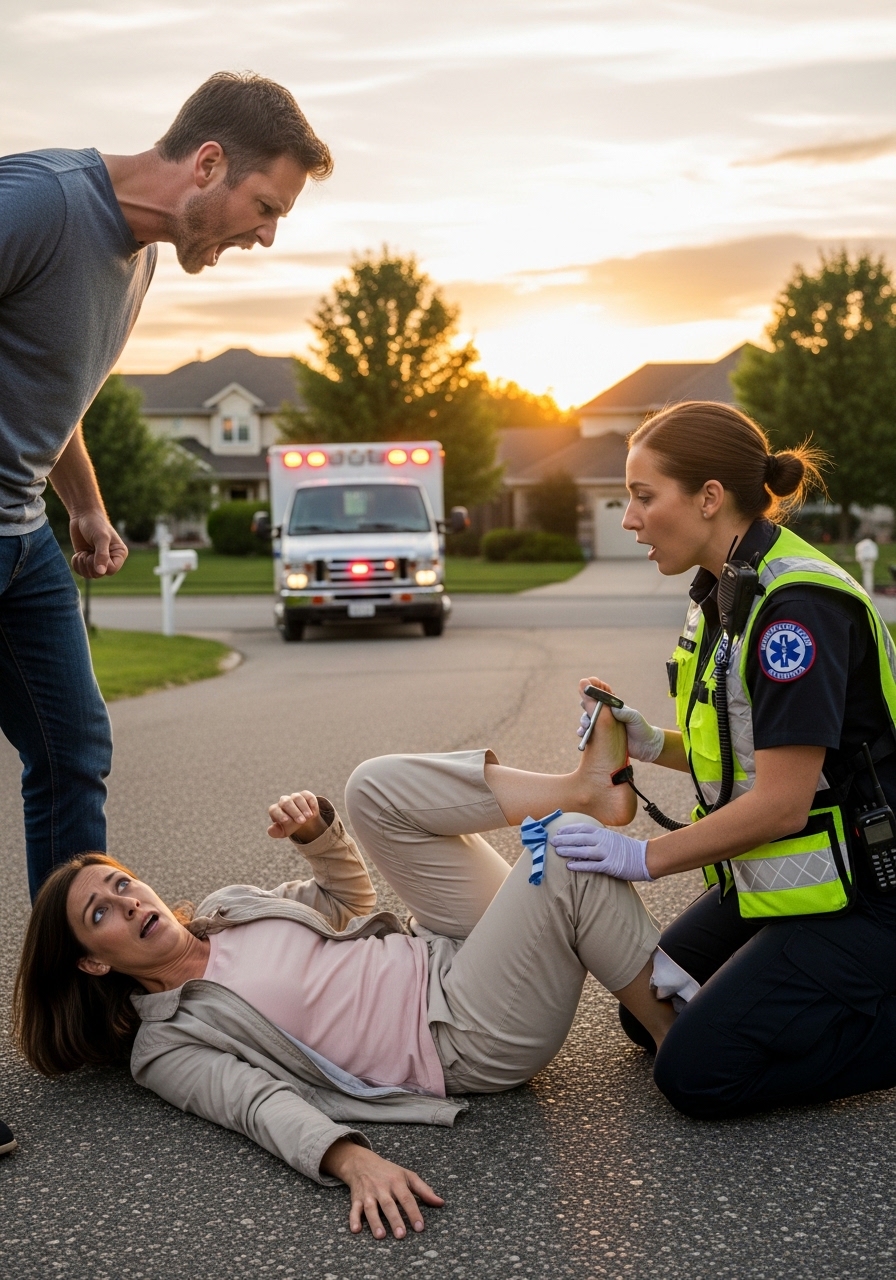
I was lying flat on our driveway, cheek pressed to the freezing concrete, one arm twisted beneath me. Above me, the sky over our quiet Ohio cul-de-sac was bright and painfully normal.
Minutes earlier, I’d been carrying a tray of cupcakes I’d baked for Ethan’s birthday brunch. His friends were arriving soon. His mother, Marilyn, had been in my kitchen since dawn — “helping,” which mostly meant criticizing everything I touched.
Ethan came outside to grab the cooler. We exchanged tense words at the top of the driveway. It started low and sharp. Then his jaw tightened. He reached for the tray. I stumbled backward, my heel catching where the driveway met the grass.
Then I hit the ground.
The strange part wasn’t the fall.
It was what came after.
I tried to push myself up. My arms worked. My head lifted.
My legs didn’t.
There was no sharp burst of pain — just an eerie emptiness. I stared at my own legs like they belonged to someone else.
Marilyn’s sandals clicked beside me.
“Oh, for heaven’s sake,” she sighed. “Ethan, ignore her. She does this when she’s not the center of attention.”
Ethan crouched down, not to help, but to hiss in my ear, “You’re not ruining my birthday. Get up.”
I tried again.
Nothing.
Our neighbor, Mrs. Alvarez, was already on her porch, phone pressed to her ear. “She says she can’t move,” she told the dispatcher.
The sirens arrived fast.
A paramedic named Jordan knelt beside me. His voice was calm, steady — the first steady thing all morning.
“Claire, can you feel this?”
He pressed along my ankles. My calves. The bottom of my feet.
I watched his hands.
I felt nothing.
His expression shifted — subtle, professional, immediate.
He repeated the test. Nothing.
Marilyn folded her arms. “She’s dramatic. She always has been.”
Jordan didn’t even look at her.
He stood, spoke into his radio, and said words that sliced through the air:
“I need police backup.”
Ethan froze.
Not confused.
Not scared.
Calculating.
“Why would you call police?” he demanded. “She slipped. She’s stressed. She does this.”
Jordan asked quietly, “Did you touch her before she fell?”
Ethan laughed too quickly. “Of course not.”
Mrs. Alvarez remained on her porch, watching. Across the street, a teenager briefly raised his phone before lowering it.
Police cruisers pulled up.
Officer Ramirez stepped out, composed but alert. Jordan gave a concise update — “no leg response,” “inconsistent story,” “possible domestic involvement.”
Sasha, the second paramedic, leaned close to me. “Claire, do you feel safe at home?”
My throat closed. Tears came instead of words.
Ethan cut in. “She’s overreacting. She’s emotional.”
Officer Ramirez calmly directed him aside.
Sasha performed another reflex test. Still nothing.
Jordan picked up my phone, which had fallen from my pocket. The screen was lit with an unfinished text to my sister:
If he starts yelling again, I’m leaving after today.
Jordan didn’t read it aloud.
He didn’t have to.
As they lifted me into the ambulance, Sasha leaned closer.
“The way your symptoms present,” she said gently, “this isn’t attention-seeking. This is serious. And police are here to make sure you’re safe.”
Inside the ambulance, sirens blaring, Jordan asked quietly:
“Did he push you?”
And for the first time in years, I didn’t protect him.
“Yes.”
At the hospital, everything moved quickly — scans, neurological exams, urgent monitoring. The doctors suspected a spinal cord injury. No guarantees. No easy answers.
Officer Ramirez returned with Officer Daniels to take my statement privately.
Then my sister Megan arrived — furious and shaking — because Jordan had called her from my phone.
When I told the officers how Ethan grabbed the tray, yanked it, how I lost balance — how he yelled at me while I couldn’t move — Daniels stopped writing for a second.
“Has this happened before?” Ramirez asked.
The truth spilled out.
The yelling. The control over money. The isolation from friends. The way he called me “fragile.” The way Marilyn called me “manipulative.” How every disagreement became my fault.
Megan spoke up.
“She sent me voice notes. Him screaming at her. I still have them.”
The room changed.
Not accusation.
Evidence.
Neighbors confirmed hearing shouting for months. A security camera across the street captured part of the driveway — enough to show how close Ethan stood before I fell, and how quickly he stepped away when sirens approached.
Ethan called repeatedly.
Marilyn left voicemails swinging between rage and false concern:
“You’re destroying this family.”
Megan saved every message.
Two days later, in my hospital bed, I wiggled my toes.
Just slightly.
Megan burst into tears.
So did I.
Not just because of movement.
Because something else had shifted too.
I wasn’t protecting him anymore.
I didn’t go back home after discharge. I went to Megan’s house.
Officer Daniels helped me file for a protective order. She gave me contacts for advocates and support services. No judgment. Just clarity.
The paramedics believed me when I couldn’t feel my own legs.
The neighbors spoke up.
The hospital treated my injuries as real.
The only people who called it “faking” were the ones who needed it to be.
I’m still recovering. Physical therapy is slow. Some days are better than others.
But here’s what I know now:
The scariest part wasn’t lying on cold concrete unable to move.
It was realizing I had been shrinking myself for years to keep someone else comfortable.
When Jordan called for police backup, it wasn’t just about my legs.
It was the first moment someone treated my life like it mattered.
And that saved more than my spine.