I grew up believing the farm would always be my safe place. I never imagined I’d have to fight to stay there the week we laid my grandfather to rest.
Grandpa raised me after my parents died in a car crash on a wet October night when I was 12. I remember sitting on a hospital bench with a social worker using words like placement and temporary housing — then Grandpa’s voice cut through the hallway:
“He’s coming home with me.”
Just his steady hand on my shoulder and the smell of hay and peppermint gum. That became my life.
The farm wasn’t fancy. Paint peeled from the barn in long strips, the roof leaked every spring. But it was ours. Grandpa taught me how to mend fences and read the sky before storms. When I had nightmares, he’d sit on the edge of my bed and whisper, “You’re safe here, Kevin. Nothing touches you on this land.”
Years passed. I married young, divorced even younger, and moved back in with Grandpa, my three kids in tow. Grandpa never complained. “More boots by the door means more life in the house,” he’d say.
***
As his health declined, I took over. I ran the harvest, handled suppliers, balanced the books, drove him to every doctor, changed his bandages. When the last harvest failed because of frost, I quietly took out a loan to keep the farm afloat.
But my aunt, Linda, was a different story. She left town twenty years ago, married a man in Chicago, posted photos of rooftop parties and spa weekends, and called Grandpa only when she needed money.
When Grandpa entered hospice, she didn’t visit once. I sat by his side every day. Aunt Linda sent a single text: “Keep me posted.”
He passed on a Tuesday at 5:12 a.m. I was there. She arrived that afternoon — shiny black Mercedes, oversized sunglasses, white blazer, no hugs. She wasn’t there to mourn. She was inspecting.
“Wow,” she said, “it looks smaller than I remember.”
“It’s the same size,” I said.
For three days before the funeral, she walked through every room like a buyer, opened cabinets, tapped walls, took notes.
“This can go,” she muttered. “Nobody wants dark wood anymore.”
“It’s our home,” I said.
She laughed, ignoring the kids. “It was my dad’s home. Developers would fight over it now.”
Cold ran down my spine.
On the night before the funeral, she cornered me in the kitchen. “Let’s not drag this out,” she said, smiling like charity. “You have three days to pack. Groundbreaking starts next week. It’s just business.”
“You can’t just throw us out,” I said.
“I’m his only child. Once the will is read, it’s mine. I’m giving you a head start,” she said, humming as she walked away.
***
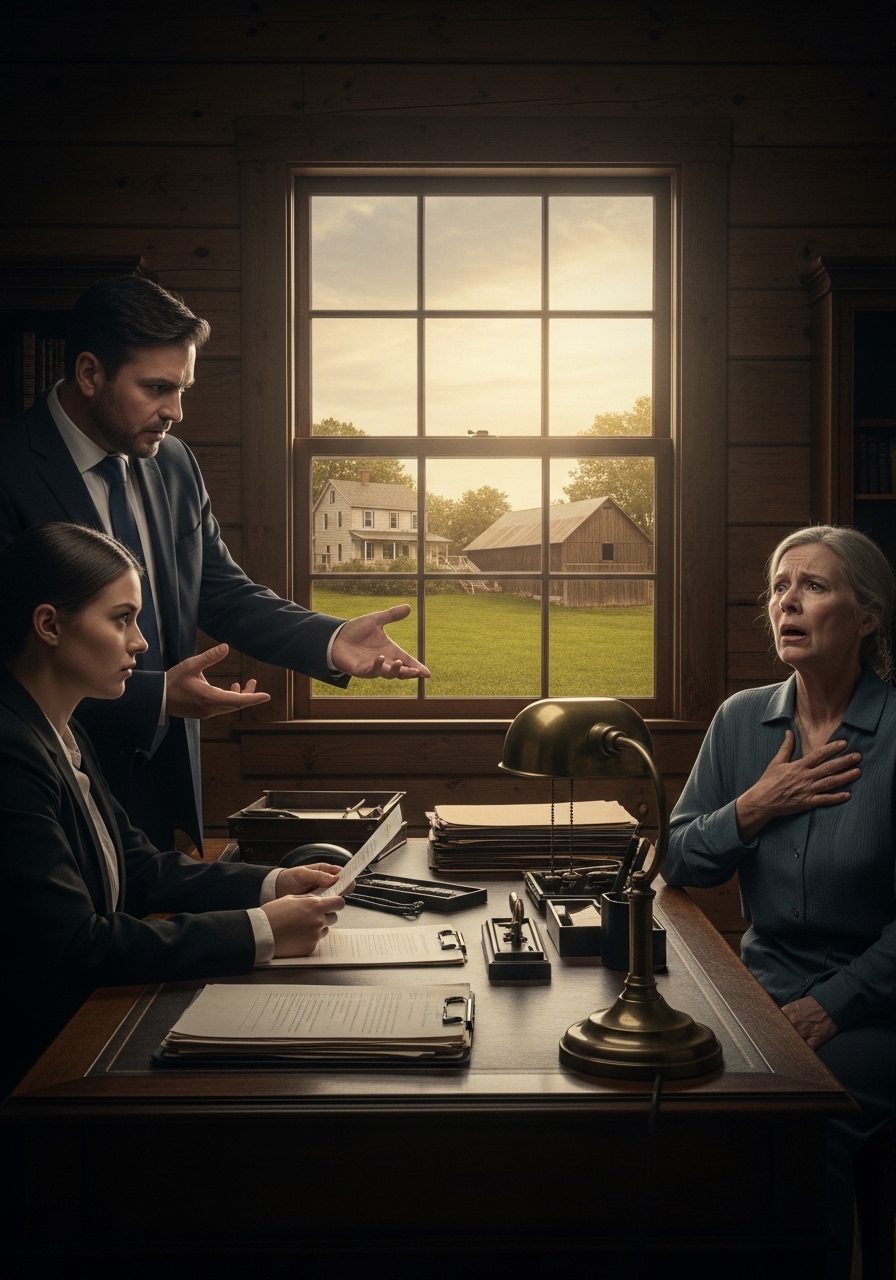
The will reading was two days after the funeral at Grandpa’s lawyer’s office. Aunt Linda arrived late, radiant as if she’d already won. She slid a folded document onto the desk: an eviction notice dated that morning.
Mr. Henderson, Grandpa’s lawyer, didn’t even glance at it. Calmly, he said, “Actually, we won’t be discussing the property today.”
Her smile faltered. “Excuse me?”
He adjusted his glasses, then said the one sentence that made her go pale:
“Your father didn’t own the farm anymore.”
The farm had been transferred to a protected family trust three days before Grandpa passed. The beneficiary? My youngest great-grandchild, Noah.
Aunt Linda’s face drained of color.
“You knew about this!” she cried.
“No,” I said, voice shaking. “He never told me.”
The lawyer pressed play on a digital recorder. Grandpa’s voice filled the room:
“If you’re hearing this, it means I’m gone. I’m making this decision because I know my daughter. Linda has always chased the next dollar. Kevin and those kids have kept this farm alive. They’ve earned the right to stay.”
Aunt Linda sank back, speechless.
“Per the terms of the will,” the lawyer continued, “Linda receives a fixed inheritance of $25,000 — conditional on assisting with the farm for five years in good faith. Any dispute forfeits her share entirely.”
Her anger vanished. She crumpled the eviction notice, muttered “Enjoy your dirt,” and left.
***
Three weeks later, life on the farm felt different. Not magically easier, but safe.
One evening, as the sun dipped over the north field, Noah sat on my lap. Emma, twelve, leaned against me.
“Does this mean we’re not moving?” she asked.
“We’re not going anywhere,” I said.
The air smelled of hay and wood smoke. The silence felt peaceful, not empty.
That night, sitting at the kitchen table, I ran my hand over the worn wood. I whispered, “You planned all this, didn’t you, Grandpa?”
And in my heart, I knew he had — protecting not just land, but our family’s future.
We weren’t just staying on the farm; we were building something stronger than ever.