I always believed my mother and I were all we had.
That belief shattered the day her will was read.
I loved my mother deeply. I grew up without a father, and whenever Father’s Day came around, I felt the absence like a bruise I couldn’t explain. My mother, Margaret, would smile gently and say, “It’s always been you and me, Claire. That’s more than enough.”
I wanted to believe her.
But even as a child, something felt missing.
She provided everything I needed—food, clothes, education—but affection was scarce. She never hugged me. When I cried, she would pat my shoulder, stiff and distant, as if physical closeness frightened her.
At seven years old, I used to stand in her doorway at night.
“Mom?”
“Yes?”
“Can I sleep in your bed tonight?”
She’d barely look up. “You’re a big girl, Claire. You’ll be fine in your own room.”
I always nodded. I always walked away. And I always pretended it didn’t hurt.
She missed most of my school plays, blaming migraines. We never had long conversations about feelings, dreams, or love. Still, when I graduated from college, she was there. When I hugged her, she stiffened before saying, “I’m proud of you.”
The words sounded practiced.
After graduation, I moved to another city and built my own life—career, apartment, friends who felt more like family than anyone ever had. I called her regularly. Our conversations were brief.
“How are you feeling?”
“I’m fine.”
“How’s the house?”
“The same.”
Eventually, I told myself this was just who she was. Maybe some mothers loved quietly.
***
The call came on a Thursday evening, just after I’d come home from work.
“Is this Margaret’s daughter, Claire?” a man asked.
“Yes.”
“This is Harold, your mother’s attorney. I’m very sorry to inform you that she passed away this afternoon after a long illness.”
The room tilted.
“What do you mean? She was fine!”
There was a pause. “She’d been undergoing treatment for over a year.”
Over a year.
She never told me. Not once.
I flew back the next morning. The funeral was small—neighbors, distant relatives, and Elena, my mother’s housekeeper. She had worked for my mother for as long as I could remember, eventually becoming full-time after I moved away.
At the service, I stood frozen beside the coffin, whispering, “Why didn’t you let me be there for you?”
Afterward, we gathered in the attorney’s office.
Harold cleared his throat. “The estate is to be transferred in full to Elena.”
The words echoed.
“I’m sorry—what?” I said.
He repeated it.
There was nothing left for me. Not the house. Not a dollar.
Outside the office, I confronted Elena. She avoided my eyes at first, then lifted her chin.
“I deserve it,” she said quietly. “I took care of her. I was there every day.”
She told me I could come collect my mother’s belongings.
The house looked unchanged, but inside, it felt hollow. I packed clothes mechanically, folding each piece like muscle memory.
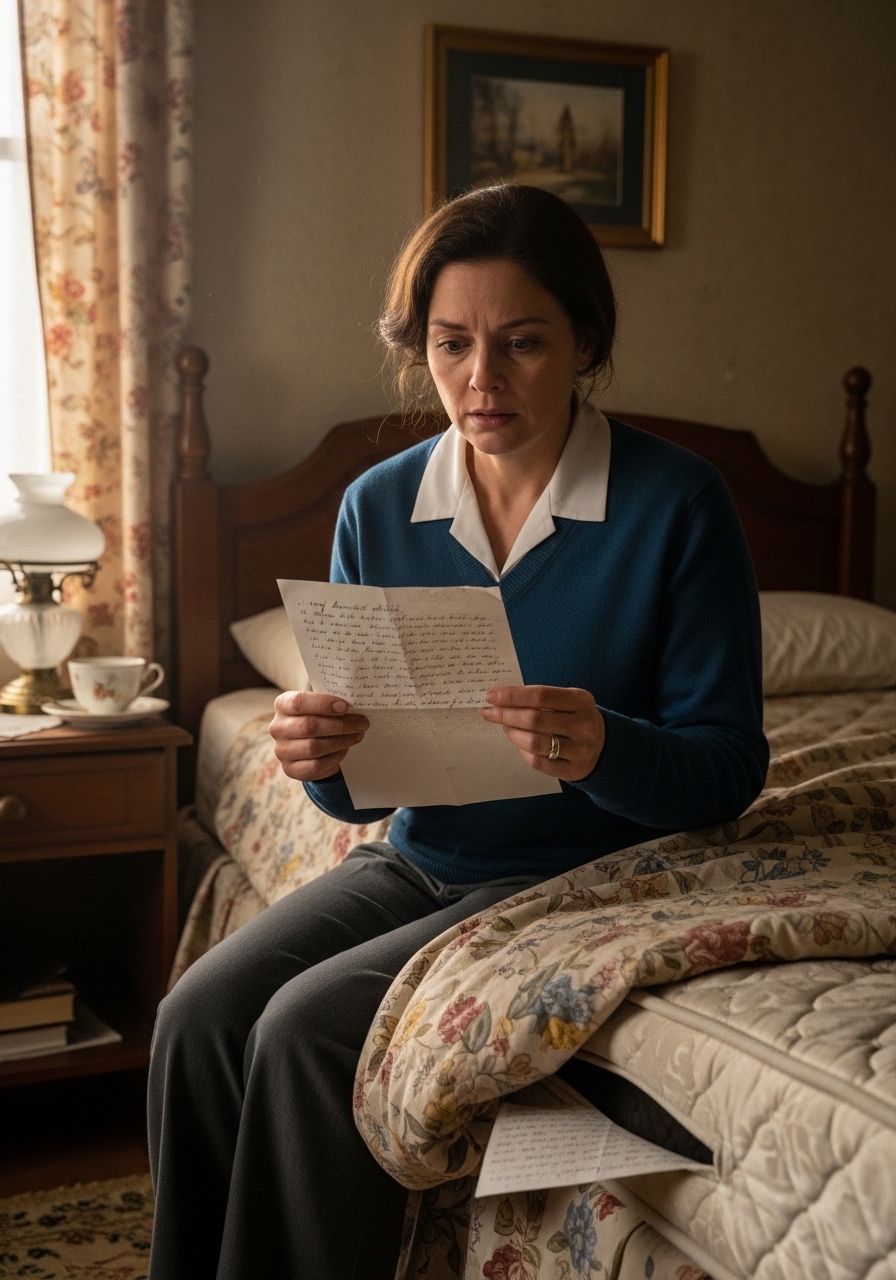
In my mother’s bedroom, I stripped the bed. As I lifted the mattress, I noticed an envelope tucked beneath it.
My name was written on the front.
My hands shook as I opened it.
My dear,
I know you have questions. There is a secret I tried to protect you from for as long as I could.
The letter unraveled everything.
Margaret wrote about her loneliness, her inability to conceive, and about Elena—only seventeen when she began working for her. Elena became pregnant at eighteen. The father wanted nothing to do with the baby and pressured her to abort.
Margaret offered another path.
She begged Elena to let her raise the child as her own, promising security and opportunity. Elena agreed on one condition: the truth would remain secret.
Tucked inside the envelope was my original birth certificate.
Under Mother: Elena.
Suddenly, everything made sense. The emotional distance. The restraint. The way Elena always watched me when she thought I wasn’t looking.
Margaret wrote that she feared loving me too openly—that I might feel torn if I ever learned the truth. She left the house to Elena because, legally, Elena was my mother.
I walked into the kitchen, letter in hand.
“We need to talk,” I said.
Elena’s face drained of color when I showed her the envelope.
“Yes,” she whispered. “I’m your mother.”
She told me she stayed silent because she was young, scared, and bound by her promise to Margaret. But then she told me about Manuel—the man who’d gotten her pregnant. He worked nearby. He’d noticed our resemblance and confronted her months earlier.
He threatened to expose everything unless the house was left to him.
She panicked. She thought protecting me meant keeping me out of it—even if that meant becoming the villain.
When Manuel called again, I took the phone.
“I know everything,” I said calmly. “You have no legal claim. If you contact Elena again, I’ll involve the police.”
He never called back.
A week later, he disappeared.
***
In the quiet that followed, Elena and I sat at the kitchen table, both exhausted.
“I thought you’d hate me less if I carried the blame,” she said.
“I don’t hate you,” I replied. “I’m just learning how to breathe again.”
We decided to keep the house—together. To start over, honestly this time.
When Elena hugged me for the first time, it felt awkward… and right.
For the first time in my life, I understood where I came from.
And the house—once filled with secrets—finally felt like a beginning.