The day my father threw me out, the air was cold — but his eyes were colder.
I was seventeen, standing on the porch with a duffel bag at my feet, when he said it in a voice like chipped ice:
“You’re on your own now.”
No hug. No explanation. No hesitation.
The door slammed shut, and with it, my entire world collapsed.
I remember the shock more than the cold. The betrayal that hit like a physical blow. How could he do that? My own father — the man meant to protect me — chose to discard me without a second thought.
I had nowhere to go. No money. No safety net. Just a burning rage that carried me forward for decades.
Standing there, I made myself a promise: I will never be like him.
I would build a life filled with warmth — the exact opposite of what he gave me.
And I did. It was brutal. Couch-surfing. Two jobs. Finishing school while barely surviving. But I clawed my way forward. And when my son was born, everything changed.
He became my entire world.
I gave him everything I never had — love, security, presence. I made sure he always knew he was wanted. We were a small family, but a strong one.
As he grew, I told him the truth about my father. Not to poison him — at least that’s what I told myself — but to explain why there was no grandfather in his life. I shared the pain. The abandonment. The scars.
I watched something harden behind my son’s kind eyes. A quiet loyalty. A fierce sense of justice.
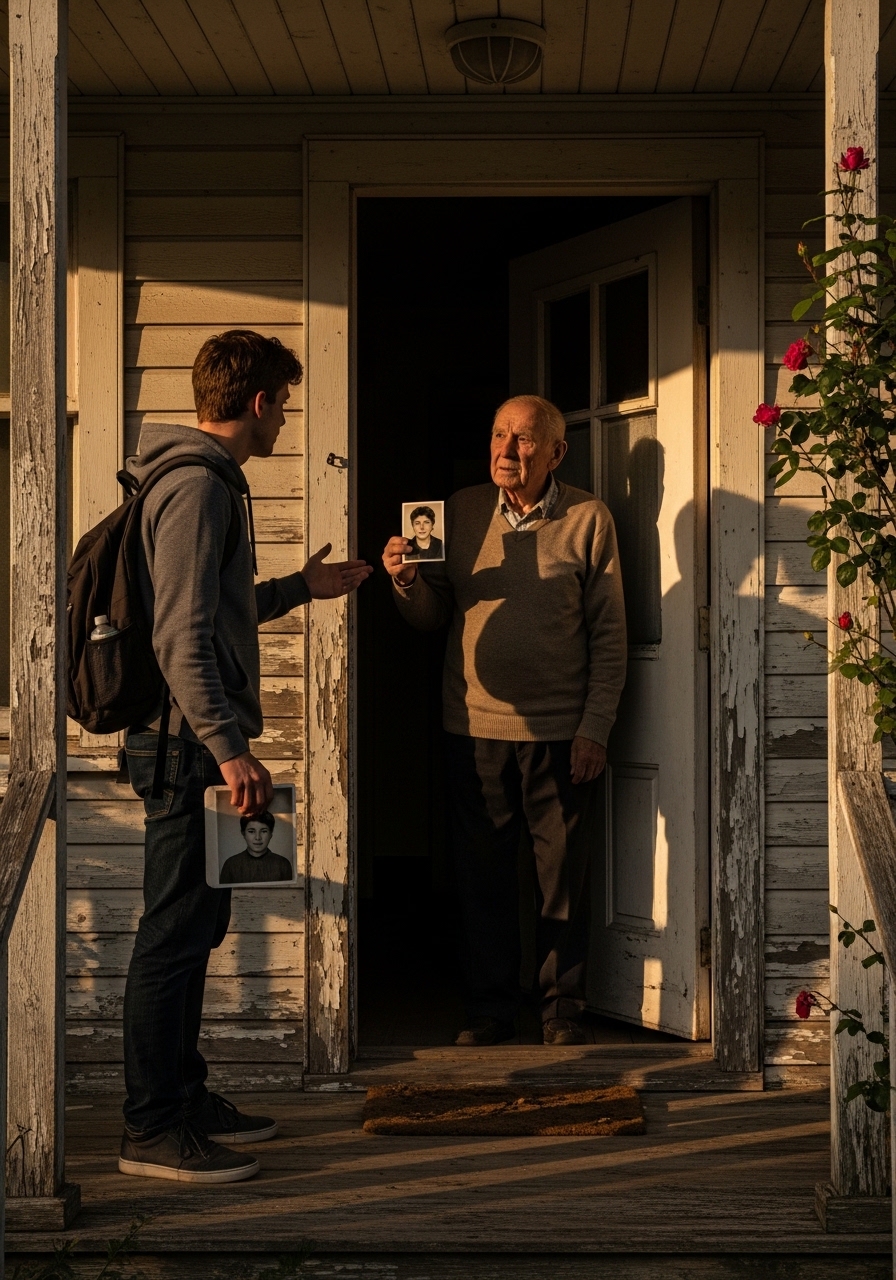
One afternoon, years later, he stood in front of me, jaw set.
“Mom,” he said, “I need to see him.”
I already knew who he meant.
“My grandfather,” he continued. “He deserves to hear what he did to you. To us.”
My chest tightened. Pride and fear tangled inside me. Part of me wanted that confrontation. Part of me was terrified of reopening wounds I’d spent a lifetime surviving.
“It’s been so long,” I said carefully. “He won’t care.”
But my son shook his head. “You never got closure. I can give you that.”
I saw myself in him — that same stubborn need to right an old wrong.
So I gave him the address.
“Tell him everything,” I whispered. “Tell him what he lost.”
He left the next morning.
I spent the day pacing, imagining the scene — my son standing on that porch, delivering the reckoning my father deserved. I didn’t know whether I wanted an apology or proof that my anger had been justified.
That evening, the door opened.
My son stood there — pale, shaken, nothing like I expected.
“Well?” I asked urgently. “Did he listen?”
My son didn’t answer right away. His eyes looked hollow.
“Mom… he didn’t recognize me at first.”
I frowned. “It’s been years, but—”
“No,” he interrupted, voice trembling. “He didn’t recognize himself.”
He told me everything.
My father was frail now. Thin. Living alone in a spotless, silent house. Polite. Distant. My son had unleashed every word of anger he’d carried — the abandonment, the missing years, the damage.
My father listened without interrupting.
Then, quietly, he said, “I remember… a daughter. But it’s all hazy.”
My son pressed harder. “You kicked her out at seventeen. How could you forget that?”
That’s when my father pointed to a framed photo on the mantel — a picture of me, young and smiling.
“She was so beautiful,” he whispered. “I couldn’t let her watch it happen.”
Then he touched his head.
“Early onset Alzheimer’s,” he said softly. “It had already started. I knew where it was going. I couldn’t bear the thought of her giving up her life to take care of me… watching me disappear.”
So he made a choice.
He pushed me away.
He made me hate him.
Because hatred would free me.
“He wanted you to remember him strong,” my son said through tears. “He chose to be the villain so you could have a life.”
The room spun.
My father wasn’t a monster.
He was a terrified man making the most painful sacrifice imaginable.
Every year of rage. Every ounce of resentment. Built on a truth I was never meant to know.
My son had gone there to give him condemnation.
Instead, he uncovered love.
And now I’m left with something far worse than anger.
Regret.
For a lifetime spent hating a man who loved me enough to let me go — and a father I never truly knew.