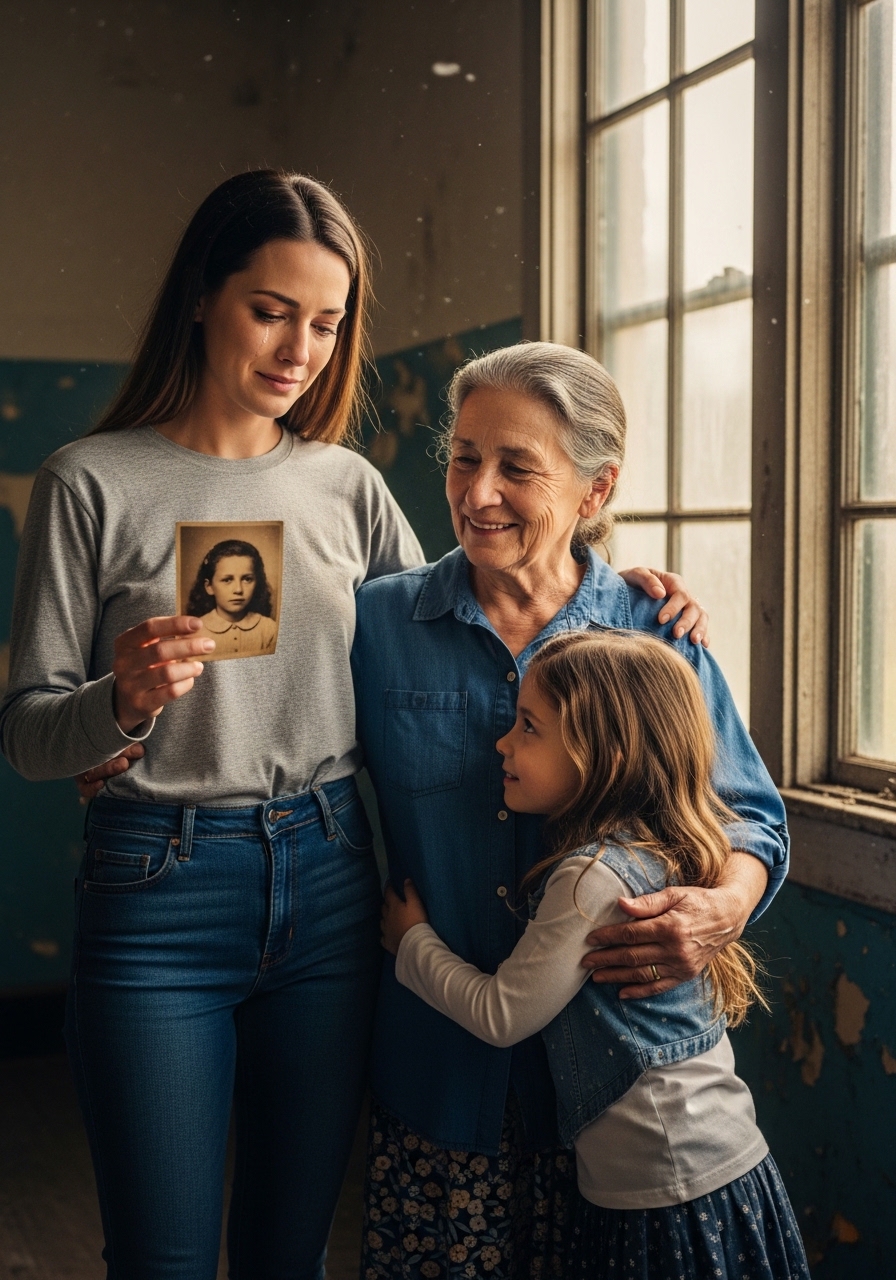
I was five years old when my mother left me at an orphanage.
Some memories fade with time. That day didn’t.
I remember the sharp smell of disinfectant mixed with boiled cabbage. The linoleum floor, icy through the thin soles of my shoes. And the plastic grocery bag she carried—translucent, crinkled—stuffed with everything I owned. Dirty socks turned inside out. A sweater missing a button. My life, tied shut like trash.
I remember calling after her.
“Mama?”
She didn’t turn around.
A woman with gentle eyes eventually crouched beside me and said it was time to come inside. I kept staring at the door long after it closed, certain my mother would come running back, breathless and sorry.
She never did.
I was adopted once. The couple smiled too much at first, then sighed too often later. I cried at night. Asked too many questions. Wet the bed. After a year, they returned me.
On the paperwork, someone wrote a single word:
Inconvenient.
That word followed me into adulthood.
But I survived. I learned how to stay quiet, how not to need too much. I studied, worked, paid my bills. I built a life that looked ordinary—small apartment, steady routines, nothing that invited disappointment. I told myself I didn’t carry anger. At least not the visible kind.
Then I became a mother.
When I held my daughter for the first time, I made a promise so fierce it felt sacred: You will never wonder if you are wanted.
Years passed. Life was busy, sometimes exhausting, sometimes kind. Then one night, everything broke open.
I came home late from work, unlocked the door, turned on the light—and froze.
My daughter stood in the living room, arms wrapped tightly around a young woman I had never seen before. They were laughing softly, the kind of laughter that comes from familiarity, not politeness.
Every instinct in me went cold.
“Who is this?” I asked, my voice sharper than I meant.
The woman turned slowly.
I knew her instantly.
Jerry.
My sister.
While our mother abandoned me, she kept Jerry.
Jerry was everything I wasn’t allowed to be—beautiful, delicate, full of promise. Our mother had plans for her. Modeling. Money. A future where Jerry would eventually repay her devotion. I’d always assumed Jerry lived that life. The chosen one.
I was wrong.
Jerry ran away at sixteen.
She survived on couches and odd jobs. Grit and silence. She saw our mother only twice after that—once in a hospital room, where the woman who had controlled her was suddenly small and fragile, and once at her funeral, where grief felt tangled and unfinished.
She never contacted me.
Not because she didn’t care.
But because she did.
She told me later that guilt followed her everywhere. Guilt that I was abandoned while she was kept. Guilt that she’d been loved in a way I never was. She didn’t know how to face me without reopening a wound she didn’t believe she had the right to touch.
Years earlier, I’d received a large anonymous donation—enough to help me buy my first home. I cried, convinced it was a mistake.
It wasn’t.
It was Jerry.
She’d been watching from a distance, helping quietly, asking for nothing. Making sure I was okay without ever stepping into my life.
She found me now through coincidence and courage. She works as a coach at a modeling school. My daughter attends as a hobby, just for fun.
Jerry recognized her immediately.
“She looks just like you,” she said, her voice breaking.
I hugged my sister for the first time in decades and cried the way children do—deep, shaking sobs that pull loose everything you thought you’d already healed.
Later, we stood together at our mother’s grave.
I waited for anger. For grief. For the familiar ache.
It didn’t come.
For the first time, I felt no loss.
Because I had a sister.
And her quiet, patient love—unannounced and unwavering—gave me everything my mother never could.