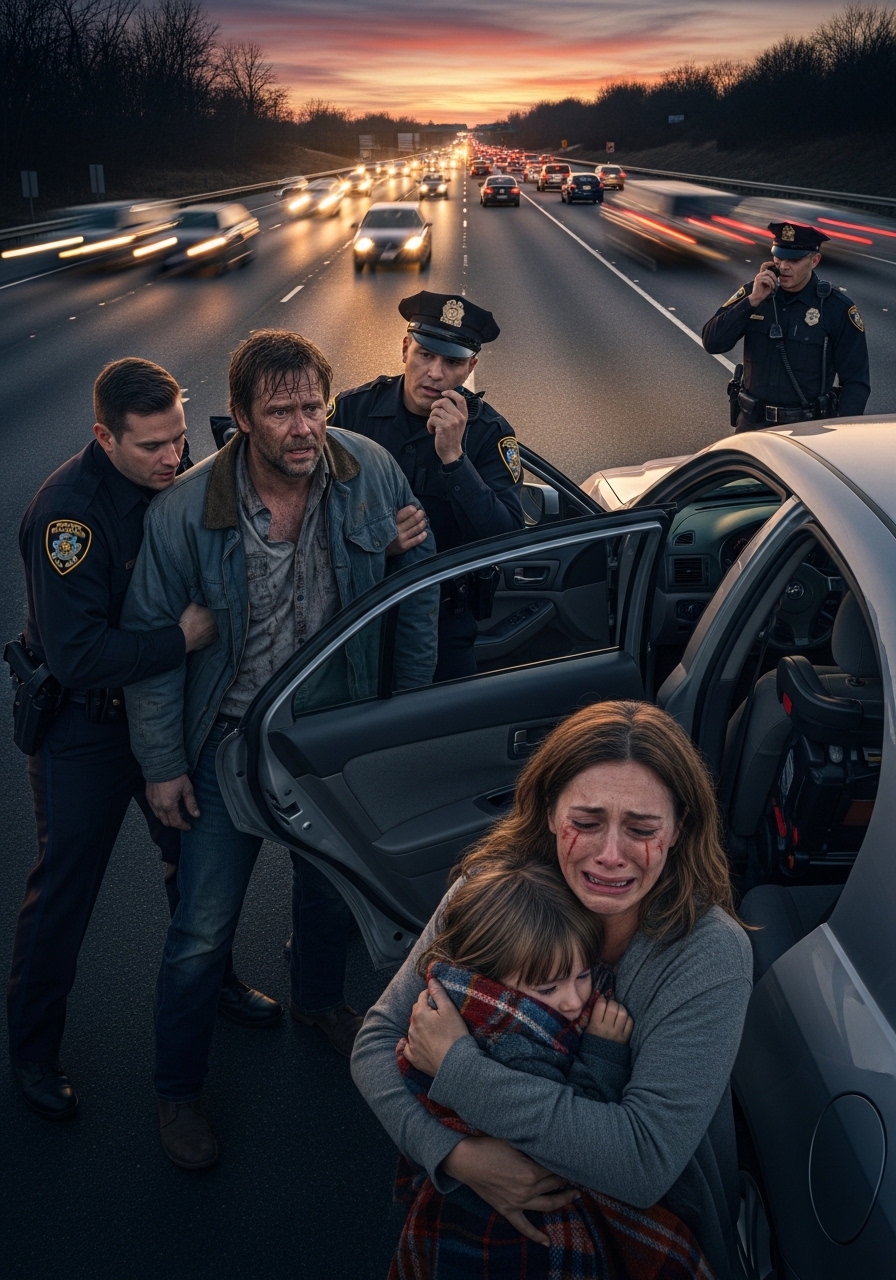
The patrol officer didn’t hesitate when he saw us on the shoulder.
He pulled over immediately, asked if we were hurt, handed Caleb a bottle of water from his cruiser, and called for backup. My hands were shaking so badly I could barely spell Brian’s last name when I gave it to them, along with the license plate number.
Within minutes, another unit arrived and drove us to the nearest station.
Under harsh fluorescent lights, Detective Angela Moore met us. She had the posture of someone who wasted neither words nor time.
“He made you get out of the car?” she asked, pen poised.
“Yes,” I said, forcing my voice to stay steady. “We were supposed to be driving to Sedona for the weekend. He pulled over, told us to get out… and drove away.”
“Has he ever done anything like this before?”
“No. He’s quiet. Reserved. He’s never been violent. Never even raised his voice.”
“You mentioned the luggage.”
I swallowed. “None of my bags were in the SUV. Only his. And Caleb’s. It didn’t feel impulsive. It felt planned.”
Detective Moore leaned back slightly. “Then he didn’t just abandon you.”
I shook my head. “I don’t think he meant to leave Caleb behind. I refused to get out alone. Caleb was strapped in the back. I think Brian panicked. Or maybe…” My throat tightened. “Maybe he planned to take him somewhere without me.”
“Where?” she asked.
“To disappear,” I said. “To start over like I never existed.”
They found the SUV within hours—parked at a small regional airport forty minutes away. Security footage showed Brian entering the terminal alone, carrying two duffel bags.
One was his.
One was Caleb’s.
He’d bought a one-way ticket to Anchorage.
There was a second ticket under Caleb’s name.
There was none under mine.
Then came the part that made my stomach drop.
Three days before our so-called trip, Brian had filed for sole custody of Caleb. The paperwork accused me of “instability” and “erratic behavior.” It had been sent to a P.O. box I’d never seen.
He hadn’t just left us on the highway.
He had been rewriting reality—one where I was already gone.
Detective Moore called it a preemptive custodial removal. Quiet. Methodical. Life-altering.
The plan was clear: file for custody, leave the state before I could respond, establish residence elsewhere, and frame me as the unstable mother chasing him across jurisdictions. If I’d agreed to let him “pack the car early,” like he suggested the night before, he would have driven away with our son while I stood in the driveway thinking we were leaving together.
A BOLO went out immediately.
Brian was detained at the boarding gate less than a day later.
He didn’t resist. Didn’t argue. Just complied.
At the station, he asked for a lawyer. No explanation. No emotion.
But the evidence spoke for him: the missing bags, the custody filing, the airport footage.
And Caleb.
Once the shock wore off, once he felt safe, my son began speaking in quiet fragments.
“Daddy said we were going to live where it snows,” he told the detective. “And Mommy wouldn’t come because she gets sad.”
My chest collapsed hearing that.
How long had Brian been preparing him? What stories had he planted to turn abandonment into adventure?
In court, Brian’s attorney called it a misunderstanding. Claimed I had “chosen not to continue the trip.” Said Brian was exercising parental rights.
The judge wasn’t convinced.
My emergency petition for temporary custody was granted. A restraining order followed. Charges were filed—interference with custody, reckless endangerment, attempted unlawful relocation.
His parental rights weren’t terminated. But they were suspended.
I moved in with my sister in Tucson while the case crawled forward. Caleb started therapy.
So did I.
Sometimes he still asks, “Is Daddy coming to get us?”
I kneel, meet his eyes, and tell him the only truth I know.
“You’re safe. And I’m staying.”
Three months later, an envelope arrived with Brian’s handwriting.
No apology.
No defense.
Just one sentence:
“I did what I had to do.”
I folded the paper and put it in a drawer.
I didn’t reply.
Instead, I enrolled in classes I’d delayed for years. Took part-time work. Built routines that didn’t revolve around interpreting his silence.
The hardest realization wasn’t the highway.
It wasn’t the airport footage.
It wasn’t even the custody filing.
It was understanding this wasn’t sudden.
It was a slow erasure.
And I had been standing inside it the entire time.