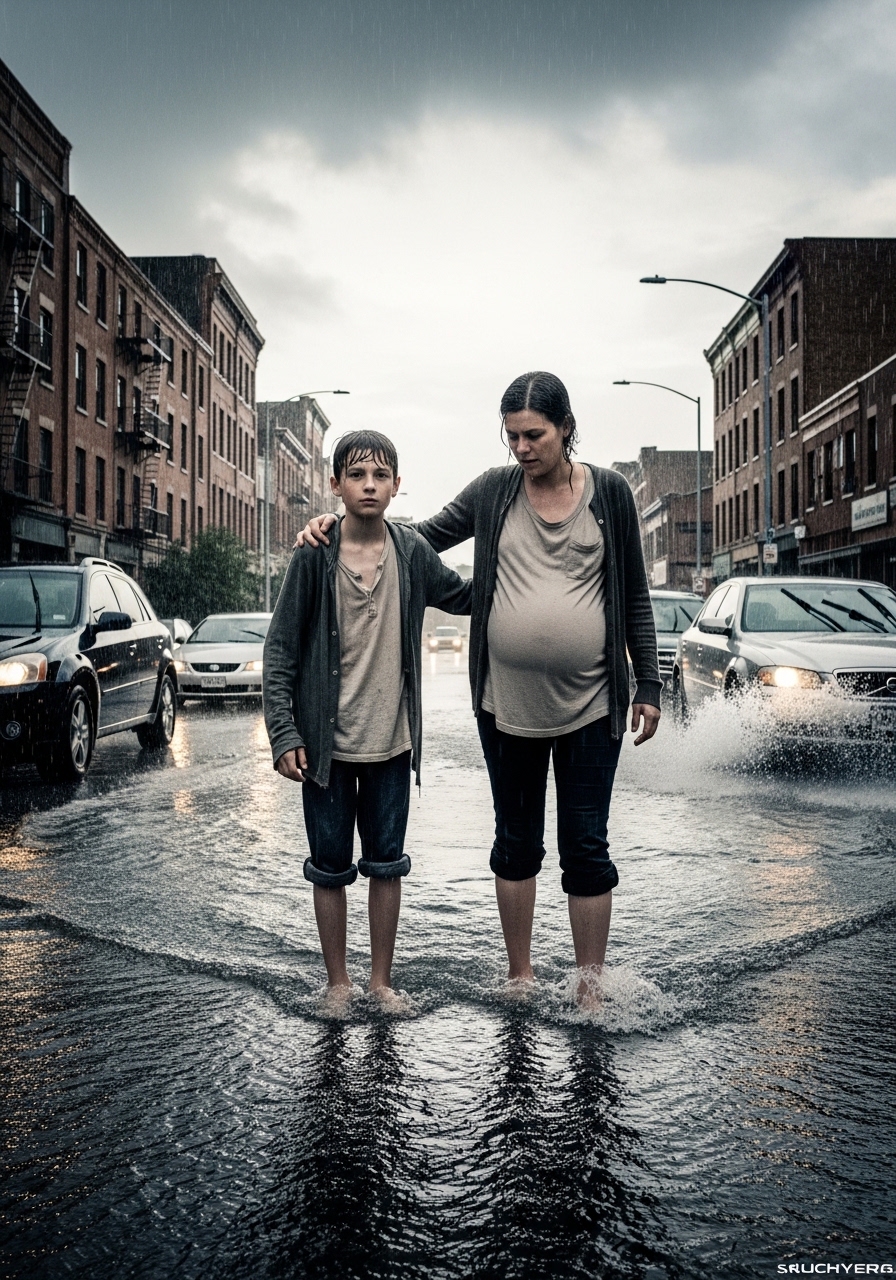
This was never how the story was supposed to begin—but it began with the truth. The kind a city prefers not to see.
The storm had swallowed Cleveland’s streets, turning them into rushing rivers beneath a dark overpass. Rain hammered the pavement, headlights cutting through sheets of water as cars sped by, spraying the sidewalks without slowing.
In the middle of the flooded road was a woman.
She was heavily pregnant, soaked to the bone, trembling as she struggled to stay upright. Her phone lay underwater beside her. One shoe was gone. Every attempt to stand ended the same way—pain twisting her face before she collapsed again, gasping for breath.
Cars slowed.
Drivers stared.
Then they drove on.
From beneath the overpass, Ethan Miller saw everything.
He was twelve years old—thin, quiet, nearly invisible. His jacket was too big, torn at the sleeve. He slept on cardboard, ate when he could, and had learned early that being unnoticed was often the safest choice. Rain seeped through his clothes, hunger gnawing constantly.
He should have stayed where he was.
Kids like him didn’t get involved.
Kids like him weren’t supposed to matter.
Then the woman lifted her head.
Their eyes met.
Fear recognizes fear.
“Help…” she whispered, the rain almost swallowing the word.
Something shifted inside Ethan.
He stepped into the storm.
“Ma’am?” he called, steady despite the rain. “Can you hear me?”
She looked at him, disbelief breaking through her fear.
“I can’t stand,” she said, tears mixing with rain. “I tried.”
Another wave of pain folded her in half.
“There’s a wheelbarrow under the bridge,” Ethan said quickly. “I can push you.”
She stared at him.
“You’re just a child.”
“I’ll be okay,” he said. “You won’t.”
The metal handles were slick and freezing. The weight was more than he expected. Water filled his shoes. A horn blared. Someone shouted something cruel.
Ethan kept moving.
“I’ve got you,” he whispered again and again. “I won’t let you fall.”
When red lights finally pierced the storm, his arms were shaking uncontrollably. Paramedics rushed forward, lifting the woman onto a stretcher.
One of them turned to him.
“Did you bring her here?”
Ethan nodded.
“You did the right thing,” the man said. “You may have saved two lives tonight.”
Ethan didn’t stay to hear more.
He disappeared back into the rain.
Three days later, the storm felt unreal—like it had happened to someone else.
Ethan sat outside a soup kitchen, picking at stale bread. His body still ached. The woman’s face stayed with him, especially the way hope had returned to her eyes.
He hadn’t told anyone.
Why would he?
Good deeds rarely changed anything for kids like him.
Then he heard it—a low engine rumble.
A black SUV rolled to a stop in front of the soup kitchen. Polished. Expensive. The kind of car that meant trouble.
Ethan gathered his things.
“Time to move,” he muttered.
But the door opened.
A well-dressed man stepped out, scanning the sidewalk until his eyes landed on Ethan.
Then another door opened.
A woman emerged carefully, one hand resting on her belly.
Ethan froze.
He recognized her instantly.
“I—I didn’t steal anything,” he blurted. “I was just sitting here.”
“No one’s accusing you,” the man said gently. “My name is Michael Harris.”
The woman stepped closer, tears already forming.
“I’ve been trying to find you,” she said. “For days.”
“I didn’t do it for money,” Ethan said quickly. “I swear.”
“I know,” she said softly. “That’s why we’re here.”
She told him everything—the emergency surgery, the baby delivered just in time, the doctors who kept talking about the boy in the rain.
“I wouldn’t be here without you,” she said. “Neither would my son.”
Ethan stared at the ground.
“I just didn’t want you to be alone,” he whispered.
Michael cleared his throat.
“We want to help you,” he said. “If you’ll let us.”
Ethan hesitated.
Help usually came with conditions.
“What kind of help?” he asked.
The weeks that followed changed his life.
Ethan was placed in a safe foster home. He had clean clothes, warm meals, and a bed that stayed. The Harrises didn’t adopt him—but they didn’t vanish either.
They showed up.
They checked in.
They listened.
School was difficult at first. Ethan wasn’t used to being noticed for anything good. But slowly, he began to believe the world might not be finished with him yet.
Months later, he returned to the soup kitchen—not to eat, but to serve.
When a volunteer asked why he kept coming back, Ethan smiled.
“Because someone once stopped for me.”
And in that moment, the city finally saw what had been there all along.
Not a homeless boy.
Not a problem.
But a hero—one who stepped into the rain when everyone else drove past.