After my father’s funeral, the house felt wrong—too quiet, too empty, like it was still waiting for him to come home. People were still dropping off casseroles and condolences when my older brother handed me something he’d found in Dad’s old toolbox.
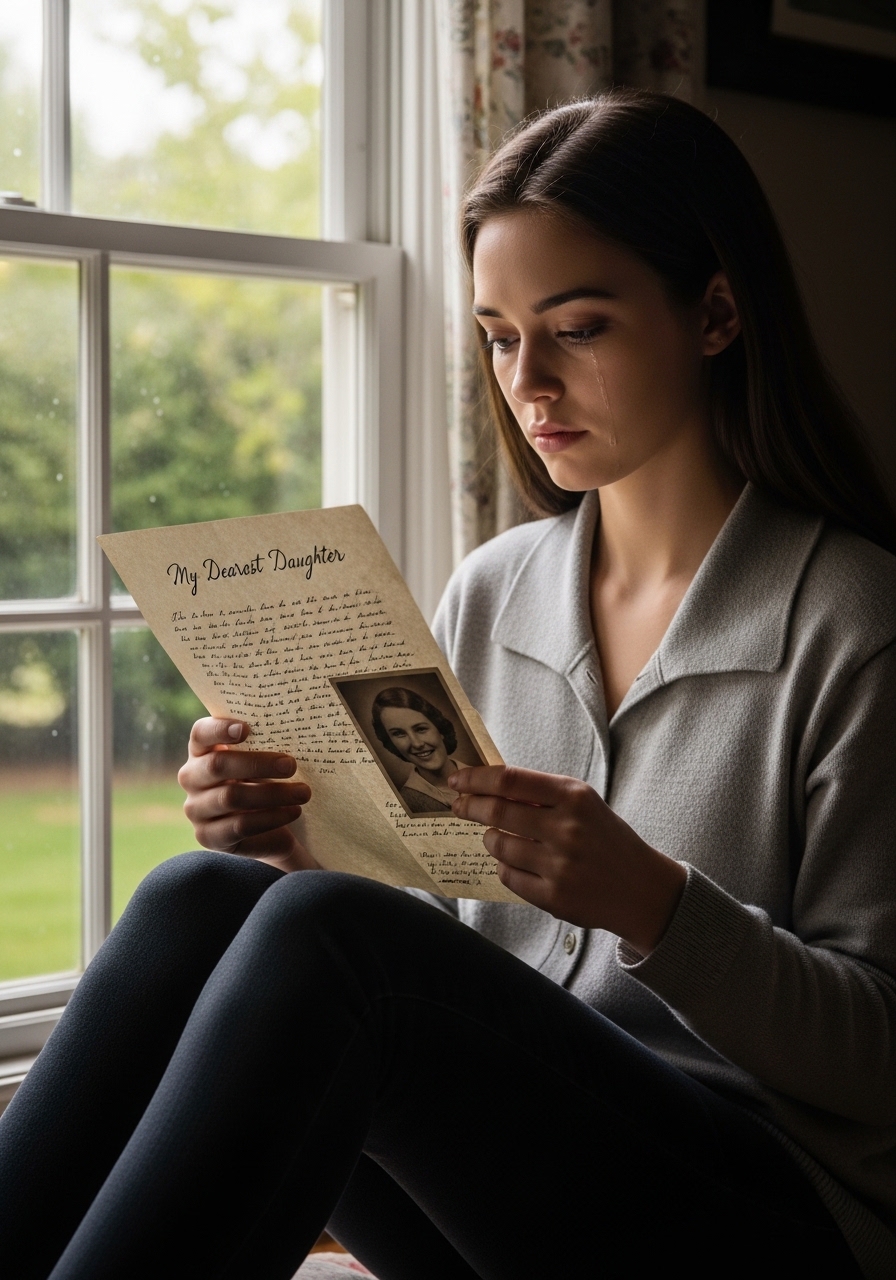
It was an envelope. Yellowed, worn thin at the edges. On the front, in my father’s shaky handwriting, were four words that made my chest tighten:
“For my daughter ONLY.”
My hands trembled as I opened it. I expected something gentle—a final message, maybe a memory, something loving he hadn’t had the strength to say out loud.
Instead, I found a single sheet of paper. Creased. Smudged. Devastating.
“Don’t ever trust your mother. She’s been secretly seeing another man and stealing money from me.”
The room seemed to tilt. I read it again. And again. The handwriting was unmistakably his. My breath caught, refusing to move forward.
From the kitchen, I could hear my mother humming softly as she loaded the dishwasher—calm, steady, completely normal. As if the words in my hands hadn’t just rewritten my entire childhood.
I wanted to tear the letter apart. To pretend it never existed. To believe the woman who raised me couldn’t possibly be capable of this.
But something inside me whispered that I needed to know the truth.
That night, after the house fell silent, I went through my father’s old papers. Insurance documents. Medical bills. Receipts. Then, tucked between two manuals, I found a small notebook.
Inside were handwritten entries—dates, withdrawal amounts, and short notes written with pain barely disguised:
“M. again?”
“Why cash?”
“Another lie.”
Each page felt like another crack in the foundation of everything I thought I knew. By the final entry, my hands were shaking.
Still, I needed undeniable proof.
I checked my mother’s phone. Her browsing history. Old messages she clearly assumed no one would ever read.
And the truth landed with cold, brutal clarity.
My father hadn’t been paranoid.
He hadn’t been confused.
He had been trying to protect me.
The next morning, my mother smiled at me and asked if I wanted breakfast. I looked at her—really looked at her—and felt nothing but distance. A hollow, aching space where trust used to live.
I didn’t confront her.
I didn’t ask why.
I didn’t give her a chance to explain.
Some apologies come too late. Others don’t matter at all.
I packed my things, walked out of the house, and cut off contact completely.
Her remorse—real or not—would never bring my father back. And trusting her again would only betray him twice.