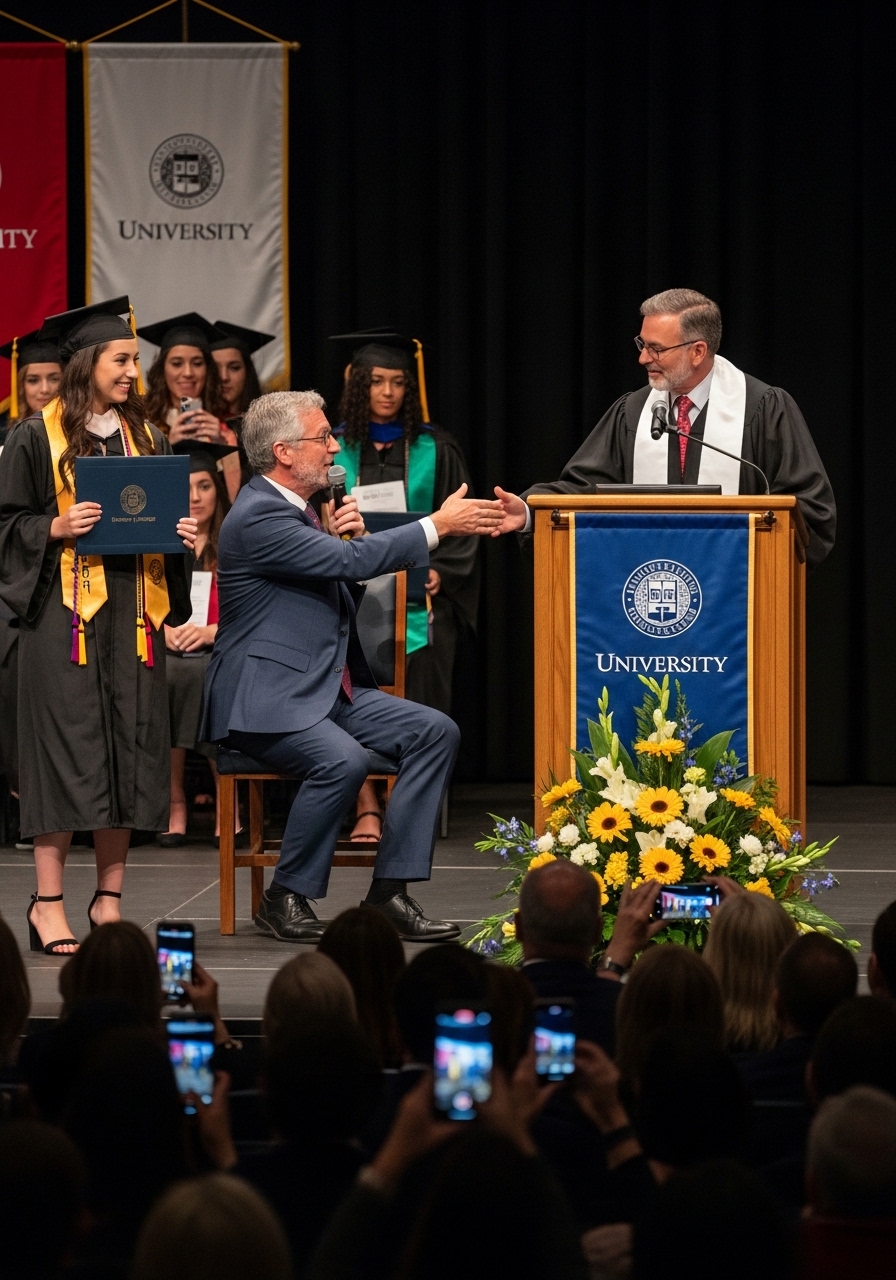
The auditorium at the University of Nueva Vista felt like a cathedral built for ambition. Polished mahogany gleamed under the lights, the air heavy with the scent of beeswax, fresh ink, and ceremony. It was a smell I had chased for nearly a decade—a promise of validation, of escape from the dust and struggle that defined the first eighteen years of my life.
I stood at the podium in my velvet academic gown, its weight pressing down on my shoulders like a borrowed crown. I should have felt victorious. Instead, I felt like an impostor beneath the blinding stage lights. Before me stretched a sea of faces: professors with silver hair and gold-rimmed glasses, proud families dressed in silk and linen, and graduates who looked as if hunger had never brushed their lives.
I had imagined this moment countless times—late nights in the library, fueled by cheap coffee and fear. I had rehearsed the smile, the handshake, the quiet confidence of success. Yet when the applause faded into silence, it wasn’t my doctorate or the tassel against my cheek that captured the room’s attention.
It was the quiet man sitting in the very last row, hidden beneath the mezzanine’s shadow.
He leaned forward, elbows on his knees, eyes locked on me with an intensity that erased the distance between us. That man was Hector Alvarez—my stepfather.
He didn’t belong in a hall like this. His thrift-store suit didn’t quite fit, the sleeves slightly short, exposing wrists thick with scars. His shoes were cheap and glossy, his flat cap brand new, likely bought to hide thinning gray hair. To everyone else, he was an oddity—out of place among wealth and prestige.
To me, he was everything.
As our eyes met, the chandeliers and cold air vanished. I smelled wet cement and sweat. I heard cicadas and felt the heat of Santiago Vale. In that moment, I wasn’t a PhD graduate. I was just a boy looking at the man who had built me from nothing.
My childhood wasn’t gentle. My mother, Elena, loved fiercely but lived fragilely. She left my biological father when I was barely walking, leaving behind silence, unpaid bills, and uncertainty. Santiago Vale was a town of dust and rice fields, where love wasn’t spoken—it was survived.
I was four when Hector entered our lives. He didn’t arrive with status or money. He came carrying a battered red toolbox, hands hardened by labor, spine already bent by years of work. I resented him. I wanted a hero; I got a laborer. His boots tracked dust across the floor, and his dinner conversations revolved around cement ratios and rebar prices.
“He’s not my dad,” I used to whisper.
“He’s a good man,” my mother would reply. “He’s trying.”
Hector didn’t try the way I understood. He didn’t play catch or read bedtime stories. He worked. He left before sunrise and returned long after dark, exhaustion clinging to him like a shadow.
Over time, I learned his language.
He fixed my bicycle chain without a word. Patched my sandals so I wouldn’t walk barefoot to school. Climbed onto a leaking roof during a typhoon while I watched in fear from inside.
But everything changed when I was eight.
Three older boys cornered me behind the old schoolhouse, demanding my lunch money—the coins Hector had earned with extra hours of labor. One raised a fist.
Then I heard it.
The rattle of a rusty chain. The cough of an old engine.
Hector skidded to a stop, dust swirling around him. He didn’t shout. He simply stepped between us, crossed his massive arms, and stared. The boys fled without a word.
He crouched beside me, wiped dirt from my face with a paint-stained handkerchief, and asked softly, “Are you hurt?”
Then he said something I would never forget.
“You don’t have to call me father. But I will always stand in front of you.”
From that day on, “Dad” came naturally.
As I grew older, my academic success clashed with our financial reality. Hector couldn’t help with calculus or literature, but every night he asked, “How was school?” He sat on the porch smoking cheap cigarettes, repeating the same words:
“Knowledge is the only thing no one can steal from you.”
When I was accepted to Metro City University, joy quickly turned to despair. The scholarship covered tuition—not life. My mother cried. Hector said nothing.
The next morning, his motorbike was gone.
He had sold it—his freedom, his livelihood—to send me to school. He walked miles to work and packed my supplies himself: rice, dried fish, peanuts, an old alarm clock. On the bus, I found a folded note:
I may not know your books, but I know you.
University life was brutal. I worked multiple jobs while others vacationed. Through it all, Hector kept working—lifting bricks, climbing scaffolds, slowly breaking his body to build my future.
When I nearly quit during my PhD, he stopped me with words that still echo:
“If you quit now, my back broke for nothing.”
And so, we returned to the auditorium.
After my defense, the room fell silent. Then Professor Alaric Mendes—the most feared academic in the department—stood and walked past everyone… straight toward Hector.
The hall froze.
“You’re Hector Alvarez,” he said, voice shaking.
Mendes told the story of the 1995 earthquake, of a man who ran into a collapsing structure and saved lives—then vanished.
“That was you,” he said.
Hector looked down. “I did what had to be done.”
The applause that followed wasn’t for me. It was for the man in the cheap suit.
Today, I teach. I have a family. Hector is retired, tending his garden, riding the electric bike I forced him to accept.
Recently, I asked him if he regretted it—all the sacrifice.
“No regrets,” he said. “Buildings fall. But you? You’ll stand.”
I may hold the title of Doctor.
But Hector Alvarez is the true architect—the builder of my life, my future, and my soul.