I used to think grief arrived with sirens and shouting.
Mine arrived with highway miles, burnt coffee, and the low hum of an engine at night.
Emily turned Snow into a ritual.
Ten years ago, I was broke, new to trucking, and desperate to be a good dad. Emily was about to turn four and wanted a teddy bear “as big as me.” On a dusty flea market outside Dayton, I found a giant white bear with one eye slightly higher than the other.
The seller glanced at my thin wallet and smiled.
“Ten bucks,” she said. “Dad price.”
Emily hugged it instantly and named him Snow.
From then on, Snow went everywhere with us. Every time I left for a long haul, Emily carried him to the truck, arms shaking, and ordered, “Buckle him in.” I always did—seatbelt tight across his soft belly.
At night, the cab hummed, and Snow’s crooked face kept the loneliness from fully settling. When I came home, Emily ran down the driveway and grabbed him back.
“See?” she’d say. “He protected you.”
I’d tap the bear’s head. “Good job, partner.”
Even when she got older and pretended it was dumb, she still packed Snow for me. Her mom, Sarah, hated the bear in the cab. She said it made me childish. Like I needed a mascot to be a parent.
The truth was simpler. I needed anything that felt like home.
Sarah and I didn’t explode—we eroded. I was gone. She was tired. Conversations became schedules and invoices. The divorce finalized when Emily was twelve.
Emily tried to smile for both houses, but her eyes always found mine first. She still handed me Snow before every trip, quietly, like a truce. Sometimes Sarah watched from the porch and said nothing.
Cancer arrived the year Emily turned thirteen. First as bruises and exhaustion, then as hospital ceilings and whispered conversations.
Emily hated pity. She joked with nurses, named her IV pole “R2-Drip2,” and demanded Snow be present at every appointment.
One late night, under buzzing hallway lights, she squeezed my hand.
“Promise you’ll keep driving,” she said.
I argued. She stared me down.
“Promise, Dad.”
I promised. Because that’s what fathers do when their kid asks like that.
Two weeks later, she was gone. And the promise felt like a chain around my ribs.
After the funeral, I did something ugly.
I started bagging up Emily’s things—clothes, drawings, glitter pens—like they were contaminated. I told myself I was cleaning, that I needed air.
Sarah walked in and saw the bags by the door.
“What are you doing?” she asked.
“Surviving,” I snapped.
“You’re throwing her away,” she said, pale.
We yelled. She left without crying, which hurt worse.
We didn’t speak after that. Except through paperwork.
The only thing I couldn’t throw out was Snow. He didn’t smell like my daughter. He lived on a shelf, then back in my truck, buckled in like always.
Driving gave my hands something to do and my mind somewhere to run.
Years blurred together.
Last week, packing for a Colorado run, I panicked when the passenger seat was empty—like I’d lost a person.
I found Snow shoved into the closet behind blankets. I carried him out, whispering, “Sorry, buddy.”
That’s when I heard it.
A small, brittle crack.
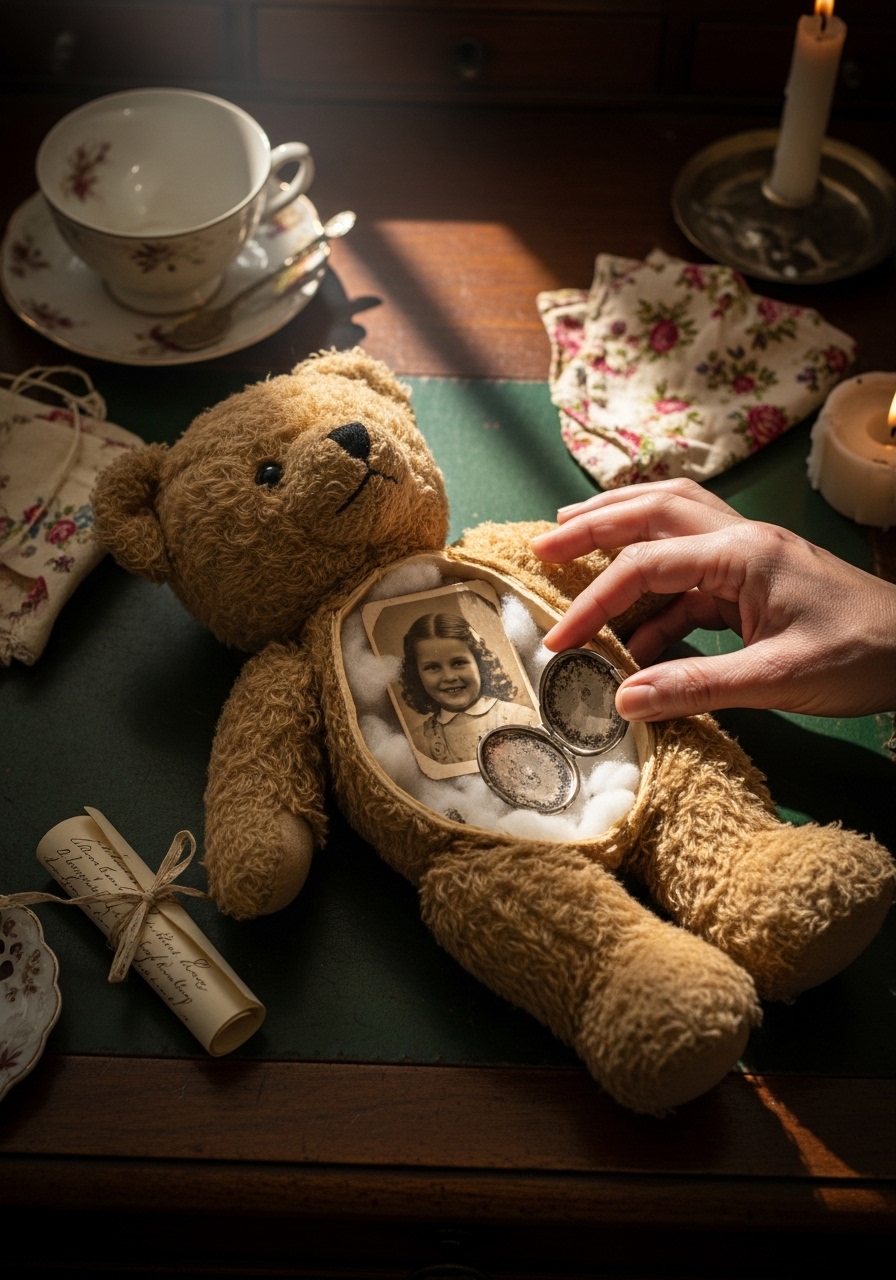
I lifted the bear and felt something hard beneath the stuffing. Along his back, the seam had split slightly.
In my kitchen, hands shaking, I cut the stitches slowly and pulled out handfuls of fluff until my fingers touched paper.
An envelope—yellowed, sealed, addressed to me in Sarah’s handwriting.
And beneath it, a tiny voice recorder taped shut.
In Emily’s messy letters, it read: FOR DAD.
I sat down hard.
When I pressed play, static hissed—then Emily’s voice burst through.
“Hi, Daddy.”
The sound knocked the air out of me.
“If you’re listening, you found it. Good job,” she said, giggling.
Sarah’s voice floated in softly. “Keep going, Em.”
Emily explained they hid it together. That Mom promised not to tell. Because “Dad is bad at surprises.”
Then her voice changed—serious, steady.
“I need you to be okay even if I’m not.”
She said there was a box buried in my yard. By the old maple tree. Where we played baseball.
“I love you,” she said. “Keep driving. Don’t get stuck. When you find it, you’ll know.”
Click. Silence.
I opened Sarah’s letter with shaking hands.
She wrote that Emily hid everything months before she died and made her swear secrecy. Sarah planned to mail it—but after seeing the trash bags, she got scared.
“I thought grief would make you destroy it,” she wrote.
She ended with directions. And one line:
If you want the rest, call me.
I didn’t call yet.
I grabbed a shovel and went into the yard without a coat. The maple tree stood bare against the sky. I found the dip in the ground where Emily used to yell, “Again!”
I dug until my back screamed.
The shovel hit plastic.
I pulled up a small storage box wrapped in a trash bag and sat in the dirt, afraid opening it would finish me.
Inside were Polaroids held together with a rubber band. And a note in Emily’s handwriting.
The photos wrecked me.
Me asleep on the couch. “Dad snores like a bear.”
Us at a diner, raising milkshakes.
My truck. Snow buckled in. Me flashing a peace sign.
Near the bottom was Emily in a hospital bed, bald and grinning, holding Snow.
On the border she wrote: Still magic.
Her letter started:
“Dad, if you found this, you’re still here. Good.”
She said the pictures were for lonely nights. Proof she was real. Proof I was a good father even when I doubted it.
Then one line stopped me cold:
“Tell Mom you’re not mad. She cries in the car.”
Anger drained out of me, leaving shame behind.
I went inside, cleaned the photos, and set them on the table. Snow sat beside them, seam open like a wound.
I finally understood why Sarah never sent the recorder.
I would have thrown it away just to survive.
Emily knew that—and planned around it anyway.
I found Sarah’s number still saved. My thumb hovered. Then I called.
“I found it,” I said. “Snow’s secret. The box.”
She cried softly.
“She told me to tell you I’m not mad,” I added.
Sarah broke.
She explained the missing part: Emily started taking photos after overhearing me cry alone in a parking lot.
“She wanted proof you were loved in real moments,” Sarah said. “Not just hospital ones.”
I drove to her place with Snow buckled in and the photos in a shoebox.
When Sarah opened the door, we just stood there—raw, quiet.
“I’m sorry for the bags,” I said.
“I’m sorry for the silence,” she answered.
Then we cried together.
Emily didn’t leave me answers.
She left me directions.
And for the first time since she died, I stopped running long enough to follow them.